A startup ecosystem can sound suspiciously like a place where other people know each other. KenKo Ventures has made a business out of giving that abstraction an address, a timetable and someone responsible for opening the room. One of its clearest examples is in Tanta, in Egypt’s Nile Delta, where it operates entrepreneurship and innovation activities at the government-backed Creativa Innovation Hub.
Here, startup support means business-model workshops, technical training, mentoring, incubation and introductions. A young person might arrive to learn a skill; a founder might come to work through an idea. KenKo’s assignment is to organize the activity that connects those ambitions with people who can help. The location matters. Its stated focus includes communities beyond capital cities, with the Delta central to its public story.
Founded by Karim Ali in 2023, the company now combines that local work with founder education, management advice for growing businesses and an Egypt–Saudi expansion service. The common thread is the work around a company: the teaching, staffing, planning and administration that makes building one less of a solitary exercise.
A room in Tanta, with people to run it
Creativa Tanta belongs to Egypt’s Digital Egypt Creativity Initiative, led by the Ministry of Communications and Information Technology alongside ITIDA and TIEC. KenKo’s role is operational. It runs entrepreneurship and innovation programming, coordinates partners and manages activities intended to help people develop skills and ventures. The government provides the institutional setting; KenKo supplies the programming and day-to-day execution described in its case study.
Its remit stretches from training in fields such as AI, the Internet of Things and cybersecurity to freelancing and career development. Incubation takes aspiring businesses through idea development, validation and the creation of an initial product. Events bring mentors, founders and other organizations into the same setting. That range helps explain why describing KenKo simply as a venture-capital company leaves much of its visible work out of the picture.
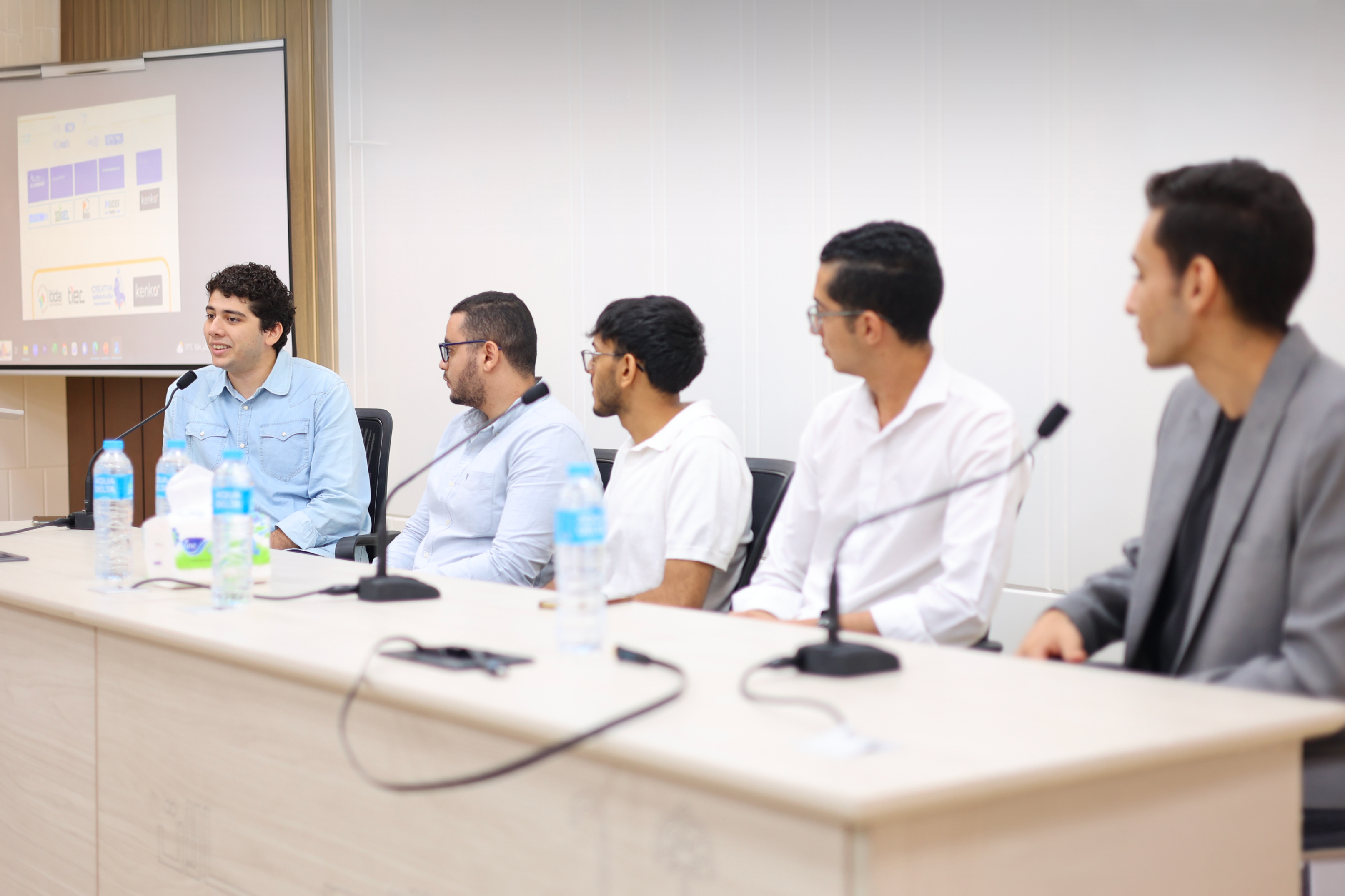
A former member of the team, Amr Khaled, supplies an unusually specific glimpse of how the project started. In a public account, he recalls a July 29, 2024 call from Ali saying the tender had been won and the team was being assembled. Khaled describes progressing from project coordination to responsibility for budgets, performance indicators and reporting. It is one employee’s account, but it makes the job tangible: a hub needs organizers as well as speakers.
KenKo’s Tanta case-study card reports more than 3,000 learners, 500 program days and 130 founders. Those are company-reported measures of activity and reach. They describe a busy program; they should be read as participation figures, with their own labels, rather than as a tally of investment successes.
The founder’s homework gets a reviewer
The most revealing detail in KenKo’s product lineup is a revision process. Startup Essentials, its 12-week entrepreneurship program, includes a digital simulator where participants build four outputs: a Business Model Canvas, an eight-section business plan, financial projections and a pitch deck. An assigned mentor reviews the work section by section. Founders revise it until it is approved.
The specifications are pleasingly concrete. The financial model covers five years. The deck has 11 slides. Mentor scoring addresses clarity, completeness, feasibility and authenticity. The company says approved sections are then locked. For an aspiring founder staring at a blank document, this turns “get ready for investors” into a sequence of tasks with an identifiable reviewer.
- 01DefineCustomer, problem and business model
- 02BuildEight-section business plan
- 03ModelFive-year financial projections
- 04Present11-slide pitch deck
Submit → Review → Revise → Approval
The workshop record gives the method some texture. A Creativa Tanta announcement invited founders who had already worked on a Business Model Canvas to a refinement session. A subsequent post described participants reviewing real business challenges and receiving feedback on their propositions. TIEC separately documented Ali teaching experience management, including how startups work with customers, teams and stakeholders.
There is a useful distinction for participants to keep in view. Mentor approval establishes that someone has examined a plan. Customer validation requires evidence from customers. The program’s review mechanism is worth copying as a discipline: make the work specific, assign an experienced reviewer and require a revision. Its usefulness depends on how honestly the founder tests the assumptions beneath the document.
Free admission still takes ten days
A July 2026 Creativa Tanta announcement offers a concrete answer to the price question for one course: admission was free. The advertised entrepreneurship training began July 25, ran for ten days and scheduled sessions from 10 a.m. to 5 p.m. Topics included design thinking, the business model canvas, prototype testing, market entry, branding and pitching. Attendance required an email confirmation.
For a participant, the commitment was therefore substantial even with no tuition charge. Ten days must fit around work, study, travel and whatever else pays the bills. The schedule makes access a practical question. A program can remove its admission fee while still requiring the kind of sustained attendance that some would-be founders find difficult to arrange.
The hub also scheduled its 2026 hackathon for July 28–30. KenKo later announced three winning teams and shared accounts of the preparation and final pitches. A short event and a longer course serve different purposes: one concentrates effort around a deadline, while the other allocates more time to learning. Both need a next step if the work is to continue after the room empties.
Ali has also described the provider’s side of that equation. In a July 2025 interview republished by KenKo, he identified difficulty recruiting Cairo-based experts willing to teach in the Delta and Upper Egypt, along with the higher cost of delivering programs outside the capital. He also raised the financial sustainability of private incubators offering much of their support free. Those constraints make local delivery capacity central to the model. A timetable is only useful if qualified people can keep turning up.
When a growing business needs an operating system
KenKo’s KEPA program addresses a different customer. Short for KenKo Enterprise Performance Architecture, it is a 12-month advisory engagement aimed at growth-stage SMEs. Its stated audience includes businesses with 10–200 employees and annual revenue of $500,000–$10 million. These are target-client characteristics, not figures describing KenKo itself.
The problem is familiar enough to picture: sales increase, decisions pile up on the founder’s desk, and informal management becomes difficult to sustain. KEPA’s published sequence moves through diagnosis, design, deployment and continuity. It covers financial organization, strategy, performance management, organizational structure and operations, with the intention of leaving the client able to run the systems internally.
This extends KenKo’s teaching-and-execution approach beyond the first pitch. An early founder needs to explain how a business might work. An established SME needs people to know who decides, what gets measured and how work moves through the organization. KEPA’s emphasis on handing responsibility back to the business is consequential: the proposed result is an internal management capability that continues after the advisory engagement.
Egypt and Saudi Arabia, in both directions
Business Hubs is the company’s most explicit cross-border offering. For Saudi SMEs, technology scaleups and enterprises entering Egypt, KenKo advertises help with company setup, recruitment, payroll, offices and local finance. The intended use includes engineering teams, customer operations and delivery centers in Cairo.
In the other direction, it offers Egyptian and regional businesses support establishing a Saudi presence. Its service description covers licensing and registration assistance, banking setup and workspace in Riyadh. The promise is coordination: one partner organizing activities that otherwise sit with several professional-service providers. KenKo describes the commercial offer as “One contact • One invoice • Full market execution.”
Build engineering, customer-support and delivery operations.
Establish a local business presence and operating support.
Ali said in the same July 2025 account that regional market research had drawn the company toward Saudi Arabia’s investor activity and support for entrepreneurship. He also outlined an intended $10 million impact fund, targeting sectors including agriculture technology, recycling, education and health, with proposed investments of $100,000–$500,000. These figures describe the ambition announced at the time. The hub operations, advisory services and training programs show the broader business he was building around it.
The business model visible across these offerings is service delivery to institutions and companies. A government or university can commission a program; an SME can engage an adviser; an expanding business can seek setup and ongoing operating help. The people attending a hub workshop and the organization commissioning that workshop occupy different sides of the relationship. Understanding that distinction explains the breadth of KenKo’s audience.
Its alternatives vary by assignment: another hub operator, an incubator, a management consultant or a market-entry agency. KenKo’s distinguishing proposition is the combination of those capabilities with regional experience. That combination is most relevant to a client who needs several kinds of support connected. A business seeking one narrowly defined service has a simpler purchasing decision.
The man behind the programs goes downstairs

Ali’s background helps explain the emphasis on learning. His company biography describes him as a founding-team member and shareholder at Arabic education platform almentor, where he worked on partnerships and customer experience. EgyptInnovate’s expert directory also identifies him as KenKo’s founder and CEO, working across innovation platforms, startup support and workforce readiness.
He now hosts ElBadrom, KenKo’s Arabic entrepreneurship podcast. Its basement metaphor points toward the work beneath the public celebration. The opening episode features Elbaraa Bahgat, CEO of Smart Technology Solutions, with a published outline covering market volatility, engineering teams, organizational constraints and difficult periods in company building. It gives the business a public conversation space alongside its physical and educational ones.
KenKo’s reflection after a Tanta roundtable asked how the needs of founders outside Cairo differ from those in the capital. The participants included institutional representatives, mentors and founders. The question asks for local knowledge before a standard solution is imposed. A reader borrowing KenKo’s approach can start there: convene the people involved, identify a concrete task and give someone responsibility for helping it happen.
“What do founders outside Cairo actually need, and how is it different?”
KenKo Ventures · Tanta roundtable reflection
Step into the room
Explore KenKo Ventures, the Tanta hub, Startup Essentials, KEPA and Business Hubs.
Follow the company on LinkedIn, X, Instagram, Facebook or TikTok. Read its blog, or watch ElBadrom’s first episode and visit the YouTube channel.