Carsten Kølbek’s early education in entrepreneurship included a particularly uncooperative audience: people who did not want what his team had made. The founders could spend months feeling delighted with an idea. The market, when eventually consulted, sometimes declined to join the celebration. It is an awkward experience to put in a company’s origin story. It is also a useful one.
Kølbek helped found Rainmaking in Copenhagen in 2007. He would become its global CEO and a co-founder of Startupbootcamp, taking the work from creating businesses to helping other founders create theirs. The interesting thread through that career is the movement of experience: first acquired at some expense, then passed around a much larger table.
A useful way to be wrong
His recollection of the beginning is disarmingly plain: there was no elaborate starting plan. Early exits gave the founders money and a reason to consider helping other startups. Their own errors supplied teaching material. Enthusiasm had sometimes run ahead of customer demand; impatience had sometimes suggested abandoning businesses before they had a fair chance.
The tension remains useful. A founder must give an idea enough time to develop while being willing to change it. A calendar cannot make that judgement. Neither can the affection of the people who thought of it. Kølbek’s account gives the grand subject of entrepreneurship a recognisable human difficulty: discovering when your confidence has become expensive.
“We began with a blank sheet of paper.”
Carsten Kølbek, recalling Rainmaking’s beginnings
The engineer takes the long route
Before the blank sheet came an engineering education at the Technical University of Denmark, followed by business studies at Nottingham. His background crosses the technical and commercial sides of a company before the company-building chapter even begins. Chemical and systems engineering appear in his education record; business and strategy followed.
At Nottingham, he reports graduating with distinction and receiving the award for the highest marks in a class of more than 75. His chosen subjects included advanced strategy, management consulting and the learning organisation. He then worked as a strategy consultant at Accenture between 2001 and 2003. There was evidently room in the schedule for both understanding organisations and getting marked on it.
Later learning continued alongside the business. His public profile lists executive courses in leadership, management and digital business strategy in 2019. There is also a 2020 HarvardX course covering the Mongol and Ming periods. The curriculum, at least, leaves room for subjects beyond the next pitch deck.
Ten teams, then a network
Startupbootcamp began its first programme in Copenhagen in 2010, bringing together ten startups. That small number is worth pausing over. An accelerator becomes tangible when it means particular teams, limited time and people willing to look closely at what those teams are doing. The international network came after the first working version.
By 2012, its offer included seed money, mentoring and a final presentation to investors. Programmes were operating across European cities. For founders, the exchange involved equity as well as attention. Support had a structure and a price; the programme had to give a team something useful in return.
Kølbek’s involvement also reached the less theatrical machinery of startup life. In a 2013 interview about investment, he discussed Europe’s growing familiarity with employee share options and convertible loans. He observed that founders increasingly recognised the need to share ownership with co-founders and early recruits. The people doing the building needed a stake in what they built.
That concern helps explain the appeal of a network. Capital matters, but so do introductions, experienced colleagues and a practical understanding of how a young business works. An accelerator gathers those ingredients in one place. Its value depends on whether the founders can put them to use after the programme ends and the audience goes home.
Kindness has a job to do
There is a quieter portrait of Kølbek in the comments of people who have worked with him. Martin Rønne Bjergegaard describes a colleague who remains friendly, calm and open when problems grow. Eoghan Jennings emphasises dependability and follow-through. Those are workaday virtues. In a young company, workaday virtues can save an extraordinary amount of time.
Rainmaking’s culture book gives kindness an explicit place alongside entrepreneurship and impact. It discourages political manoeuvring, performative late nights and senior people making themselves too important to help. The stated preference is for capable people who contribute and have lives outside the office. The office chair is apparently allowed to cool down.
A company handbook is an intention rather than proof of every working day. Even so, these choices tell us something about the environment the founders wanted to create. The book favours people who can take responsibility without constant supervision. Freedom needs colleagues who answer questions, listen and make decisions.
One colleague’s account supplies a concrete example. Todd O’Brien described Kølbek helping secure funding for the Dubai accelerator as the local operation took shape in 2017. When O’Brien explained ambitions beyond a single programme, Kølbek welcomed them. The story concerns encouragement accompanied by practical assistance: money to close, doors to open, work to finish.
A company can have muscles and still need nerve
Rainmaking’s corporate venture work brought another set of partners to the table. A large business can contribute resources, customer access and industry knowledge. An entrepreneurial team can build a new business around them. Making those contributions useful requires decisions about ownership, authority and who carries the risk.
The firm’s model includes putting capital and resources into new companies and sharing ownership with corporate partners. That arrangement gives the company builder a continuing interest in the venture’s result. It also makes the relationship more consequential than delivering a set of recommendations and sending the last invoice.
In 2023, Rainmaking announced the expected sale of its Asia Pacific operation to Bain & Company. Kølbek, speaking as Rainmaking Global CEO, welcomed the proposed transaction and the opportunities it would give the regional team. The announcement concerned APAC; the businesses elsewhere would continue under Rainmaking Global.
The regional operation had been established in 2017. By the sale announcement, its roughly 50 employees were working across Singapore, Japan and South Korea. A venture-building operation had itself become something a buyer wanted to own. For Kølbek’s career, the episode marks a change of scale: the founders’ accumulated methods had become an organisation with value beyond their original market.
There is an ownership question running through these different settings. An early employee joins a young company; an accelerator backs a founding team; a corporate partner brings resources to a venture. Each relationship needs an agreement about contribution and reward. Reading Kølbek’s career through those arrangements brings the work into focus. The recurring task is to give people reasons to build together, then leave them enough room to do it.
The table in Tbilisi
In June 2025, another part of the story took place at Caucasus University. Kølbek visited with Sarah Grippay to meet the university’s Innovation and Entrepreneurship Center. The discussion covered local startup development and possible joint programmes for Georgian founders. The photograph from the visit shows a meeting table, shelves of books and people talking. Company building has less photogenic hours than launch day.
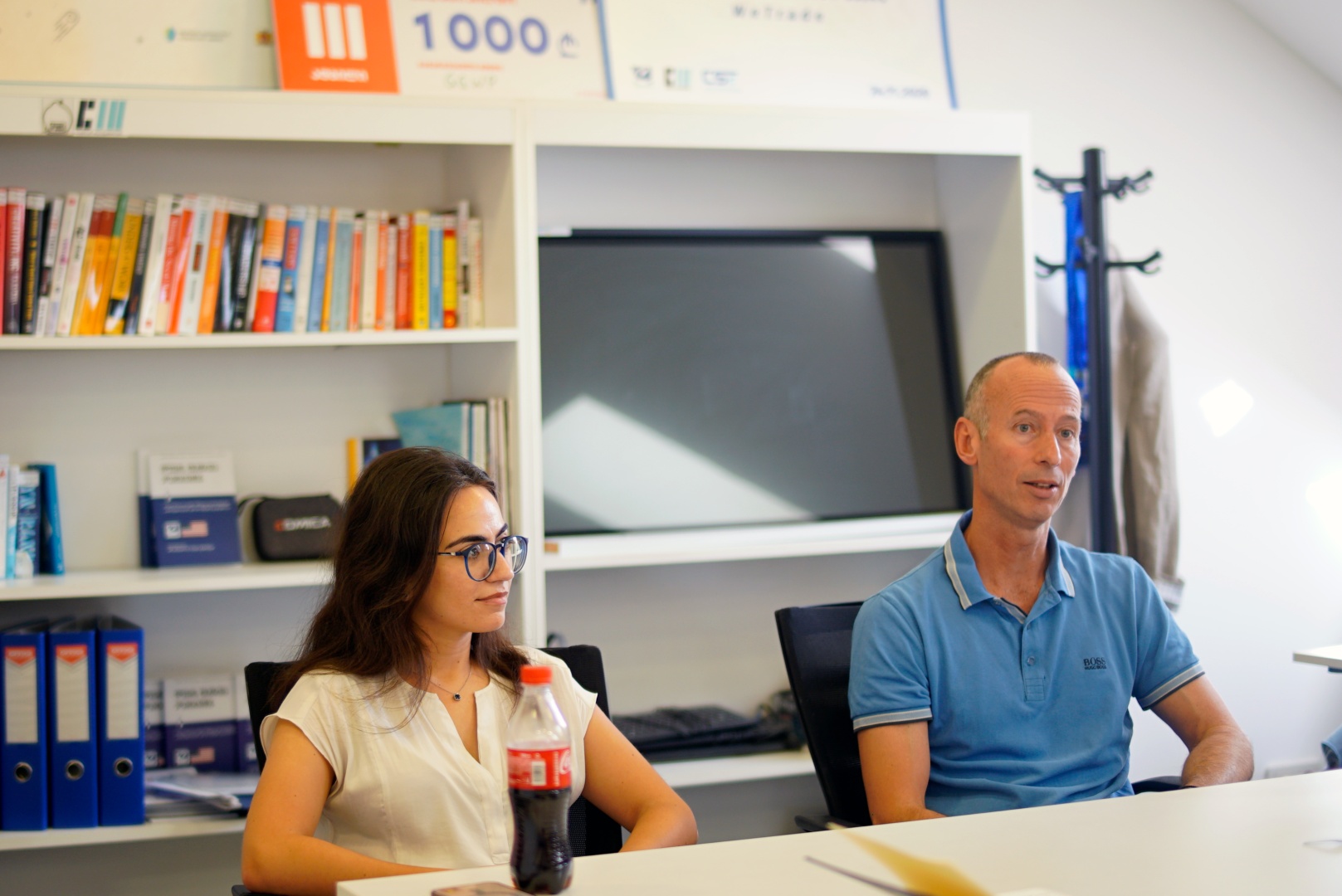
The university meeting expressed interest in future collaboration. It was a conversation about what might be built together, rather than an announcement that every possibility had become a programme. That distinction preserves the ordinary, necessary work of forming a partnership: finding out what each side knows and where their interests meet.
Startupbootcamp’s subsequent public account of its Georgia MVP stage credits Kølbek with a masterclass on the pivot mindset. The cohort comprised 20 startups, including teams progressing from an earlier stage and new entrants. Each received a 50,000 GEL grant from Georgia’s Innovation and Technology Agency. The old question about changing direction had found another classroom.
In Bahrain, an accelerator announced with Tamkeen in November 2025 set out a different three-year plan: train 160 entrepreneurs, develop 80 market-ready products and dedicate $4 million in direct investment to promising projects. Kølbek was quoted as Startupbootcamp co-founder and chairman. These were programme commitments, with the results still to be earned.
Programme targets announced in November 2025. These figures describe planned activity.
The next decision
Kølbek’s recent public activity also includes support for Founder Factor, an investment platform focused on Y Combinator companies. In a 2026 post, he reported 17 investments during the preceding autumn and plans for 25 in the next batch. The platform combines a prediction model with diligence by people who have built companies themselves.
The arrangement extends a familiar interest: using the experience of founders to help assess and support other founders. It also introduces a useful question for an investor. A model can organise signals. People still have to decide what they mean, what deserves investigation and where to commit capital.
For November 2026, he is listed for a Tbilisi leadership discussion alongside investor Jed Ng and AXEL managing director Iro Tsagareishvili, moderated by Grippay. The announced subject is the decisions that shape companies: what to build, what to back and what creates lasting value. As of October, that conversation lies ahead.
It is a fitting subject for a career that keeps returning to other people’s decisions. The engineer, consultant, company builder and accelerator co-founder has worked through several ways of bringing an idea into contact with the world. Somewhere in that process, a founder has to listen to an answer they were not hoping to hear. Then there is another decision to make.
Follow the work
Explore the organisations, conversations and public profiles connected with Kølbek’s career.
- Rainmaking · Startupbootcamp
- Carsten Kølbek on LinkedIn · X
- The 2020 conversation about building innovative companies
- Listen: The Change Officer, episode 89, on venture studios
- The Caucasus University visit · Startupbootcamp Georgia
- Founder Factor · Dare to Lead: November 2026 programme
- Rainmaking’s culture book · The 2013 investment report