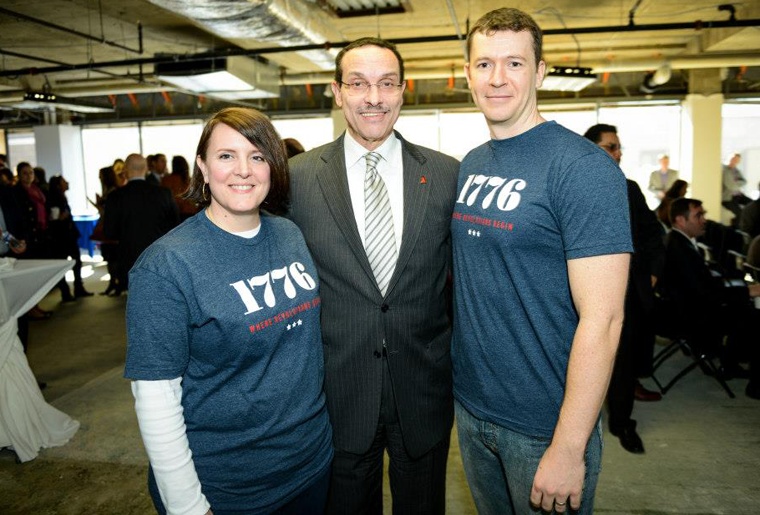
In February 2013, Donna Harris stood beside Evan Burfield and D.C. Mayor Vincent Gray at the opening celebration for 1776. The founders wore T-shirts bearing the venture’s name. The mayor wore a suit. In one photograph, Washington’s two familiar uniforms had finally agreed to share a frame.
The proposition was straightforward enough: give entrepreneurs somewhere to work, meet people and find help in a city better known for governing things than starting them. Harris and Burfield had chosen the capital deliberately. Its institutions, expertise and connections could be useful to young companies trying to change industries with complicated rules. Washington had assets. They wanted entrepreneurs to have access to them.
More than a decade later, Harris is still working on access, though the room has changed. She leads Builders + Backers, a venture studio combining founder guidance, artificial intelligence and funding for early experiments. The people she wants to reach include those who have yet to adopt the word entrepreneur. An idea can sit for years inside an ordinary working life, waiting for an invitation that never arrives.
Harris’s career poses a practical question: how much of entrepreneurship is talent, and how much is having a place to begin? Her answer has become less dependent on an address. A person with experience of a stubborn problem ought to be able to test a solution. The invitation should arrive before the polished slides.
Before the T-shirt
Harris came to startup support with experience of building and operating businesses herself. Her earlier career included roles at Oracle and EDS, and she founded Kinderstreet, which provided software for municipal, education, sports and recreation customers. Those are markets where a product has to survive contact with organizations, budgets and everyday administrative habits. A clever idea still has to work on Tuesday.
She studied at Central Michigan University and earned an MBA at the University of Michigan’s Ross School of Business. Her career also took her into government markets and public affairs through Interpoint Group. Software and institutions both appear in the background of her later work: she had spent time on either side of the gap between what technology could do and what organizations could actually use.
At the Startup America Partnership, where she served as managing director, Harris designed and led the Startup Regions Initiative. The work connected entrepreneurial communities across the United States. It required thinking beyond individual companies to the local conditions that helped them form: experienced founders, introductions, support and places where someone could ask an unglamorous question.
That experience gave the 1776 idea a context. Harris had been working with communities nationally; here was a chance to build something in Washington. In 2011, she contacted Burfield about a leadership meeting. He brought experience as a technologist and founder. Their eventual collaboration made the city’s proximity to institutions part of the pitch.
A room in Washington
1776 launched in 2013. By March, its founders were reporting more than 160 applications and 75 acceptances. They had expected filling the space to take nine months. The early response suggested that entrepreneurs had been waiting for the kind of gathering place they were proposing. Applications came from the Washington region and farther afield, including Chicago, New York and Silicon Valley.
The ambition also traveled. The Challenge Cup brought entrepreneurs from different countries together, and 1776 became a stop for visiting leaders. On July 3, 2014, President Barack Obama visited the startup hub. It was a conspicuous encounter between an institution of government and a place built around people trying to make something new.
The later history was less tidy. 1776 expanded into additional locations, and its incubator business eventually encountered difficulties. Harris stepped down as co-CEO in 2016; the incubator merged with another operator in 2017. That history belongs alongside the launch photographs. Startup infrastructure has operating problems of its own, even when its purpose is to help other people solve theirs.
Harris’s work continued through investing, including 1776 Ventures. In 2016, American University awarded her an honorary Doctor of Laws and invited her to address graduates of its Kogod School of Business. By then she had become a familiar figure in the effort to connect entrepreneurship with economic development. The next question was how early that help should begin.
The idea before the company
Builders + Backers brought Harris together with fellow founder Kathleen Hale around people and ideas that conventional startup pathways could overlook. Its Idea Accelerator grew from an initial group of 15 builders. By its third-anniversary celebration in 2024, the organization said the program had helped more than 1,000 builders across more than ten cities and regions.
Its language matters. Calling someone a builder lets an action precede an identity. You can try something before deciding whether you belong to the tribe with the startup T-shirts. The program paired guidance with Pebble Funds, small amounts of capital intended to make testing possible. The money had a job: help someone find out whether an idea could survive outside its owner’s imagination.
In a 2023 announcement, Harris described bringing the program to Detroit with Heartland Forward and Ford Motor Company Fund. She said it had been nearly 15 years since she moved from Detroit to Washington. The first summer Detroit cohort would include 20 builders, each receiving $5,000 for experimentation. The announcement returned a national mission to a place she knew.
The ideas have been agreeably varied. When Harris celebrated the summer 2024 cohort, she listed tools for fundraising and college financing alongside a bait vending machine, a snack cake and a coffee brand. An entrepreneurship program broad enough to accommodate both software and fishing supplies has made a useful editorial decision about what counts.
- NoticeA problem worth investigating
- TestA small experiment with support
- LearnEvidence for the next decision
The trouble with a beautiful pitch
Harris remains an investor. She also questions how thoroughly investor-facing habits have come to shape entrepreneurship. In a 2022 conversation with Hall Martin, she compared an economy obsessed with venture-scale outcomes to a baseball game interested only in home runs. The comparison leaves room for companies with different ambitions, customers and financing needs.
Her emphasis on founders is similarly practical. She looks for people who know their problem deeply and can respond when the market contradicts their original idea. Confidence has a use; so does the capacity to revise. A founder who listens badly can spend a great deal of money defending an assumption.
In May 2026, her Builders Field Guide essay “Breeding Cobras or Building Companies?” challenged the prominence of pitch competitions in local entrepreneurship programs. She used the familiar cobra-bounty story as a warning about incentives: reward a visible activity, and people become very good at producing it. A community can end up with an impressive calendar of competitions while founders still need customers.
Her proposed alternatives involve observing progress over time, supporting relationships and helping founders understand capital. It is an inconvenient argument for anyone who likes a clear winner and a photograph of a large check. Customer conversations seldom look good on a stage. They do, however, give a person something more useful than applause to work with.
“Pitch competitions are the cobras in our communities.”
Donna Harris · Builders Field Guide, May 2026
What the machine makes possible
Builders + Backers now presents itself as an AI-powered venture studio. Its team includes technologists, operators and builders-in-residence. The central proposition combines tools with experience: software can make support available more widely, while people who have built companies contribute judgment about what to do next.
The 2025 national call for ideas offered two routes: a structured virtual cohort with coaching and workshops, and a self-paced AI platform with expert support. Participants in either route could apply for Pebble Funds. Funding was subject to evaluation, rather than an automatic consequence of joining. That detail preserves the distinction between opening a door and promising every visitor the same outcome.
The organization’s scale had become measurable. In August 2025, Builders + Backers announced its first appearance on the Inc. 5000, at No. 528. It reported helping launch more than 600 companies and reaching aspiring entrepreneurs across all 50 states. Those figures describe the organization’s work at that point in time; they do not tell us that every experiment succeeded. An experiment is allowed to produce an answer its inventor dislikes.
Harris’s interest in AI extends to who owns what gets built. In a September 2026 essay, she examined a possible economic hierarchy in which owners hold the productive assets, machines perform valuable work and people service the machines. She argued that cheaper tools for creating businesses could help more people participate in ownership. Entrepreneurship, in this account, is part of the argument over where people will stand in an automated economy.
A cardboard box on the reading list
There is a less technological side to Harris’s thinking. Her work with Praxis and her public conversations about Christian faith place community and collective responsibility inside her account of entrepreneurship. She has spoken about the biblical story of Nehemiah, particularly the many different people involved in building. The attraction is the shared work. One person with funding cannot repair everything alone.
Her board and advisory connections extend that concern beyond individual founders. They include the Global Entrepreneurship Network and the Economic Innovation Group’s Policy Council. Those roles put her in conversations about the conditions surrounding enterprise, from local opportunity to wider economic policy. The founder coaching and the institutional work address different distances from the same starting point.
Her August 2026 reading list offered a revealing detour: children’s books for adults carrying an idea around. She included Peter H. Reynolds’s The Dot and Antoinette Portis’s Not a Box. The appeal was to the willingness to imagine, make a first attempt and learn from it. A cardboard box is a surprisingly inexpensive addition to an executive reading list.
Outside work, her personal biography describes family time, animals, cheering for her son’s football team and community volunteering. These details give her days dimensions beyond the public roles. Someone can spend a career discussing global entrepreneurship and still have a local game to attend.
The continuity across Harris’s work is the person poised just before action. In 2013, that person might have needed a room in Washington and an introduction. Today, they might need guidance on a screen, money for a small test or permission to treat their own experience as useful. Her aspiration is to make those starting conditions available to more people. The first version may be awkward. At least it exists.