George Goda was asked to come up with a business idea. He had studied semiconductors, worked in established companies and dealt with international business. Yet the invitation to invent something from scratch left him stuck. He remembers freezing. It is an appealingly awkward detail in the life of someone who now helps other people create businesses: at the beginning, he too had trouble finding the beginning.
Business school put entrepreneurs within reach. A fellow student was starting an IT company, and Goda joined. Years later, he would help build 01Booster, the Tokyo business creation company he co-founded in 2012. The blank page had acquired colleagues, customers and consequences. His route suggests a useful way to read his career: watch what happens each time he enters a setting where his previous experience is insufficient.
The engineer learns another language
His education began in electrical and electronic engineering at Aoyama Gakuin University, with a bachelor’s degree followed by a master’s. His graduate studies included semiconductor device processes and analysis. In April 1994, he joined Toshiba in research and development, working on high-voltage technology and power transformers. This was a career built around physical things, where an idea eventually had to contend with the behavior of a device.
Over the following decade, his responsibilities widened. He moved into development and product planning, worked on an alliance with a Swedish appliance company, and dealt with manufacturing in China and Thailand. The work connected the technical object with production, partners and markets. A product could leave the design department and immediately become a problem involving several countries.
In October 2004, he moved to Murata Manufacturing. There he handled technical sales involving North American customers, semiconductor vendors and Motorola’s global communications devices. Corporate marketing followed in 2007. Research, design, sales and company strategy each supplied a different view of how an industrial business works. The job titles changed; the distance between the component and the customer kept getting shorter.
Research & development
Technical sales
Marketing & overseas strategy
Co-founder
A smaller company, a faster education
Goda’s move into startup life came through Nobot, a smartphone advertising business. He joined as Marketing Director in January 2011. His responsibilities included marketing, events and overseas expansion. The company was subsequently acquired into the KDDI group, and his work extended to acquisition coordination and international strategy at mediba. For someone interested in how businesses change, this was an unusually concentrated syllabus.
His public career history places him at mediba from September 2011 to March 2012, planning international expansion and helping establish overseas locations. The sequence matters. He had experienced a manufacturing corporation, a young advertising company and work inside a group after an acquisition. Collaboration between companies would later become central to his job. He had already encountered some of its complications from the inside.
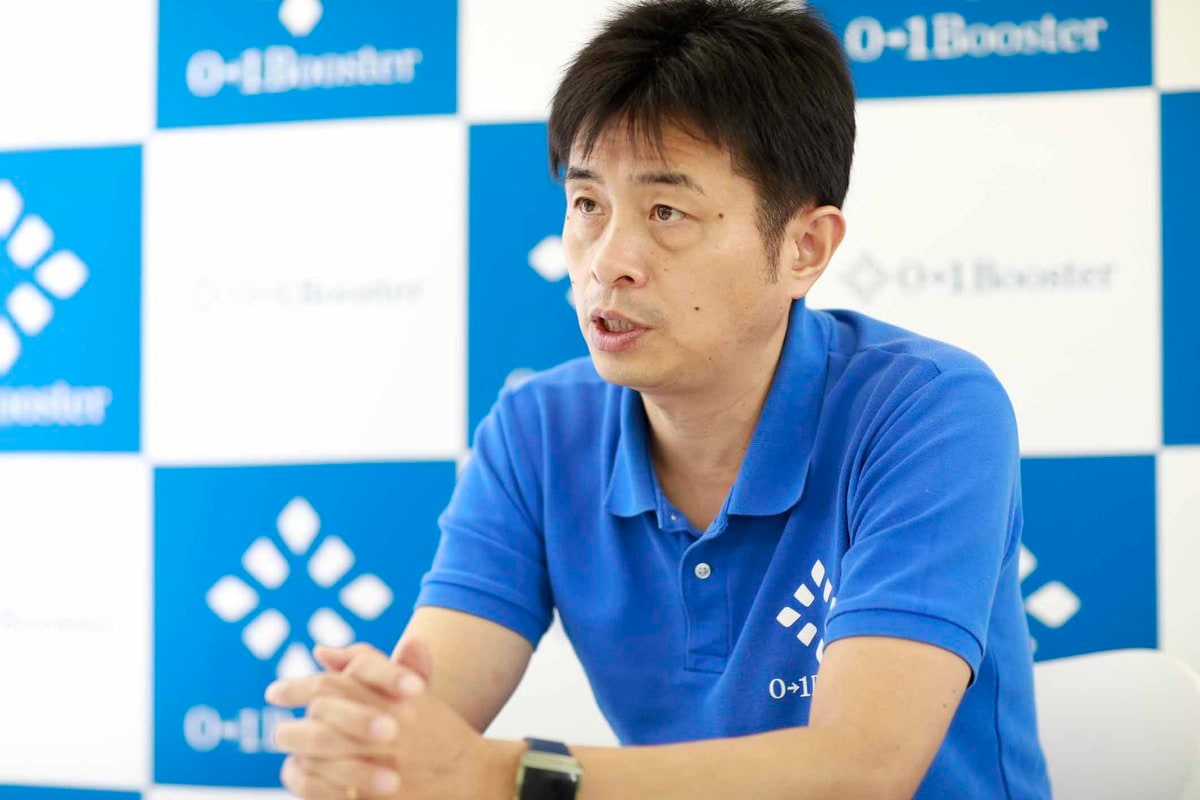
In March 2012, 01Booster began. Fellow co-founder Norifumi Suzuki brought his own experience of corporate work and entrepreneurship. Goda now serves as 01Booster’s Representative Director and CEO, alongside a directorship at 01Booster Holdings. The enterprise they built works with companies, startups, universities and public bodies. Its territory is the often untidy passage from wanting a new business to actually operating one.
An introduction is only the beginning
The word accelerator can make the work sound pleasantly mechanical: put in a company, apply speed, remove a faster company. Goda’s description is more social. Business plans are solicited and selected. Startups are matched with established companies. The participants set objectives, meet repeatedly and work together on creating a business. In one account, he described a program lasting roughly four months, with follow-up meetings along the way.
For an entrepreneur, selection can provide credibility as well as access. Approaching a large company alone is difficult, however capable the founder. A structured program supplies a setting in which that conversation can happen. Goda has described cases where applicants did not yet have a company and formed one after being selected. Sometimes the organization arrives after the opportunity.
There is also a stage before the business plan. Through 01 Dojo, 01Booster has worked with people who want to start something but have yet to settle on what. The questions move from personal motivation toward customers, interviews and a service someone might use. That progression gives his work a particular intimacy. Before a founder needs an introduction to a corporation, they may need a conversation about why they want to begin.
“Change the world through the power of business creation.”
Goda’s public self-description and 01Booster’s mission · translated from Japanese
The map must be bigger than the town
Goda’s concern with access extends beyond the meeting room. In 2019, he argued that Japan’s regional startup support needed wider connections and a broader view of markets. Local authorities may understandably want promising companies to remain nearby. He warned that this instinct can limit the very businesses they hope to help.
He discussed programs in Sendai and Aichi that connected local interests with companies from elsewhere. The logic was that an open program could attract more participants and create more commercial possibilities, with benefits returning to the region. A local economy does not cease to matter when a customer lives somewhere else. For a founder, the municipal boundary is a curious place to end a sales plan.
His preferred image for an entrepreneurial ecosystem was a forest, sustained by contributions to the shared environment. Companies, universities, financial institutions and government all had a place in that picture. The emphasis fell on the quality of the surroundings in which founders work. Mentoring one company has value; improving the circulation of knowledge and introductions can reach the next company too.
Conceptual illustration of Goda’s ecosystem argument.
Invite the people department
By 2024, another part of his argument was especially clear: human resources belongs in the business creation conversation. Addressing an HR conference audience, Goda placed the people function near the center of the work. New ventures involve employee development, organizational culture and the rules under which people can take on unfamiliar responsibilities.
He proposed looking at what employees learn through new business activity and how those skills affect the existing business. This broadens the question a company asks of a venture program. Alongside commercial results sits the question of how the organization itself changes. A project has participants who return to other teams, carrying experience with them.
The connection to his own career is easy to see. He accumulated capabilities by moving across functions and company settings. His HR argument applies a similar attention to learning inside an organization. Someone must make the unfamiliar assignment possible, recognize what was learned and decide where that person can use it next. The people department has rather more to discuss than the seating plan.
Four hundred pages against the shortcut
In August 2026, Goda and Tomoharu Hayama published 新規事業の本質, whose title can be translated as The Essence of New Business. Hayama is an innovation advisor at the Swiss Business Hub. Their book brings research and practical experience into a single account of new business development. Its published length is 400 pages. Brevity, evidently, was not the organizing principle.
The contents show why. Methods sit alongside organizational systems and human resource management. Technology commercialization leads into open innovation, corporate venturing and acquisitions. Later chapters cover venture capital, accelerators, venture clients, venture builders and entrepreneurial ecosystems. A reader looking for a single trick will instead encounter the relationships between several different kinds of work.
Goda wrote at publication that the work involved reviewing more than 1,000 research papers, particularly international research. The book includes questions from practitioners and draws on examples from the field. The combination suits an author who has moved between technical work, commercial work and helping others connect the two. Experience can pose the question; research can make the answer less provincial.
The experiment gets easier. The decision remains.
Later that month, he published reflections on using AI. He saw possibilities for transferring tacit knowledge into business processes and reducing effort in areas with many possible combinations. Creating proofs of concept and minimum viable products was becoming more accessible. Evaluating the results, he argued, could still separate people with different levels of experience.
This was an observation about the work in progress, rather than a prediction with a victory date. If more people can produce an experiment, the next question becomes whether they can interpret it. His emphasis on experienced judgment fits the rest of his career: technical possibility opens a door, and then someone has to decide what to do with the room.
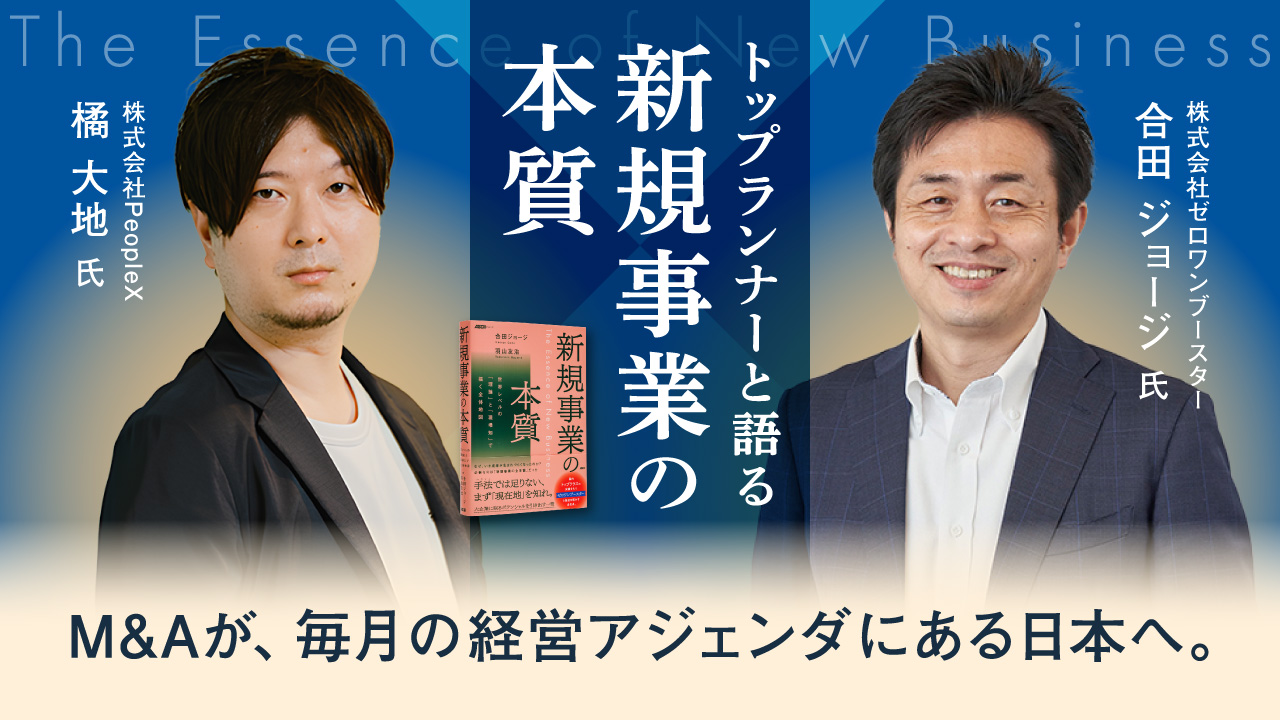
In October, his conversation with PeopleX founder Daichi Tachibana returned to acquisitions and cooperation. They discussed approaches that preserve the strengths of acquired businesses, repeated acquisitions as a growth method, and building trust after a deal. The questions reached beyond the transaction into how people work together afterward. For Goda, whose own career passed through a startup acquisition, the subject has a professional history.
Across these chapters, the scale of his attention has widened: from devices to products, from products to companies, from companies to the relationships around them. He still occupies a practical space between an ambition and its execution. The person once stopped by an empty page now spends his time helping arrange the people, knowledge and opportunities that can make the next page easier to write.
Continue the conversation
Explore Goda’s writing, public profiles and recent conversations.