Paulo Justino made a career move that would look peculiar on a recruitment slide: he asked to stop driving trucks. At Martins, the Brazilian wholesaler, he moved through parking vehicles and data entry before finding his way into computing. In his telling, a disappointing report from an onboard computer presented an opening. He persuaded his boss to buy a book, taught himself what he needed and wrote software to improve the report. A practical complaint became a different working life.
He called the move a career downgrade. The phrase has a pleasing lack of ceremony. There was no grand announcement about discovering his purpose, just a change of job and an opportunity to solve something irritating. Today, as the founder and CEO of FCJ Venture Builder, he works on a much larger version of the question that episode raises: what happens when somebody with a problem meets somebody who can help?
“fiz um downgrade na carreira”
Paulo Justino, recalling his move away from truck driving, 2021
Born in Uberlândia, in Minas Gerais, Justino had already tried running a furniture business before that change of direction. It failed. Later, a software business failed too. Those closures sit alongside the executive titles in his career, rather than being tidied away as youthful preliminaries. They help explain why the company he founded in 2013 concerns itself with the machinery around entrepreneurs: advice, administration, commercial access and people who have encountered the difficult bits before.
A programmer learns the price of advice
His working history spans software development, information systems and sales. In 1999 he created PowerCity, a system for managing municipal government and public bodies. He also worked on consulting assignments for local government and spent years as a commercial director in technology businesses. The progression gave him experience of making a product, selling it and dealing with organizations whose decisions involved more people than its original developer.
There is an obvious temptation to read that résumé backward, as if every previous job had been an audition for FCJ. Real careers are less considerate. A business can close despite its founder knowing the product. A programmer can solve a technical problem and still lack the commercial or contractual judgment needed to keep the company alive. Justino has explicitly connected his own business troubles to a shortage of experienced counsel.
FCJ began with a reported R$8,000 investment. The sum makes an appealing opening line, but his explanation for starting is more revealing than the amount. He wanted other founders to have access to the guidance he had missed. Turning that wish into a business required a specific bargain: FCJ would help develop companies and participate in their ownership. Advice would have an ongoing relationship attached to it, with responsibilities extending beyond an afternoon of enthusiastic feedback.
- 1986Furniture enterprise
- 1999PowerCity software
- 2013FCJ begins
- 2018Licensing begins
Build the support, then repeat it
In the model Justino describes, FCJ finds startups already operating in the market and helps build their businesses. A corporate partner brings problems, industry knowledge and access to customers. The venture builder brings a process and shared support. The startup arrives with its team and a solution worth developing. Each participant has something the others would otherwise have to assemble, purchase or patiently discover.
The arrangement is often called an open venture builder. “Open” matters here because the search extends outside the corporation. An established business can look for a young company addressing an existing need, then work with it rather than attempting to invent every answer internally. Legal, accounting, marketing and administrative support become part of the arrangement. These functions rarely receive a standing ovation at a startup event. They do, however, have a habit of becoming urgent on a Friday afternoon.
For the first five years, the central task was developing FCJ itself. In 2018, Justino began licensing the model. That decision changed what could be repeated: other organizations could use the method to build portfolios within their own regions or industries. In 2019, the approach expanded toward corporate partners. The founder was moving from helping individual young companies to helping establish the organizations that would support them.
A 2022 account of the Algar partnership described minority startup stakes ranging from 5% to 20%, and licensing options organized around geography, industry, corporations or government. Those were features of the arrangements described at that time, rather than a universal price list. Their significance is the variety of possible partners. A retailer and a telecommunications business may want quite different products; both still need a workable way to engage with the people developing them.
The network needs more than introductions
International expansion added another layer of coordination. By July 2021, FCJ had been incorporated in Lisbon and the United States, with partnerships also taking it into other countries. Justino later discussed internationalization as a way to take the corporate venture builder model beyond Brazil. A founder entering a new market needs local knowledge as well as a warm introduction, which helps explain FCJ’s emphasis on softlanding services alongside venture building.
The group’s public leadership roster places him alongside Márcio Almeida in the United States, Giovanni Oliveira in Brazilian operations and Ariadne Carrijo in finance. The range of responsibilities is useful context for a business described so often through its founder. Operating a network requires people who can handle its local and functional differences. A diagram can join countries with a neat line; somebody still has to make the meetings and the accounts work.
His public discussions also return to leadership and trust. In an interview about FCJ’s work, he described leadership as developing other leaders and emphasized transparency in a market carrying substantial risk. Those are statements of his approach, rather than guarantees about any investment. They establish a standard by which the business can be judged: people joining the network should be able to understand how it works and what they are agreeing to.
FCJ begins licensing its venture building model.
The paperwork became part of the story
That standard makes FCJ’s regulatory history relevant. On May 3, 2022, Brazil’s securities regulator, the CVM, fined FCJ Participações S.A. R$255,000 and Paulo Sérgio Alves Justino Junior R$127,500 for a public securities offering conducted without registration or an exemption. The ruling concerned the offering of securities, a distinct question from whether providing operational support to startups was a useful business service.
FCJ and Justino contested the decision. Their defense argued, among other points, that the offering was private and that the material did not establish the public fundraising alleged. On October 10, 2022, the National Financial System Appeals Council unanimously denied their appeals and maintained both fines. The episode gives the account of building an entrepreneurial network a necessary legal dimension. Relationships with founders and investors involve formal obligations as well as shared ambitions.
A football club, a television pitch, a second chance
By October 2025, the model had reached São Paulo Futebol Clube. The club, FCJ and Sportheca announced Inova.São Ventures, linking the startup method to a football organization with its own operational needs and audience. Justino explained that the intended candidates would already have revenue and validated business propositions. A selection committee would bring together the partners and specialists to evaluate prospective participants.
It is a useful illustration of what the corporate arrangement asks of a startup. Getting near a recognizable institution is only the beginning. The company must have something the institution can use, and the relationship needs a way to test that proposition. In this setting, brand access and practical applications belong in the same conversation. Football supplies an audience; the venture building work still has to supply a business reason for the partnership.
Another project put an equally recognizable setting to a different use. FCJ’s Anzol de Ouro initiative was designed to support entrepreneurs who left the tenth season of Shark Tank Brasil without investment. Its proposed tools included content, visibility and connections. Agnes Veeck led the project, with Justino joining its public explanation of why a televised pitch should have a life beyond the verdict delivered in the studio.
There is a familiar thread here for a founder whose own career includes closed businesses. A rejection can be consequential without being the final assessment of an enterprise. The Anzol de Ouro proposition creates a further stage of preparation and development for participants. Television likes a decisive ending. A business, inconveniently for television, has to open again the following morning.
Back in Minas, looking at the next tool
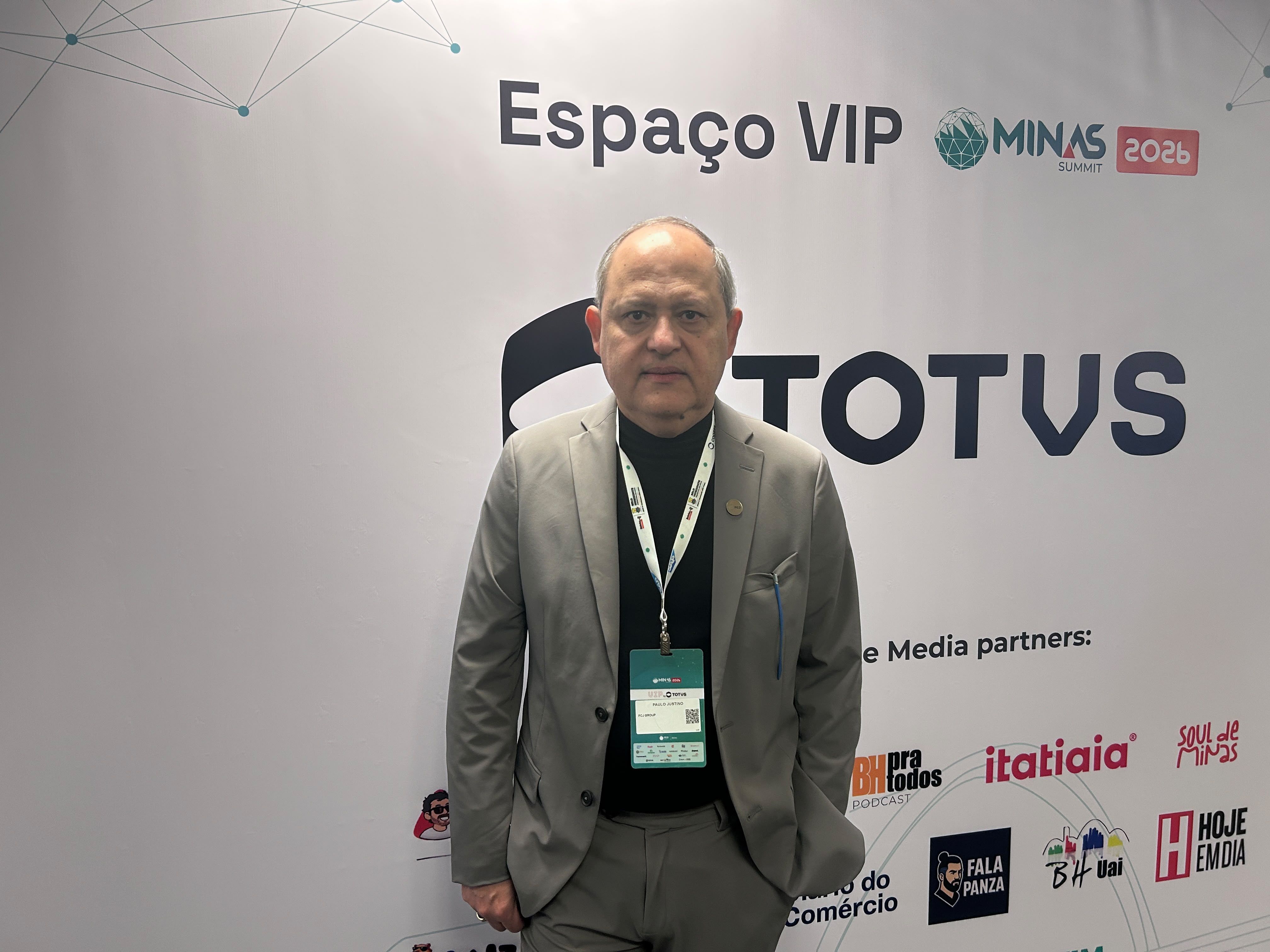
At Minas Summit in June 2026, Justino’s attention returned to the state where he began. He spoke about renewed activity in Belo Horizonte and Uberlândia, as well as Pouso Alegre and Varginha. His argument was regional and practical: Minas Gerais had active communities capable of supporting innovation. FCJ helped organize the event, placing him in the role of convening that community as well as commenting on it.
He also pointed to artificial intelligence as a change in the cost and effort of developing a product. In his assessment, tasks that once demanded substantial spending and a large team could increasingly be attempted by an individual working with AI. The observation echoes his early move into software, although the tool has changed considerably since the book he asked his boss to buy.
The connection is an editorial reading of his career, rather than a claim that every stage followed a master plan. Justino has repeatedly crossed between building things himself and organizing help around other people. The truck driver who moved into computing eventually established a business built on those exchanges. His continuing task is to make the help useful, the arrangements clear and the next founder’s difficult lesson a little less expensive.