Before Paulo Justino built a business around helping founders, he had lost two businesses himself: a woodworking company at eighteen and a software company at thirty-five. The sequence matters. FCJ Venture Builder emerged from a founder’s experience of failure, with an unusually practical proposition: somebody should help carry the work that surrounds the idea.
- FCJ becomes a working partner to startups and licenses its method to corporations.
- Its open model usually selects existing teams; a separate studio also builds from scratch.
- The help includes shared services and corporate connections. Ownership and delivery terms deserve scrutiny.
Two failures. Then a different kind of company.
Justino had worked as a truck driver, programmer and senior executive. In 2013, he founded FCJ in Belo Horizonte. Exame reported an initial investment of R$8,000. That sum bought the beginning of an organisation, rather than a warehouse of finished products. The product would become a way of helping other people build theirs.
The temptation is to make this an inspirational tale and leave it there. The more interesting detail is the division of labour. A founder can understand software while struggling with cash flow, contracts or selling to a corporation. FCJ’s proposition addresses those surrounding jobs. Having suffered the founder’s predicament, Justino made it his market.
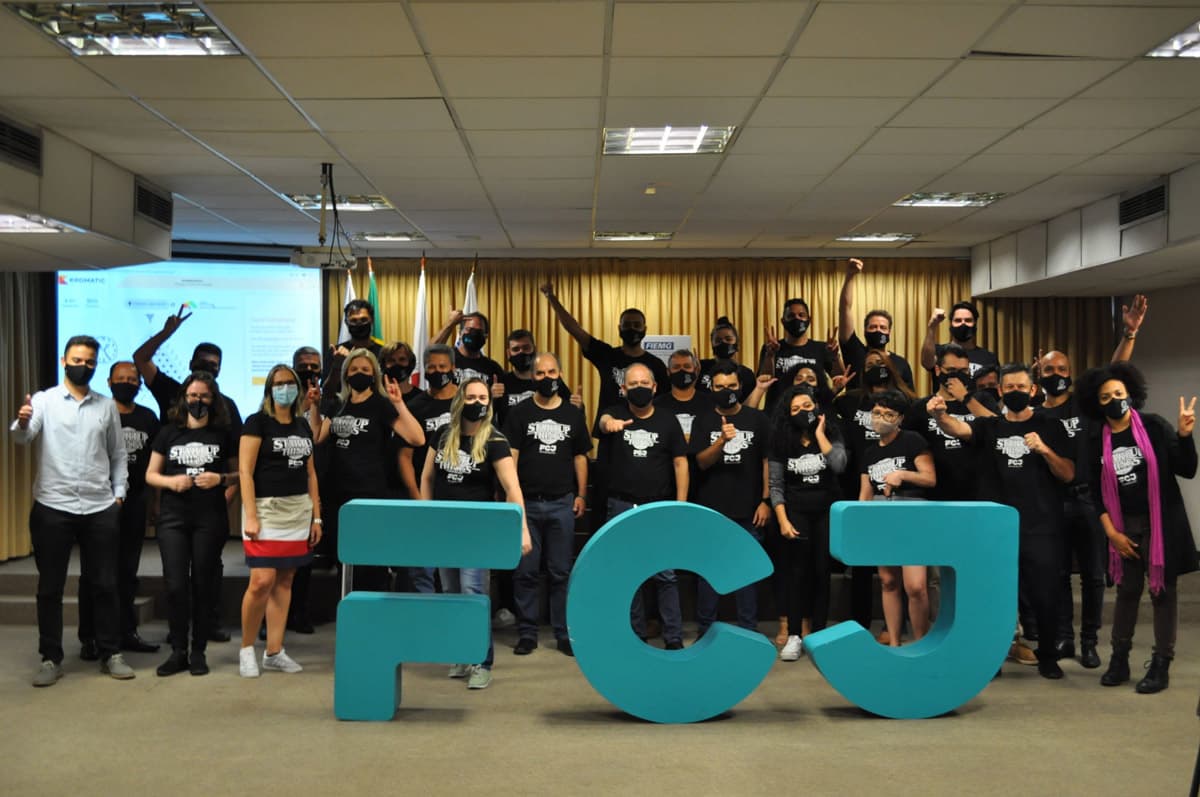
A factory that starts outside its own walls
“Startup factory” suggests an assembly line of inventions. FCJ’s open venture-builder model works differently. It finds existing startups and works alongside their entrepreneurs. Shared infrastructure can include marketing, accounting, legal support and management. The venture builder takes an ownership position, making the relationship more involved than a passing introduction.
Its model explainer describes six years of testing before corporate licensing began in 2019. The reasoning is straightforward: when founders elsewhere are already developing useful technology, a corporation need not recreate every solution internally. The harder task may be helping that young supplier become capable of serving an established business.
- 01FindAn existing team
- 02SupportServices + governance
- 03ConnectCorporate demand
- 04DevelopDelivery + growth
This places FCJ between familiar alternatives. A venture-capital investor primarily supplies capital. An accelerator usually offers a bounded programme. An internal innovation team works within the company’s own organisation. FCJ sells continuing operating support and a corporate interface. Whether that combination is useful depends on the bottleneck the founder actually has.
The first obstacle was inside the customer
Grupo Leonora, the Brazilian school and office supplies business, launched Leonora Ventures with FCJ in 2021. Its published case study describes a concern about matchmaking programmes: finding a startup would not explain how an established company should implement its technology. Leonora chose a structure running alongside existing operations, introducing new practices gradually.
“It wasn’t easy; there were many rejections.”Ana Debiazi, CEO, Leonora Ventures
Translated from the 2023 case study
The team mapped internal processes and looked for places where innovation could help. Early resistance gave way to trust as individual departments produced working examples. FCJ supplied methodology and guidance on finding and supporting startups. The transferable lesson is the order: understand the operation, make something work, then ask the rest of the organisation to believe.
A mental-health business supplies a concrete test
FCJ points to Psicologia Viva as an early test of its method. The online psychological-care platform merged with Conexa Saúde in 2021. Conexa’s current website confirms that Psicologia Viva users and their histories have migrated into its service. Here is a business outcome readers can identify, beyond an innovation presentation.
The distinction is useful. A successful company in a network does not establish the returns of every company in that network. But it shows the kind of destination FCJ is aiming for: a supported startup becoming valuable enough to join a larger operating business. The merger is evidence of one trajectory, rather than a forecast for the next founder.
The cheque is only one part of the price
FCJ’s commercial menu includes corporate licences and operating fees. Innovarium sells software modules; education sells enrolments and corporate programmes; communities bring memberships and sponsorships. Equity relationships add another layer. The group combines recurring services with stakes in young companies whose eventual value remains uncertain.
For a founder, ownership is an economic cost even when support arrives as services. For a corporate buyer, the practical comparison is the cost of running an equivalent team internally. My reading: negotiate named deliverables, responsible people and decision rights. A thick network directory is less useful than knowing who will help secure the next customer.
Capital also has a regulatory history. In May 2022, Brazil’s CVM fined FCJ Participações R$255,000 and Justino R$127,500 for an unregistered public securities offering. That decision allowed appeal. Today, group-linked InvestPlus describes itself as an authorised crowdfunding platform and explicitly distinguishes platform authorisation from CVM approval of individual offers.
The model has acquired a second door
In March 2026, FCJ announced Yggia, a legaltech developed through its Startup Studio. Its proposed tools address health-insurance information: comparing plans, explaining complex contracts and helping users navigate disputes. This is a revealing addition. Alongside selecting existing companies, FCJ offers a route for turning an idea or corporate spin-off into a business.
Education and communities widen the entrance further. Reino Academy partnered with Startup da Quebrada in June 2026 to bring entrepreneurial projects into its digital campus. October’s newsletter promotes Minas Summit Club, extending connections beyond an annual event. These offerings give people ways to encounter the group before a venture-building relationship begins.

Borrow the sequence, not the optimism
The lesson for an executive is to name an operating problem before scouting technology. For a founder, identify the missing capability before giving away equity to obtain it. FCJ is most intelligible when the two needs meet: a startup needs commercial and operating help; a corporation needs a supplier it can actually use.
That meeting requires a buyer, an accountable internal sponsor and enough time to implement. If the customer cannot purchase, the product does not solve its problem, or the founder needs only a cheque, additional machinery may add friction. The clever part of FCJ’s proposition is making the surrounding work visible. The customer’s job is to decide which of that work is worth buying.
Follow the machinery
Explore FCJ’s services, the company journal, Innovarium and the Leonora case study.
Watch the workReino Academy presentation ↗Notion Experience: organising operations ↗Paulo Justino: Instituto PARAR interview ↗