A promising technology can survive a laboratory test and still struggle with a much simpler examination: somebody has to buy it. Altitude Accelerator has organized much of its work around that second test. The Brampton nonprofit helps founders identify customers, build a sales approach and prepare for the questions that arrive when another person’s money enters the conversation. The invention gets you in the door. The business needs its own work.
That emphasis gives Altitude a useful place in Southern Ontario’s crowded startup-support scene. Its territory includes hardware, software, advanced manufacturing, cleantech and life sciences. Its services range from self-paced lessons to individual advice and selective cohorts. The connecting idea is commercialization: helping an entrepreneur move from something that works to something a market can support.
A prototype is an opening argument
Consider a wonderfully unruly example from Altitude’s founder community. Stephanie Lipp and Leo Gillis, the founders of MyCoFutures, moved from gourmet mushrooms into materials. In a May 2025 interview hosted by Altitude, Gillis recalled trying to break apart spent mushroom blocks. A lawnmower met one particularly stubborn block and, in his telling, never started again. The material had made an impression.
More evidence followed. An advisor in a separate pre-accelerator encouraged them to explore materials; customer discovery revealed makers struggling to access alternatives. Later, Lipp described the difficulty of producing consistent, useful sheets from storage totes in a basement. An SRTX relationship brought a reported $100,000 purchase order and factory space in Montreal. Altitude’s Investor Readiness program is one part of their support history; it should not receive credit for every turn.
The lesson travels well. A technical surprise can suggest an opportunity, but production and buying behavior still decide whether it becomes a business. For a founder, the useful question is what evidence would justify the next expense. A broken mower is memorable. Repeatable production is what a customer needs.
Twelve weeks on the sales problem
Altitude’s Market Readiness program makes that commercial question explicit. The current flagship runs for 12 weeks in a hybrid format, with sales and marketing at its center. Its published features include preparing and launching a minimum viable product, beta testing, capital raising and corporate governance. The aim is to help companies communicate with the right buyer and develop a workable sales pipeline.
Those subjects belong together. A founder who cannot explain the buyer’s problem will struggle to choose a marketing channel. A company that cannot describe its sales process will struggle to defend its forecast. Altitude uses workshops and advisory support to work through these connections, making commercial preparation part of the product’s development rather than an errand left for launch week.
On Altitude’s website, Vivo Surgery’s Phillip Mohabir describes identifying additional customer channels, improving the conversion pipeline and setting priorities around different purchasing cycles. That is a more revealing outcome than a photograph of a graduation certificate. It concerns the decisions a company makes on an ordinary Tuesday: whom to approach, what to say and how long a sale might take.
Different entry points. Founders are assessed for program fit.
Free admission. Bring your working hours.
The price listed on the current pages for RevUP, Market Readiness, Investor Readiness and Altitude for You is free. That makes the first decision easier for a cash-conscious founder. It does not make participation effortless. Investor Readiness asks for four to ten hours each week during regular business hours. Over eight weeks, that implies roughly 32 to 80 hours before any extra work a founder chooses to put in.
Investor Readiness is intended for technology companies with traction preparing for a seed raise. The curriculum includes financial modelling, ownership tables, valuation, intellectual property and a data room: the organized records an investor needs to examine a business. Successful completion can lead to matching and introductions. An introduction still leaves the investment decision with the investor.
“The team was supportive and compassionate”
Stephanie Lipp, MyCoFutures, on Investor Readiness
The nonprofit’s economics sit behind those free places. Altitude acknowledges Ontario ministry support through the Regional Innovation Centre network and works with sponsors and community partners. A 2026 Brampton staff report recommended municipal support of up to $100,000 in each of 2026 and 2027. That is a recommendation for public operating support, separate from money investors might put into participating startups.
A founder can also choose a smaller commitment. RevUP is online and self-paced, with a listed duration of one week. It covers business models, target customers, competition and intellectual-property strategy, and asks participants to produce a ten-slide pitch for advisor feedback. It is a practical entry point for someone whose idea still needs a more disciplined shape.
Altitude for You takes another approach: flexible, individual help with a forecast, acquisition strategy, messaging or pitch deck. Its usefulness is in the specificity. A founder with a weak financial model can arrive with that problem. There is no need to pretend that every business is experiencing the same difficulty at the same time.
The regional institution that changed its name
Altitude began in 2008 as the RIC Centre. Pam Banks, its executive director, is credited by the organization with bringing it into existence. Her background is in economic and business development, particularly assembling support across industry, education and government. That helps explain the organization’s approach: much of its value comes from knowing which person or institution can help with a particular obstacle.
The Altitude identity was unveiled in September 2021, after the organization had moved into Brampton’s emerging Innovation District during the pandemic. Banks described its offer as “honest and straightforward advice.” The rebrand agency’s account records a refreshed website, a revised communications approach and an October launch event that introduced Investor Readiness and partnerships with Preference Capital and Algoma University.
There was a commercial reason for changing the label. In a later reflection, outgoing chair Andrew Opala described wanting to move beyond the image of a government-funded service counter. The intended emphasis was on customers, products and funding. Nick Kuryluk and Holly Gardner became board co-chairs in September 2025; Kuryluk had experienced the organization as an entrepreneur in an early RIC Centre cohort.
Altitude operates between the Toronto and Kitchener-Waterloo startup centers. Founders also have options such as Waterloo’s Accelerator Centre and Brampton Venture Zone. The useful comparison is program fit: the founder’s stage, the expertise available and the introductions that matter. Altitude’s combination of regional relationships and experience with physical technologies gives an applicant something concrete to evaluate.
Sometimes the missing advisor is a chemist
For a materials or cleantech company, commercialization may involve chemical analysis before it involves a persuasive pitch. Altitude has documented a partnership with GreenCentre Canada, the specialized chemistry organization in Kingston. That relationship gives founders a route to technical expertise and research resources that can be difficult for a small company to assemble alone.
This is where the breadth of Altitude’s network becomes useful. The organization describes more than 100 advisors and industry, academic and government partners. That figure describes a support network, not a payroll. Its June 2026 event also named Sheridan College, municipal partners, legal sponsors and a new life-science insurance sponsor among the institutions helping founders navigate different stages of growth.
Access to expertise matters most when the question is precise. A founder needs to explain what must be measured, which production step is uncertain or what a prospective customer requires. General encouragement cannot settle those questions. Nor can an accelerator make an uneconomic manufacturing process affordable simply by arranging more meetings. The underlying product and its costs remain the entrepreneur’s responsibility.
Now the money gets a wider address
The investment side has been expanding. Brampton Angels launched in 2023 and became Altitude Angels in January 2026, broadening its western GTA emphasis across Brampton, Mississauga and Caledon. At the rebrand, the network reported $2.6 million invested in seven companies during its first two years, after hearing pitches from more than 100 founders.
Invested across seven companies.
Startup investment, separate from Altitude’s operating funds.
Summit Edge SPV adds a different mechanism. Created with Preference Capital, the vehicle pools investor capital for selected startups. Its founder page targets commercially ready, scalable technology businesses with less than $250,000 in lifetime revenue and advertises the chance to compete for investment of up to $300,000. Selection remains competitive. As of September 10, Altitude’s homepage lists September 14, 2026 as the founder application deadline.
This is a meaningful extension of the support model: preparing founders while cultivating the people who might back them. The distinction between the programs and the money remains essential. A company can benefit from business advice without winning an investment. An entrepreneur seeking an automatic cheque in exchange for attending sessions would be misunderstanding the offer.
Three minutes at the microphone
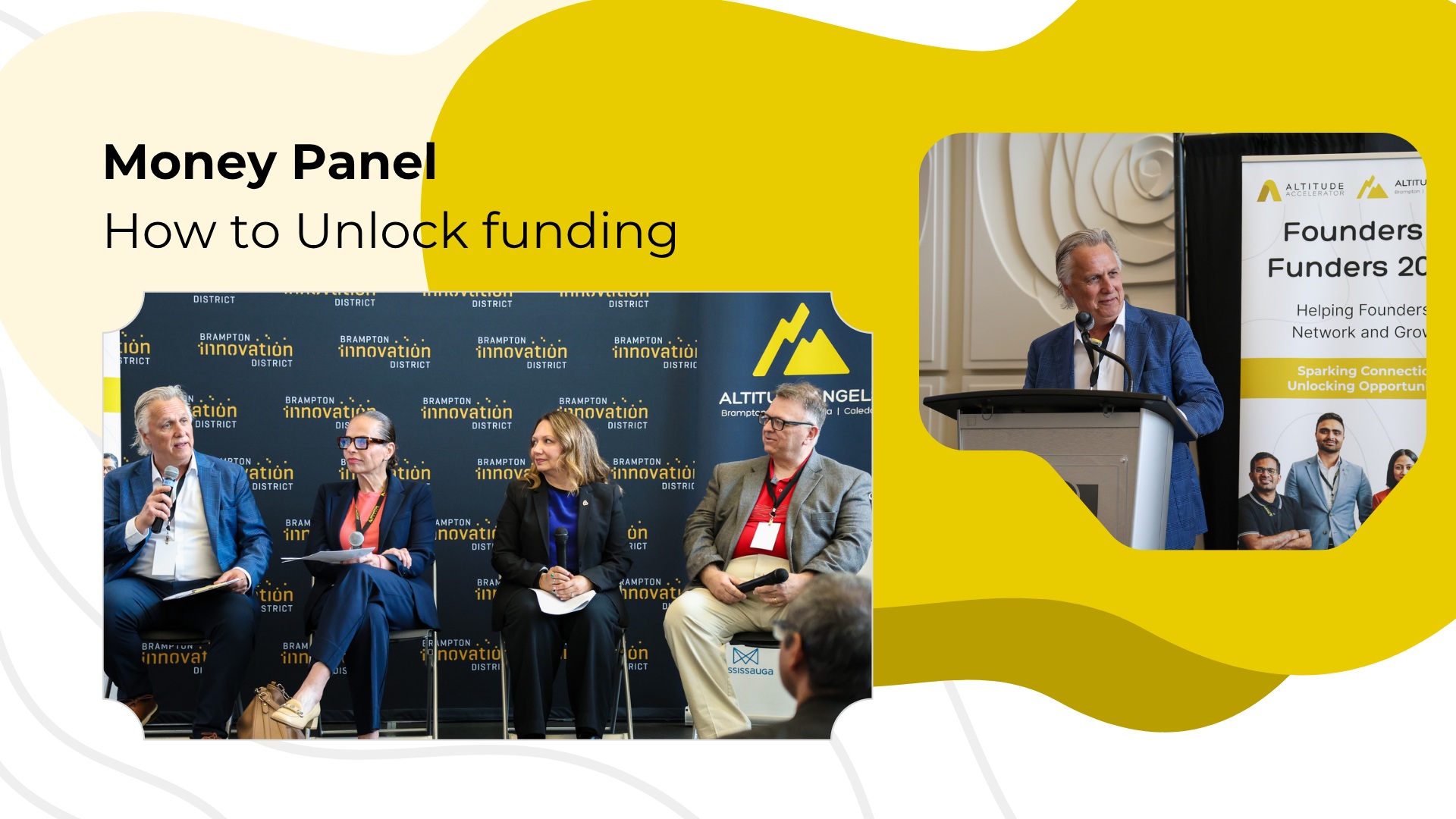
At its second annual Founders and Funders event on June 16, 2026, Altitude gave 15 founders three minutes apiece to pitch. It also reversed the usual arrangement: investors presented fictional companies while founders judged them. A little theater served a recognizable purpose. Defending an assumption feels different when the microphone is yours.
That exercise captures something useful about the organization. Its work asks founders to make their thinking inspectable: a customer segment, a model, a product demonstration, a pitch. Readers can copy that habit without joining anything. Write down the assumption holding up the next decision, identify the evidence that would change it and put the question to someone capable of disagreeing. Then return to the business and make the change.