The pitch is the public part. Before a student founder stands in front of investors at the Rice Business Plan Competition, there is a less photogenic assignment: let somebody experienced pick apart the plan. Entrepreneur Futures Network helps organize that encounter. The questions arrive while there is still time to do something about the answers.
Rice describes a preparation period of three to four weeks, with competing startups connected to experienced mentors. Reviewing a business plan, sharpening a deck and practicing a pitch become scheduled work. For founders trying to explain unfamiliar technology to people holding the checkbooks, that is a useful kind of rehearsal.
EFN, a nonprofit born at the University of California, Berkeley, has made a business of organizing such help. Universities, accelerators and public agencies bring the programs; entrepreneurs bring the questions. EFN supplies training, experienced people and the coordination that gets them working together. Its specialty is making entrepreneurial education happen outside the lecture.
A classroom idea that escaped campus
The organization traces its beginnings to 2003 and Berkeley’s E110 course, “The Startup Company.” Undergraduates developed products, prototypes and business models with help from mentors. The course’s lecturers and advisers saw something worth extending: a student could learn venture creation while working alongside someone who had wrestled with business decisions.
Thomas Jensen founded EFN after teaching and mentoring in that environment. Po Chi Wu also helped establish it. Around 20 mentors joined the initial effort, according to the organization’s account. The origin explains the continuing emphasis on universities: EFN grew from the practical needs of a classroom where making something was part of the homework.
Jensen’s background includes technology consulting, energy and manufacturing work at SAIC and a software spinout, Formatics Technologies. Wu brings venture-capital experience and a decidedly varied academic résumé: molecular biology at Princeton, mathematics and music at Berkeley. EFN identifies him as a leader of its entrepreneur and mentor curriculum development. The pairing gives the educational mission a commercial vocabulary.
The work hiding behind a good introduction
For an institution, EFN offers two main ways to engage. A fully managed arrangement gives it responsibility for coordinating a substantial mentoring or accelerator program with the host organization. A customized arrangement supplies selected pieces, such as specialist mentors, training or a broader investor network, to a program already running.
That distinction matters to a university with an established entrepreneurship center. It may have faculty, facilities and students while needing people who understand a particular industry. Another organization may need the entire program organized. EFN’s service descriptions cover both situations, with examples ranging from solar incubators to regional manufacturing workforce initiatives.
There is software underneath some of this work, too. EFN advertises a client-branded platform for enrollment, mentor matching, planning, milestones and reporting. Founders can track tasks and relationships; mentors can see their teams and activity; administrators can follow participation. The unglamorous benefit is visibility. A match becomes something a program manager can follow up on.
- 01EnrollBring teams and mentors into the program.
- 02MatchConnect the question with relevant experience.
- 03PracticeReview the plan. Rehearse the pitch.
- 04Follow upTrack participation, tasks and milestones.
This places EFN in a particular part of the startup-support market. A founder might choose a peer community such as Founders Network for continuing access to other founders. A university might build its own advisory system. EFN’s institutional offer is the design and delivery of that system, with experienced people attached. Depending on the assignment, an accelerator can be its customer or collaborator.
Rice puts the relationship on the calendar
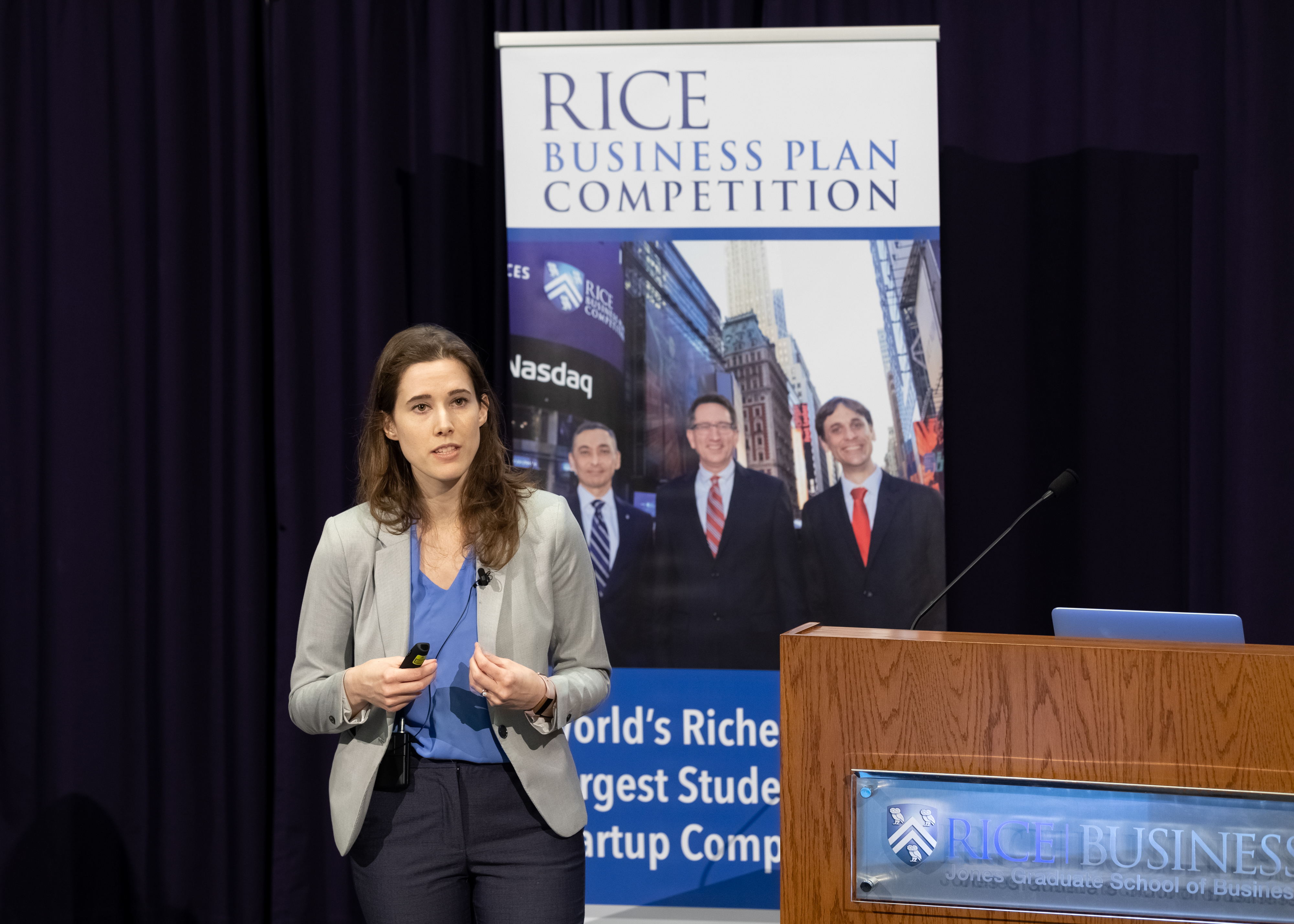
At Rice, the arrangement is concrete. The competition describes 120 pre-qualified participating EFN mentors, with teams matched to one or more advisers. New mentors receive training. The preparation includes feedback and pitch coaching, giving participants opportunities to revise before the scored rounds begin.
“The RBPC/EFN mentoring program was a great experience and our mentors were incredible.”
Ramses Alcaide, CEO of Neurable, in a testimonial published by Rice
The financial terms visible to competitors are equally specific. Rice’s 2026 prize page lists EFN mentoring as an in-kind benefit for all 42 invited teams. The 2024 competition program separately listed a $1,500 EFN cash prize. Advice and prize money are different contributions, and the distinction helps explain how the network participates.
EFN’s wider model combines institutional services, funded partnerships and volunteer expertise. Corporate and public-sector organizations support its challenge and accelerator work; a foundation supported its mentoring research. The founder’s experience can therefore be subsidized by an institution or sponsor. “Free to the participant” still involves somebody organizing the work and somebody supplying the time.
Clean technology has paperwork, too
EFN’s subject matter extends well beyond student pitch competitions. It says it has run or supported more than 45 challenges and competitions, including work involving micro-batteries, carbon capture, water power, geothermal technology and energy storage. Those topics explain why its training includes commercialization and research-funding applications alongside presentations.
EFN Learn makes that mix tangible. Its library includes sessions on patent portfolios, customer discovery for energy companies, grant budgets and the technical portion of Department of Energy applications. A founder can arrive with a specific task and select training relevant to it. An entertaining pitch will only carry a technical company so far if the application behind it is poorly assembled.
The public-sector connection is documented beyond EFN’s own website. A DOE water-power funding webinar identifies EFN among contracted American-Made Network Power Connectors, organizations providing additional guidance and connections. The Clean Energy Business Network also documents a joint June 3, 2026 webinar with EFN about SBIR/STTR developments. This is practical continuing education around a funding process founders have to navigate.
EFN also helped develop Empower Innovation, a California Energy Commission initiative. The platform’s own description identifies ICatalysts as its manager, while EFN describes its development and outreach role. Membership is free. The service gathers opportunities and connects people who might otherwise be searching separate institutional websites.
The community includes technology developers, investors, local organizations and potential adopters. Members can message one another and use directories to identify collaborators. Its Projects and Places directory distinguishes work already happening from locations seeking solutions. That is a useful detail: a clean-technology venture needs somewhere its technology can be used, as well as somebody willing to finance it.
Good advice needs a willing recipient
EFN has also studied its own central proposition. The Kauffman Foundation supported work with the University of Michigan on “Mentoring in Startup Ecosystems,” published in 2017. The project collected perspectives from 820 respondents, including entrepreneurs, mentors and program administrators. Researchers examined the relationships inside university and private accelerator programs.
The paper’s abstract is refreshingly candid: effective programs are difficult to organize even when intentions and budgets are reasonable. Its findings connect mentoring outcomes with personality and beliefs about whether entrepreneurial skills can develop. A prestigious résumé alone does not settle whether two people will work well together.
EFN’s account emphasizes fit, commitment and repeated interaction. It also records a specific adjustment: the 2018 surveys moved away from some questions addressed in 2017 and placed more emphasis on satisfaction, performance and outcomes. That is an observable change in the research design, a modest but useful example of applying what the organization learned.
For readers running a program, the implication is practical: select for relevant experience, establish expectations and make time for follow-up. For founders, arrive with a decision to examine and something concrete to review. A relationship that never gets beyond introductions has little opportunity to improve the next decision. Mentoring asks for attention from both sides.
The same idea, different passports
International work takes the method into locally partnered programs. In 2021, EFN launched Empower Queensland with the Australian state government and U.S. State Department funding. In September 2022, it partnered with ESADE’s entrepreneurship institute on a mentor-based accelerator for 40 women entrepreneurs in Spain, supported by U.S. diplomatic missions.
Korea supplies a more recent example. January 2025 reporting described 25 women entering a roughly three-month Academy for Women Entrepreneurs program co-led by EFN and Nuleep. Activities included online training, mentoring, workshops, networking and a business-pitch competition. The combination joins formal instruction with opportunities to discuss the participants’ own businesses.
These programs make EFN’s idea of access quite specific: a local partner organizes around a particular group, while mentoring connects participants with additional experience. Its published principles stress cross-generational learning, respect for volunteers and participant confidentiality. The culture it describes is built around professionals sharing what they know with people still acquiring it.
Homepage figures reviewed September 2026. Cumulative reach, not a measure of mentoring’s causal effect.
Read the billions carefully
EFN’s homepage reports more than $5 billion raised by startups it has mentored, alongside more than 40 exits valued above $5 billion. These are the organization’s reported outcomes for mentored companies. They describe the scale of businesses connected to the network; they are neither EFN’s revenue nor money it has itself invested.
The distinction leaves a more useful way to judge the service. Can the organization assemble relevant expertise, give participants a workable schedule and help them improve a plan? A founder can explore EFN Learn or an eligible partner program. An institution can engage EFN around the parts of mentoring it needs help delivering. An experienced professional can apply to mentor.
The next step is small enough to be actionable: bring a real question. A budget to examine. A customer assumption to challenge. A presentation whose explanation keeps losing the room. EFN’s work begins where general encouragement runs out of specifics, while there is still time to revise the answer.