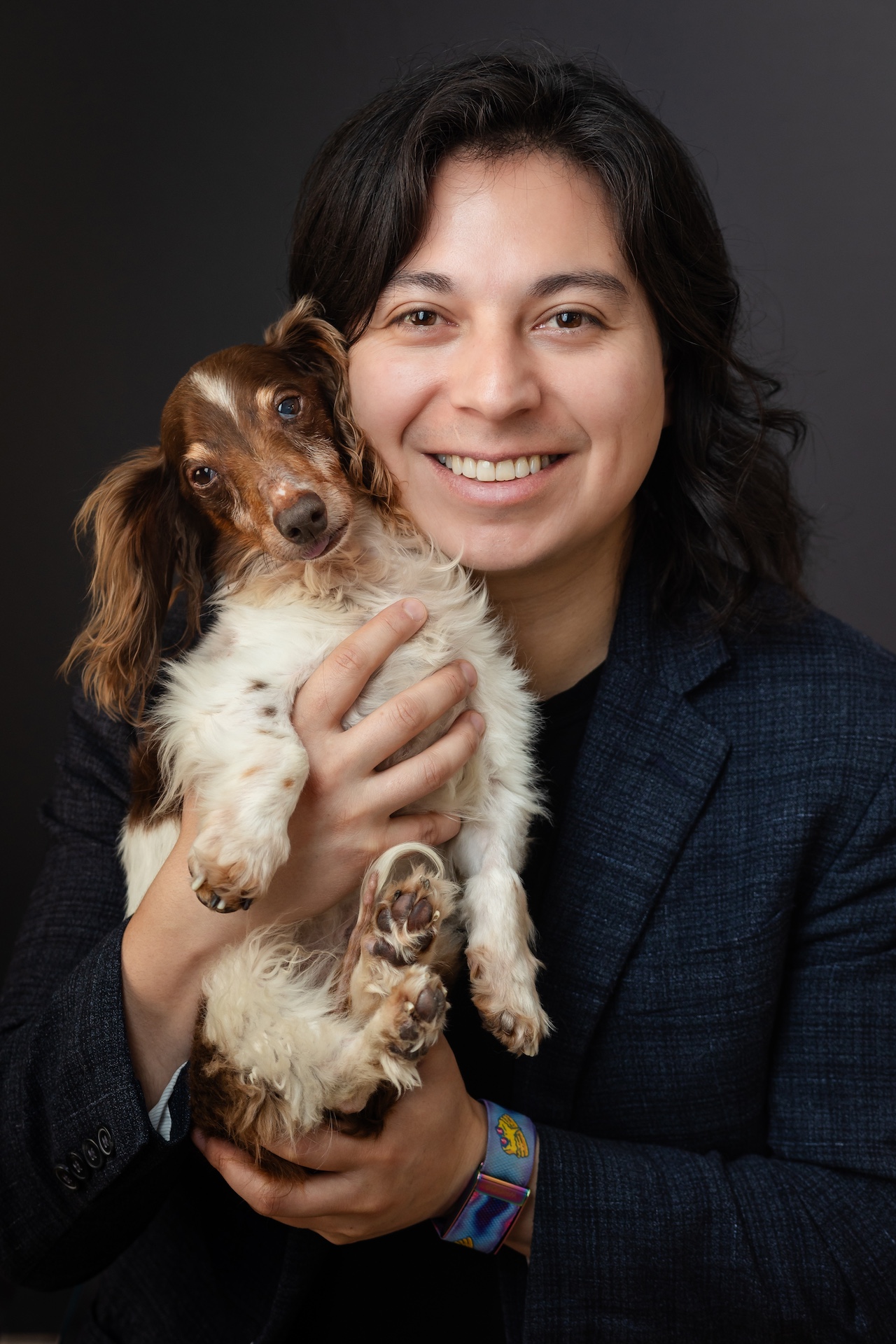
Ramses Alcaide sells a brain-computer interface. He does not, however, look like he sells a brain-computer interface. The product looks like a pair of headphones - the black-and-brass Master & Dynamic MW75, more or less - and that is the entire commercial thesis of Neurable, the company he co-founded in 2014 and has run as CEO ever since.
You put them on. You listen to a podcast. Meanwhile, EEG sensors tucked inside the earpads read the electrical activity of your prefrontal cortex, and a companion app tells you, in the polite prose of a wellness app, that your focus dropped at 2:47 p.m. and might benefit from a walk. The engineering here is decades in the making. The marketing is roughly six months old. Both are the achievement.
Consumer neurotechnology has, until recently, been an awkward category. It required gel, or swim caps, or - in the Neuralink direction - a hole in the skull. Dr. Alcaide, whose PhD from the University of Michigan involved building EEG biomarkers for children with cerebral palsy, has spent a decade making the whole apparatus look like something you would already own. In late 2025 he closed a $35M Series A on the strength of it. In January 2026 he stood at CES with HyperX and unveiled a brain-controlled gaming headset. The shape of the pitch is: we are not asking anyone to do anything new. We are asking them to notice.
On the product
"Because they're headphones, you can just put them on and nobody will know that you're wearing a brain-computer interface. It just looks like an average pair of headphones."
Neurable's origin sits in a University of Michigan lab called the Direct Brain Interface Laboratory, where in 2011 an undergraduate-turned-graduate-student named Ramses Alcaide was working on an algorithm to improve the signal-to-noise ratio of EEG data - the ancient problem of consumer neuroscience, which is that the human scalp is a lousy antenna. His work at Michigan focused on people with severe cerebral palsy, ALS, and amputations. In 2014, he spun the technology out through the university's Innovation Partnerships accelerator. He was still finishing his doctorate. He kept the company small and unglamorous for years, which turned out to be the right call.
The story he tells about why he does this involves a truck. When Alcaide was eight, an uncle he was close to lost both legs in a trucking accident. Alcaide has said in several interviews that the experience of watching that uncle navigate the world was what put him on the path. The connection between "help my uncle" and "sell EEG headphones to knowledge workers" is not, at first glance, obvious. But if you accept that the underlying technology - non-invasive, real-time interpretation of brain signals - is the same regardless of who wears it, then the consumer product is what pays for the assistive one. This is a very common founder logic. Alcaide is unusually explicit about it.
He grew up in a suburb of Seattle. His parents were college professors in Mexico; in the United States they worked as school custodians. The family emigrated when Ramses was four, with his father arriving first and the rest of the family following a year later. In the version of the story he has told publicly, his parents read The Iliad to him aloud as a child. At six, he was buying broken video games, repairing them, and reselling them for a profit. At some point after that, he was fixing computers. The pattern, if you want a pattern, is that he was a person who liked to open things up and see what was wrong with them, and the human brain is, at the level of electrical engineering, a thing that can be opened up and looked at.
His degree from the University of Washington is in electrical engineering. His graduate work at Michigan is in neuroscience. He holds fellowships from the National Science Foundation, McNair, and Ford Foundation, and he was a Rackham Merit Fellow. He is a two-time Neuroscience Innovators Award winner. Forbes named him a Next 1000 member in 2021. This is a long list, and the appropriate response to it is not "how impressive" but "how patient." Nothing about Alcaide's public trajectory suggests a person in a hurry.
CEO philosophy
"The job of a CEO is to find the lightest shade of grey to choose from." Not black. Not white. Grey.
Neurable's commercial breakthrough came in 2024, when Alcaide's team shipped the MW75 Neuro in partnership with Master & Dynamic, the New York audio brand. The MW75 Neuro is what Neurable had always promised: EEG in a form factor that a person would buy anyway. Reviews were, in the diplomatic terms of technology journalism, curious rather than ecstatic - the point being that they existed at all. TechRadar wrote that they "promise to help you focus and avoid burnout." Digital Trends called the potential "fascinating." SoundGuys called them a "game changer." A follow-up model, the MW75 Neuro LT - lighter, less expensive - shipped in 2025. Alcaide's line about the LT is worth quoting because it functions as the whole company's tagline: "Your brain has been trying to tell you something, and until now, no one was listening."
The Neurable philosophy, which Alcaide has articulated across a Forbes interview and various podcasts, is that brain data should be treated as "good mental hygiene" - a phrase he uses on purpose. Hygiene is boring. Hygiene is daily. Hygiene is what you do to avoid a problem, not what you do after you have one. Framing consumer neurotech as hygiene, rather than as diagnosis or enhancement, is the marketing move that lets a headphones company sell EEG to people who do not think of themselves as patients. It also, presumably, keeps the FDA at a comfortable distance.
In January 2026, at CES, Neurable and HyperX unveiled a gaming headset controlled by brain signals. The market logic here is easy - gamers already tolerate strange peripherals; gamers already care about focus; gamers already have expensive headphones on their heads for hours a day. Alcaide's public statement about the partnership included the line, "understanding your mind becomes as natural as understanding your mechanics." Gaming as the entry point for consumer BCI is not a new idea. Doing it with a company that ships hardware at scale is.
Alcaide, when not running Neurable, is on record as enjoying leadership study, quality steaks, and strategy gaming. His focus music while working is a track called "No Mercy No Respite" by Doyle W. Donehoo. His brain break is a quick workout. His motto, which he shared with Neurable's own website, is "Don't stop when you are tired, stop when you are done." He volunteers with STEM programs including the Science Club for Girls in Boston. He has said, more than once, that the two qualities he credits for his success are perseverance and coachability, and that passion, on its own, is not enough.
The Series A - $35M, closed December 1, 2025 - is Neurable's largest single raise and brings total funding to roughly $49M. It is, by neurotech standards, a modest sum. Neuralink has raised roughly 20 times that. Kernel and Synchron have each raised more. Neurable's counter-argument is that surgical BCI is a decade away from a consumer market and that consumer neurotech is here already, sitting on people's heads, playing Spotify. This turns out to be a defensible position when your product is a pair of headphones.
What Alcaide is really building - and this is the part that requires reading between the lines of a press cycle - is a data business. Every MW75 Neuro on every knowledge worker's head is, in aggregate, a real-time map of cognitive states across a working population. The company insists on privacy; users own their data. But the technical possibility of that map is what makes the company interesting to investors, and it is what makes Alcaide's slow, form-factor-first strategy pay off. He is not trying to be first. He is trying to be normal.