At three in the morning, Peter Torstensen was on his couch watching a Danish swimmer win an Olympic gold medal. Pernille Blume had won the 50-metre freestyle in Rio. He recalled the goosebumps and the tears. Here was years of work compressed into seconds, with a result nobody could negotiate away.
He described the moment in August 2016, then turned to the thing he said moved him even more: seeing startup founders succeed. The comparison was revealing. He was interested in the preparation behind the result, the coaches and institutions that helped talent become performance. The pool had lanes. Entrepreneurship required considerably more improvisation.
Torstensen’s career has revolved around giving that improvisation some support. He founded Accelerace, the Copenhagen accelerator and early investor, and leads Symbion, the startup community. Today, BII also lists him as its Chief Commercial Officer. Through those roles runs a question with consequences for anyone starting a company: how much must a founder learn alone?
How do you give a first-time founder the benefit of somebody else’s second attempt?
An address is only the beginning
His LinkedIn education history places him at Roskilde University between 1987 and 1992. By April 2006, he had become CEO of Symbion. It was a useful vantage point for someone interested in what surrounds a young business: premises, neighboring companies, university relationships and people who might know whom to call.
Symbion’s reinvestment model gives the work a particular shape. Torstensen has explained how surplus goes back into additional locations, improvements to existing buildings and activities for the companies inside them. Offices bring people together geographically. Talks, events and relationships can make the proximity worth something.
Accelerace, founded in 2008, addressed the business taking shape inside that environment. In a 2012 interview, Torstensen discussed a program whose participants already included Trustpilot, Labster and Me-Mover. The organization reported having worked with 150 startups at that point. There was an accumulating body of experience to examine, rather than a theory waiting for its first encounter with a customer.
For Torstensen, the practical question was how that experience could help the next company. A new founder might have an original idea and a thoroughly ordinary problem selling it. Originality is expensive enough without paying full price for every familiar mistake. A clear introduction or an experienced question can shorten the search, leaving the team more time to work on what is new.
Practice, with somebody watching
His personal blog, Creating Startup Winners, sets out a belief that entrepreneurial methods can be learned through repeated work, aided by skilled people and a systematic approach. He puts the emphasis on practicing while building a business. The classroom has its uses; the customer retains the inconvenient privilege of disagreeing with the lesson.
That belief makes the mentor’s job more demanding than delivering a stirring talk. The help must reach the specific decision: which customer to approach, what assumption to test, what evidence would justify the next investment of time. Repetition becomes useful when someone helps the founder notice what changed.
Torstensen has also been willing to ask whether the organizations doing that early work are properly rewarded. In October 2016, he used European football as an analogy. Clubs developing young players contribute to later success. He wondered what a comparable incentive structure could do for the institutions nurturing startup talent.
His proposed startup Champions League was an argument about cooperation and economics. If value arrives years after the earliest work, the people financing that work need a reason to continue. The celebrated company at the end depends on less celebrated activity further back. Somebody has to pay for the training ground.
“I love watching the Olympics.”
Peter Torstensen, writing in August 2016
Progress before the revenue arrives
There is a measurement problem hiding inside this interest in practice. An early company may lack the revenue history that makes later investment decisions easier to discuss. Work is happening. How can an investor judge whether it amounts to progress?
In 2021, Torstensen and David Ventzel co-authored a framework called Momentum. It examines development across four areas: the team, technology, customer insight and customer commitments. Those advances are considered against the time and money available. A result acquires meaning when you know what it took to reach it.
The authors acknowledge limitations, including differences in the difficulty of technical advances and the significance of customer commitments. Their model cannot settle every investment question. Its appeal lies in bringing a loosely described process into a conversation where assumptions can be examined.
That habit fits Torstensen’s larger project. If entrepreneurial work can be made more explicit, another person can help improve it. The founder gains a way to discuss a difficult month that goes beyond declaring how busy everybody has been.
The graduate comes back
His interviews offer a more conversational version of the same effort. In January 2016, he sat down with Thor Angelo, whom he had first met when LanguageWire participated in an early Accelerace round. Angelo was now investing in other companies. The former participant had become somebody with experience to pass along.
Torstensen’s curiosity extended to the community itself. A December 2015 conversation with Jasenko Hadzic explored startup communities and the grassroots initiative #CPHFTW. These discussions treated the relationships around entrepreneurship as something worth investigating, alongside the companies receiving the attention.
Accelerace’s present mentor roster gives that circulation of experience an institutional form. It includes Christian Lund and Henrik Printzlau of Templafy, André Clement of Penneo, Eske Gunge of Actimo and Mark Højgaard of Coinify. Alumni return with knowledge acquired after the accelerator program ended.
There is a modest but useful idea here: graduation need not mean disappearance. A founder who has learned how to hire, sell or negotiate can become the person another team needs to meet. The connection is valuable because the experience is specific. General encouragement is easier to obtain, and rather less helpful when a negotiation has reached page seventeen.
The company on the other side of the table
Torstensen has spent time considering the established company’s part in this arrangement. His 2016 writing on corporate entrepreneurship asks large businesses to think carefully about the value they deliver to startups. Access to markets, infrastructure, specialist knowledge or funding gives a founder something concrete to assess.
The argument contains a reversal of the usual corporate courtship. A recognizable brand does not automatically make a useful partner. The startup has choices, too. A corporation hoping to attract capable founders has to understand why they would spend scarce time working with it.
His January 2017 discussion with Anneli Bartholdy, then an innovation portfolio manager at Maersk, addressed corporate innovation, culture, leadership and measurement. Accelerace was collaborating with Maersk on an international program for startups in global trade, shipping and energy. The question of useful access had a particular corporate setting.
Years later, Accelerace’s AI Match project offered another practical form of matchmaking. Industriens Fond lists DKK 2.1 million in support for its 2025-2026 period. The program connects startups and Danish businesses around concrete needs. The recurring concern is whether the introduction produces work that both parties have reason to pursue.
A merger against fragmentation
Universities occupy another important place in Torstensen’s thinking. Accelerace’s cooperation with Latvia’s UniLab brought him into a collaboration among universities supporting new companies. He praised their willingness to work together. The subject fits his wider concern with getting knowledge across institutional boundaries.
On 1 October 2025, BII and Accelerace announced their merger, with Accelerace becoming an integrated part of BII. The stated ambition included supporting more university-based companies in technology, AI and quantum. For Torstensen, the combination offered a larger resource platform for ideas emerging from research.
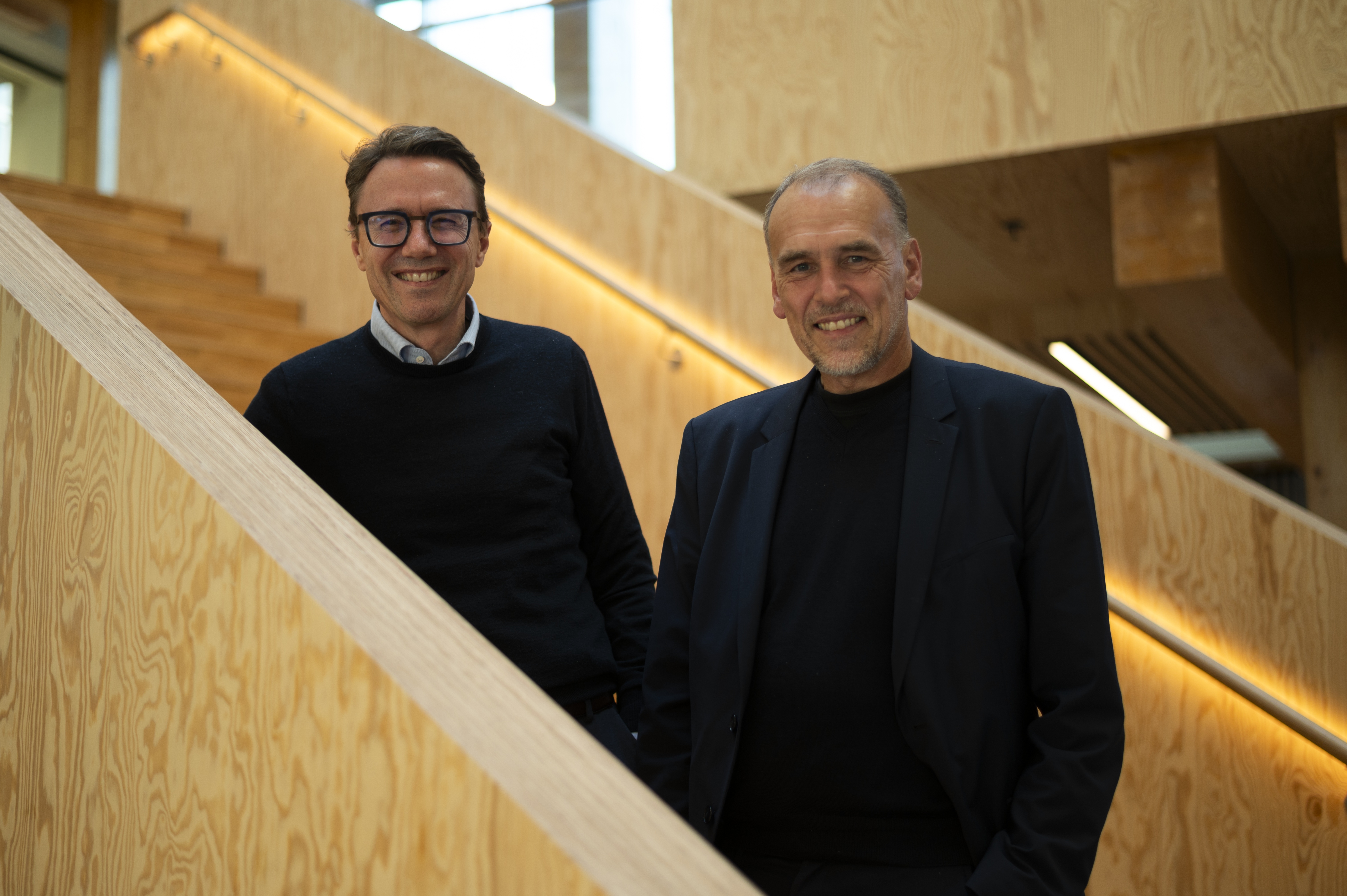
Later that month, he and BII CEO Jens Nielsen co-authored an opinion piece for Børsen on fragmentation in Denmark’s innovation ecosystem. Their concern was that resources and expertise were scattered across too many initiatives. Having capable organizations is one thing; making their combined capabilities accessible to a founder takes further work.
The merger gave that argument an organizational consequence. It also placed Torstensen’s longstanding interest in early ventures alongside BII’s research-commercialization work. His current commercial role makes the route between an idea and a working business a particularly immediate responsibility.
The next machine room
In May 2026, Industriens Fond announced DKK 60 million in support for AI Lab at BII. Its project listing runs from 2026 to 2031 and describes three tracks: industry, tech and deep tech. The design accommodates both immediate company needs and ideas with a longer journey from research to use.
Support from Industriens Fond to BII.
Project period: 2026-2031.
The published agenda for the 4 June launch, The Machine Room, named Torstensen to introduce the case for AI Lab and deliver closing remarks. His own invitation called on founders, investors and other participants to help shape it. He described the need for community, physical, skills and financial infrastructure.
That list brings his earlier work into focus. The accelerator, the mentor, the corporate partner and the university connection each cover a different part of the journey. A new field changes the people and technical problems involved. It still requires a way for those people to find one another and begin useful work.
Torstensen’s story keeps returning to the preparation that precedes a visible result. A company may eventually have its moment on the podium. Long before then, somebody needs a customer conversation, an experienced adviser or the money to attempt the next experiment. He has made a career of attending to those less photogenic moments. They are where a head start can still be built.