An electric truck is a rather expensive object to leave waiting for a plug. At the Denker depot in Southern California, Performance Team, a Maersk company, had trucks to deploy. The local grid upgrades could take an estimated three to five years. Prologis, the logistics landlord developing the site, had a choice: accept the utility’s calendar, or find another way to supply the power.
It chose a microgrid. Generators, batteries and controls would do the work while the trucks got on with theirs. The depot’s construction took five months. There is a useful introduction to Prologis here: a company whose business begins with a building, then follows the customer’s problems beyond its walls.
- The space: warehouses for retailers, manufacturers and logistics operators.
- The next sale: equipment, storage design, energy and fleet charging.
- The lesson: identify the bottleneck before buying more capacity.
The bet was on the journey
To understand that habit, go back to 1999. AMB, one of the predecessors of today’s Prologis, exited community shopping centers and concentrated on industrial property. Imagine the decision from a shopper’s perspective. The store was the visible part of commerce. The warehouse was somewhere you hoped never to visit.
From a logistics perspective, the interesting thing was the journey. Goods needed places to pause near ports, airports and large consumer markets. E-commerce would make those places more consequential. In a company retrospective, co-founder Hamid Moghadam described the decision as a move to “zero in on industrial.”
AMB’s roots go back to 1983, with Moghadam, Douglas Abbey and Robert Burke forming its founding team; the company chronology dates Burke’s arrival to 1984. AMB merged with the separately established ProLogis in 2011. Today’s business combines warehouse ownership and development with the management of institutional property capital.
Its customers include Amazon, Home Depot, FedEx, DSV and DHL. They need different buildings in different places, but share a practical concern: the building must work as part of a distribution network. A cheap lease loses its charm if the location adds miles to every delivery.
Other landlords understand this too. Goodman develops logistics properties for customers including DHL and Maersk; STAG Industrial offers industrial space across the United States. Prologis’s pitch rests on the combination of its property network, operating services and capital relationships. A customer choosing between them still has to start with a local question: which available building actually fits the job?
The square feet you already have
One 2026 customer story begins with a 260,000-square-foot warehouse in the Pacific Northwest. A consumer products company planned to stack overflow inventory on the floor. Within two months of moving in, it won new retail distribution business. The stopgap had become a constraint.
Prologis Essentials helped remove an obstructive interior wall, rework the layout and coordinate permitting, lighting, electrical work and racking. Twelve-foot rack beams replaced eight-foot beams in the design, allowing more pallets per bay. A mixture of used and new equipment helped manage costs. Installation proceeded around live operations.
The result: capacity increased from about 12,000 to more than 23,000 pallet positions inside the same footprint. That is the appeal of Essentials. A tenant can buy racking anywhere. Coordinating racking with building changes, safety requirements and an operating warehouse is a different assignment.
The transferable idea is modest and useful. Before expanding, measure what prevents the existing space from working. It might be an awkward wall, the wrong storage geometry or a workflow designed for yesterday’s inventory.
Extra square footage can be an expensive answer to the wrong question.
A roof with a second job
The same reasoning applies overhead. Warehouses have large roofs; customers have electricity bills. Prologis reported one gigawatt of solar generation capacity at the end of 2025. Its energy business turns some of the real estate it already controls into a place to generate power.
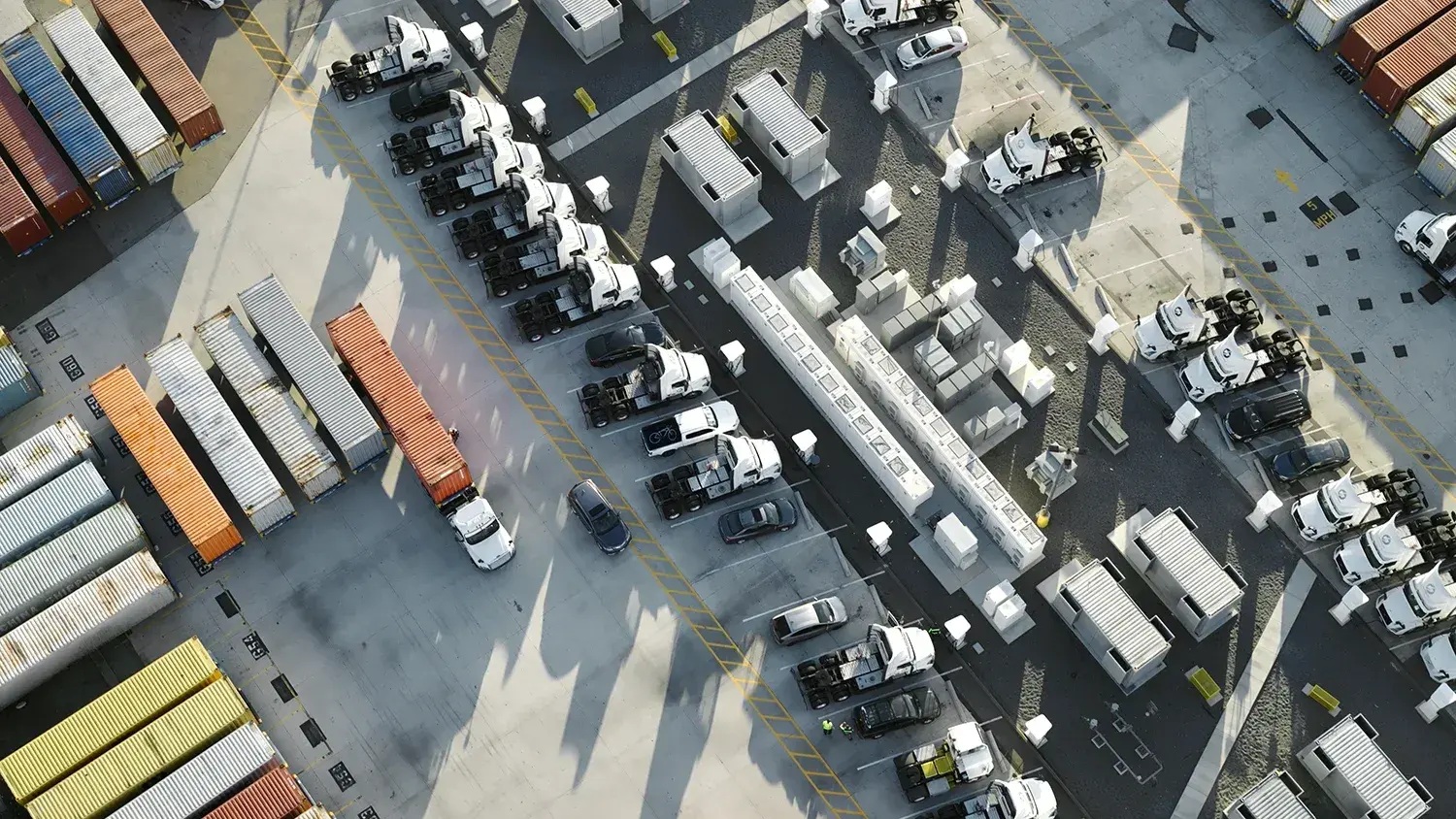
Denker takes that logic into the yard. Its system combines fuel-flexible linear generators with 18 megawatt-hours of batteries, supporting up to nine megawatts of charging capacity and as many as 96 trucks charging simultaneously. The site contains six independent microgrids. Mainspring Energy supplied the generator technology.
The important failure came before construction: ordinary utility timing did not fit the customer’s schedule. Prologis changed the power design to fit the deployment. The distinction matters because the answer to an energy shortage can be organizational as much as electrical.
Copying it requires arithmetic. A fleet needs enough use to justify dedicated infrastructure; fuel prices, permitting and emissions requirements must cooperate. Hydrogen-ready equipment also does not mean hydrogen is the fuel being used. A smaller fleet with reliable grid service may have little reason to duplicate Denker’s machinery.
The bill behind the box
Prologis is a publicly traded real estate investment trust, listed as PLD. Rent anchors its economics. Development adds buildings; acquisitions add portfolios; institutional co-investment ventures supply capital and generate management fees. Equipment and energy services extend what an existing customer can buy.
Scale costs real money. The 2022 Duke Realty acquisition closed at approximately $23 billion, including assumed debt, and added more than 500 customers. In March 2026, Prologis and GIC announced a $1.6 billion U.S. build-to-suit venture. These are different transactions: one bought a company; the other organized capital around customer-specific development.
A warehouse operator considering Essentials should compare the whole job: equipment, installation, financing, downtime and ongoing obligations. Buying everything through one provider can simplify coordination. It still needs to earn its place against specialist vendors and an independently managed fit-out.
The next bottleneck
Dan Letter became CEO in January 2026, with Moghadam continuing as executive chairman. By the third quarter, Prologis reported 95.1% average occupancy. Letter said customers’ “excess capacity within their networks has largely cleared.”
Meanwhile, the proposed SEGRO acquisition would expand its European platform. Announced in August 2026, the deal remained pending in October, despite reaching shareholder approval. More buildings mean more customer relationships - and more chances to discover what those customers cannot yet do. Sometimes the answer is another warehouse. Sometimes it is a wall that needs to come down.