The awkward question for a laboratory landlord comes after the laboratory is built. Suppose the tenant leaves. Who takes the keys? A building fitted for biology cannot simply become an accounting office without wasting expensive infrastructure. Alexandria Real Estate Equities built its business around an answer: find a neighborhood with more scientists.
- The offer: specialized laboratory space, campus services, and room for life science companies to grow.
- The bet: proximity to research, talent, and capital makes a building more useful.
- The test: even a good scientific neighborhood can have too many empty laboratories.
A garage startup with a very expensive idea
In 1994, Joel Marcus and Jerry Sudarsky started Alexandria with $19 million in initial capital. Marcus was a lawyer and accountant with biotechnology experience. The company’s first acquisitions were in Torrey Pines, San Diego. Three years later, it went public on the New York Stock Exchange under ARE. The proposition was unusually specific: build a real estate business for the people trying to make medicines.
Getting investors comfortable took work. Recalling an early fundraising round in a 2019 interview, Marcus said roughly 28 or 29 of 30 meetings ended in rejection. One investor’s aversion to laboratories turned out to concern a building handling printing solutions. Biological research had been confused with an entirely different activity. The pitch had a vocabulary problem before it had a property portfolio.
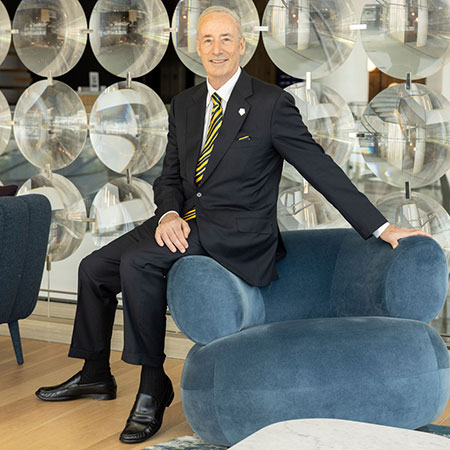
Marcus himself had needed persuasion to run the business. “I turned them down three times, and then finally said yes,” he recalled. It is a useful founding detail: the man who would spend decades advocating the niche needed repeated invitations to enter it.
The neighbor is part of the product
Alexandria’s cluster model borrows from Harvard professor Michael Porter’s work on industry concentration. Its four ingredients are location, innovation, talent, and capital. Laboratories belong near universities, medical institutions, pharmaceutical companies, and investors because those are places where potential employees, partners, and customers already gather. The value proposition extends beyond the leased floor.
IN GOOD COMPANY03 / TALENT04 / CAPITAL
This also answers the question about the departing tenant. A specialized building in a deep research market has a larger pool of plausible replacements. That is the commercial logic behind concentration. It helps explain why Alexandria favors research neighborhoods rather than spreading laboratories evenly across a map. Proximity is useful to scientists and useful to the person collecting their rent.
The company owns, operates, develops, and redevelops laboratory and office properties. Its campus offer includes amenities, operating support, and flexibility to accommodate growth. The New York Alexandria Center for Life Science opened in 2010. Greater Boston, San Francisco, San Diego, Seattle, Maryland, and Research Triangle are other core markets. These are different scientific communities with a shared need for specialized space.
A bench before a building
For a young biotech company, the immediate problem can be smaller than a campus and bigger than a desk. It needs somewhere to do experiments. Alexandria’s 2016 announcement of New York LaunchLabs offered shared equipment, laboratory management, mentorship, and flexible laboratory and office space, with an opening planned for summer 2017.
The advertised entry price was $1,995 a month for membership, a workstation, and a laboratory bench in a shared suite. That is a historical price, not a current quote. The accompanying seed fund targeted $10 million to $25 million. The practical attraction was to bundle several early obstacles into one arrangement, then offer larger space as successful companies grew.
Alexandria also started venture investing in 1996. The company says that activity gives it insight into scientific trends and relationships with entrepreneurs, institutions, and investors. A landlord who understands a tenant’s science may ask better questions about its future space needs. That is a plausible advantage, though it also ties more of the business to the same industry.
The lease is long. The cycle is shorter.
Alexandria reported $3.03 billion in total revenue for 2025. Rent and property-related reimbursements underpin the model. Its customers include large pharmaceutical companies and younger biotechnology businesses; Bristol Myers Squibb, Eli Lilly, and Moderna appeared among major tenants in June 2026. Competitors include BioMed Realty, Healthpeak, and Longfellow. Alexandria competes through its campus locations, technical operations, and relationships.
The company recruits across laboratory operations, engineering, life science, leasing, and finance. Its stated culture emphasizes humility and teamwork. For customers, that mix matters more than a landlord’s taste in lobby furniture: somebody must understand both the experiment’s working environment and the building’s economics.
June 30, 2026
By June 2026, operating occupancy was 86.9%. Including signed leases awaiting occupancy brought it to 90.9%. Those figures describe different things: a contract for future use does not mean the tenant is working there today. They also expose the limit of the neighborhood argument. Concentration cannot manufacture immediate demand when customers postpone expansion.
For a prospective tenant, the decision is practical: does the available space suit its research, hiring plans, and funding runway? A campus can offer useful connections and room to expand. It still has to fit the company’s budget. The surrounding scientific activity cannot rescue a lease signed for more space than the business needs.
Keep the cluster. Change the spending.
The adjustment was concrete. In late 2025, Alexandria sold or designated three projects for sale and shifted another to a lower-investment approach. It reduced future construction funding requirements by more than $300 million. In September 2026, it announced an amended $5 billion credit line with maturity extendable to January 2032, subject to conditions. Credit capacity provides flexibility; it does not replace leasing.
The lesson readers can borrow is to design for the second customer before signing the first. Build near a repeatable need, and remove the customer’s related obstacles. The conditions matter: scarce capital, excess laboratory supply, or a location without enough research activity can undermine the economics. Alexandria’s achievement was recognizing a useful neighborhood. Its continuing task is deciding how much more of it to build.