The reason to care about Scrunch is not that marketing needs another dashboard. It is that the customer journey can now begin, narrow and nearly finish inside an answer box. A buyer asks ChatGPT for three vendors, Gemini compares them, or Perplexity cites a year-old review. Your immaculate homepage may never get its entrance. Scrunch is for the team that suspects this is happening and needs to see the trail: the prompt, the answer, the citation, the crawler and, eventually, the visit.
That makes the natural buyer a mature marketing, SEO, content or digital-experience team. Agencies can use it across client brands. Enterprise teams can connect deeper site and data infrastructure. A solo founder with twelve pages and no established search program will probably find the monthly bill and prompt setup excessive. Scrunch earns its keep when there are products to compare, competitors to watch, pages to repair and colleagues who can act on the evidence.
The pitch, minus the fog machine
Scrunch began building in 2023 under co-founders Chris Andrew and Robert MacCloy, both veterans of Hearsay Systems. The product came out publicly in November 2024. Its first job was familiar to anyone watching the new AEO and GEO category: run representative prompts across answer engines and report whether a brand appeared, where it ranked, how it was described and which pages the model cited.
The company kept moving down the stack. Agent Traffic watches bots arrive at a website. AI Referrals follows people coming back from answer platforms. Site Diagnostics checks whether pages are retrievable and citable. Content Delivery can serve agents a lighter, JavaScript-free version at the edge while people keep the designed experience. In Scrunch language, this closed loop is an Agent Experience Platform, or AXP.
What you can actually do
Start with a library of questions your customers might ask. Scrunch collects answers and lets you slice performance by model, topic, funnel stage, persona, geography and competitor. The useful view is rarely a single visibility percentage. It is the source map beneath it. If a rival wins because three respected comparison pages keep getting cited, that suggests a different job from rewriting your homepage. If an old pricing URL is feeding the answer, the fix may be pleasantly unglamorous: update it, redirect it or remove it.
Observe
Track answers, mentions, position, sentiment, citations, bot crawls and AI referrals.
Understand
Find competitive gaps, blocked crawlers, weak page structure and missing facts.
Deliver
Route fixes to a team, a CMS workflow or an agent-facing version at the edge.
Signals looks for changes instead of making someone patrol charts all morning. It flags drops, spikes, sustained trends and newly appearing brands, then gives the movement an impact score. Explorer is the more flexible analysis surface. Scrunchie, the in-app assistant, accepts plain-language questions. Scrunch MCP extends that conversation to compatible clients such as Claude, ChatGPT and Copilot, where permitted users can inspect data and take actions without copying an API key into a mystery field.
The feature that separates it
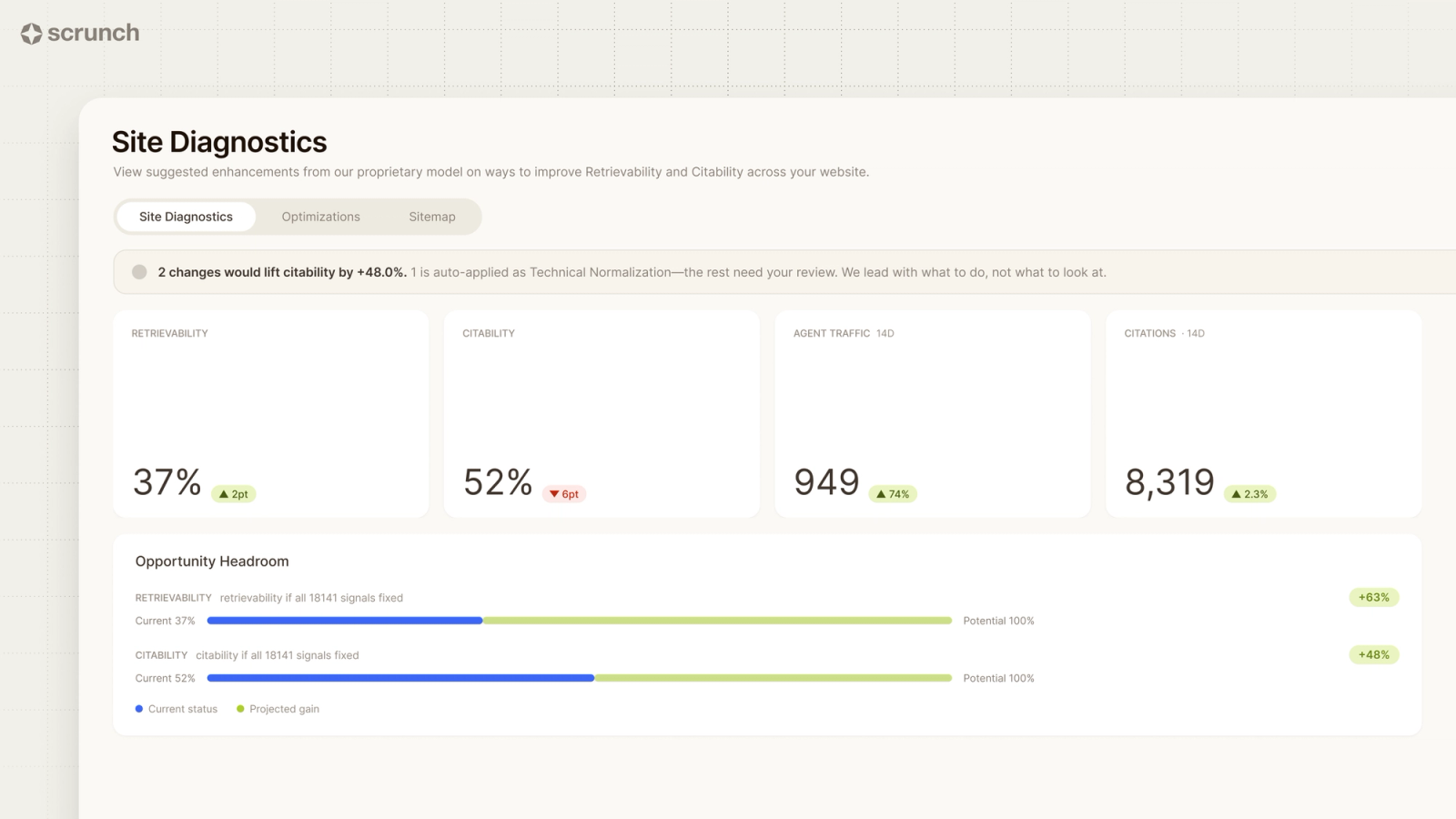
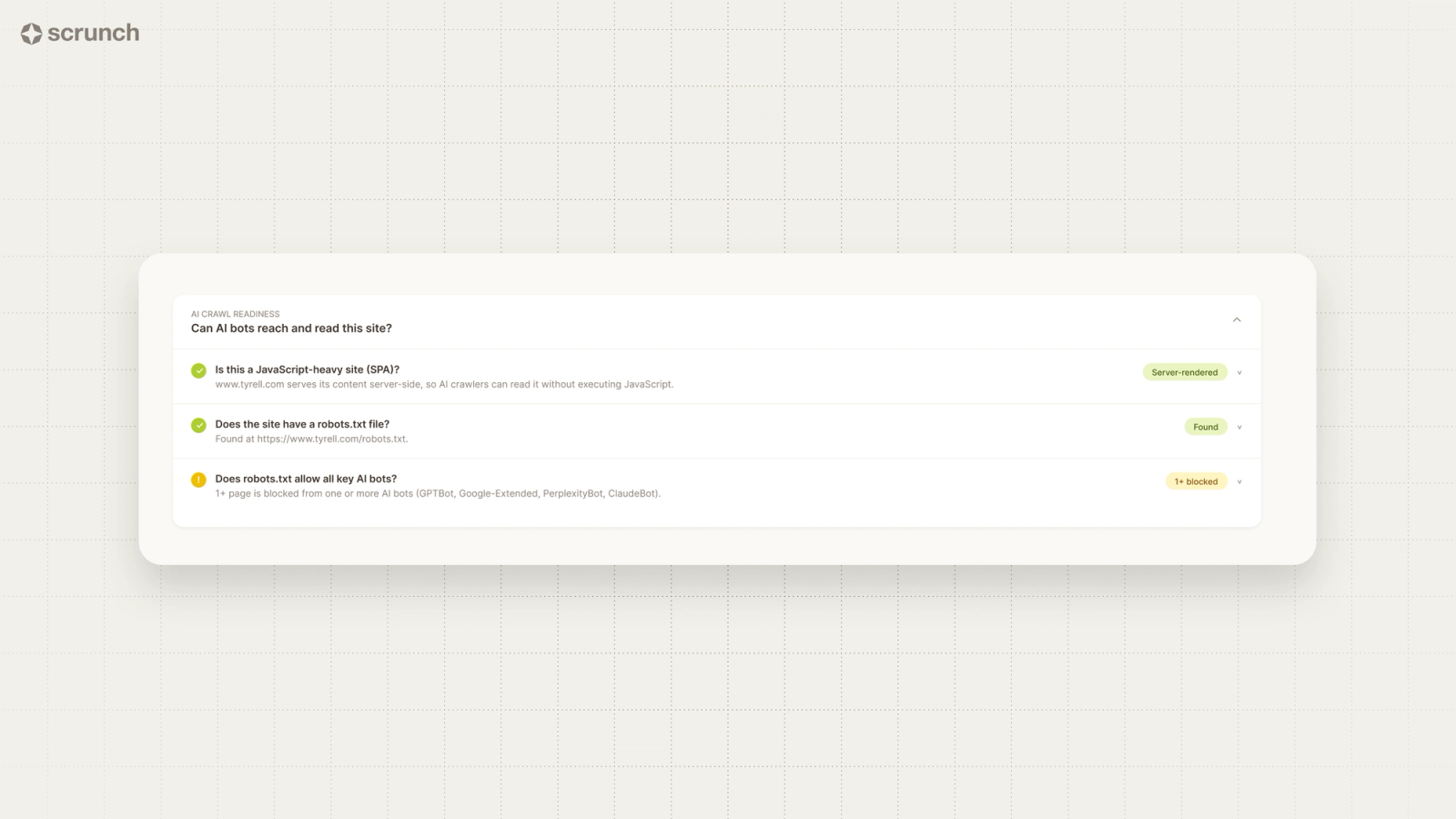
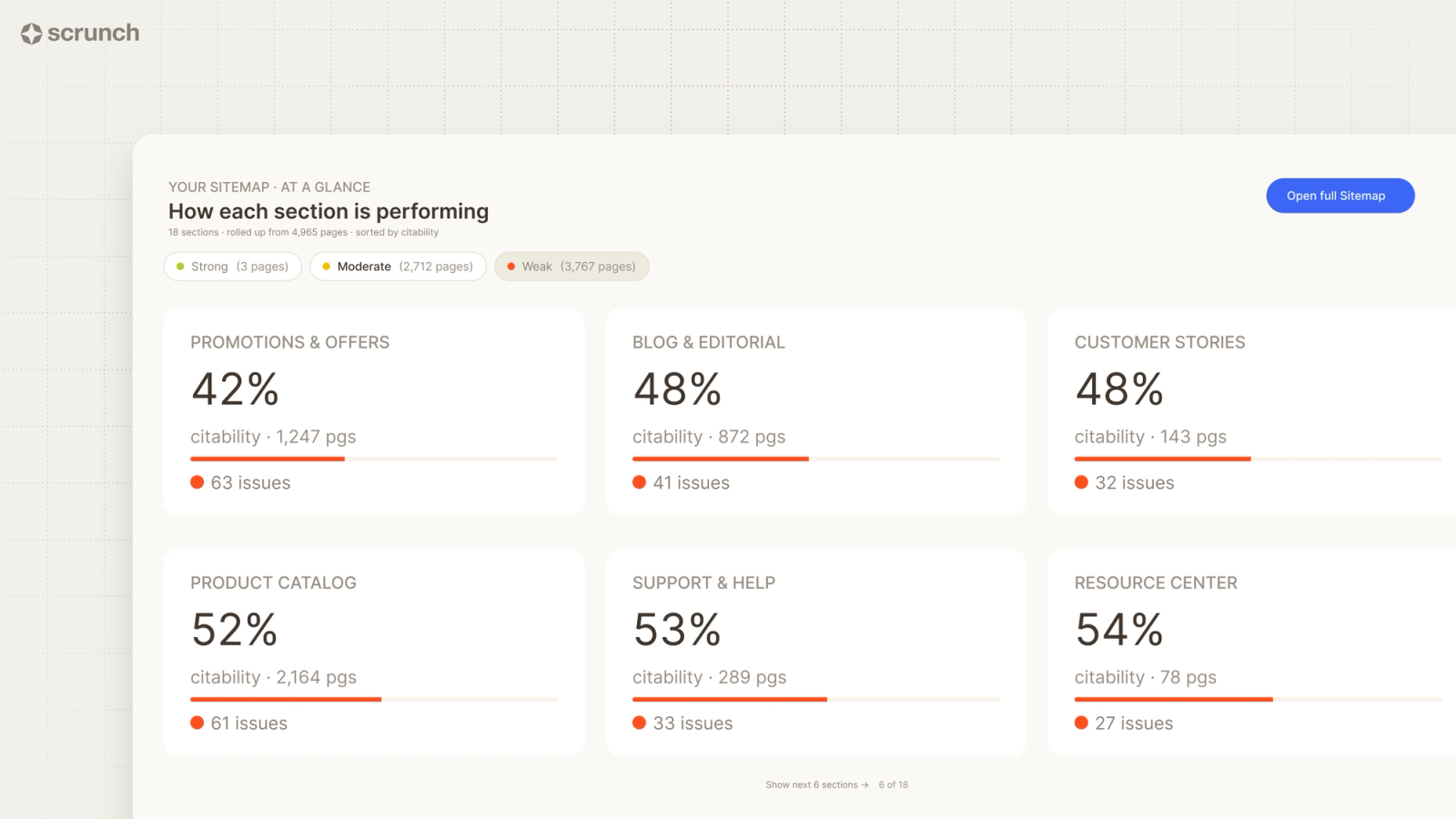
Many competitors can tell you whether a brand appeared in generated answers. Scrunch's more distinctive work begins when the question changes from “Did we show up?” to “Could the agent read us properly?” Site Diagnostics scores pages for retrievability and citability, checks rendering and bot access, groups issues by site section and ranks proposed fixes by predicted impact. Recommendations can cover technical normalization, restructuring existing material or enriching a page with approved facts.
The delivery layer is the bolder part. Universal Optimization removes scripts, trackers, layout shells and other machinery an agent does not need, producing lean HTML. Adaptive Optimization can also apply approved content changes and revisit them as the data changes. This is not invisible magic. It is infrastructure, with governance questions attached. Teams should decide who approves agent-facing copy, how parity with the human page is checked and how experiments are measured. Enterprise buyers should ask for crawl logs and before-and-after citation evidence, not a theatrical demo.
“Scrunch helped us turn AI search into a core part of our acquisition strategy.”Emmett Fear, Growth Lead at Runpod, in a Scrunch case study
A score is not a census
Every AI visibility product has the same uncomfortable limitation: platforms do not publish a complete ledger of what everybody asks. Vendors construct, collect or model a useful sample. Scrunch has added customer personas, prompt variations and a Keyword Volume Estimator based on a panel of real consumer conversations. The estimator reports weekly US volume, commercial intent, themes and a 20-week trend. Scrunch itself calls the count a calibrated estimate and recommends using it as an order-of-magnitude signal, not an exact total.
That caveat should shape the buying process. Choose prompts from sales calls, support tickets, search data and customer interviews. Separate branded questions from discovery questions. Keep a stable benchmark set, then reserve a smaller set for experiments. A graph can rise because prompts changed, models changed, collection timing changed or the market genuinely moved. The best operator documents all four possibilities before announcing victory in the Monday meeting.
Pricing: where curiosity meets procurement
The published Core plan is $250 per month after a seven-day trial. It includes 125 unique prompts, five site audits each month, one brand workspace, five users and four answer surfaces: ChatGPT, Perplexity, Google AI Overviews and Microsoft Copilot. It is enough for a focused evaluation, particularly if the team arrives with a clean question set and a shortlist of competitors.
| Decision point | Core | Enterprise |
|---|---|---|
| Price | $250 per month | Custom quote |
| AI coverage | 4 surfaces | 9 surfaces, adding Claude, Gemini, Meta AI, Google AI Mode and Grok |
| Brands and people | 1 workspace, 5 users | Custom workspaces and users |
| Site work | 5 audits and 1 page optimization per month | Full-site audits and custom optimization capacity |
| Infrastructure | Agent traffic included | AXP, API, integrations, SSO and dedicated account team |
The important capabilities around delivery, broad model coverage, SSO and custom scale live in Enterprise. Ask how prompts are counted, how frequently each model refreshes, which features are generally available, and what implementation work Content Delivery needs on your CDN. Also ask what happens to historical data if you change prompts or leave. Those details matter more than a long feature checklist.
What users like, and where it rubs
At the snapshot reviewed, G2 showed a 4.6 out of 5 rating from 71 reviews. Users repeatedly praised the interface, competitor and citation analysis, support and the ability to turn findings into content decisions. One growth marketer said Scrunch had the “best price” and the most intuitive, actionable presentation among tools tested. An enterprise SEO leader liked being able to move from reporting into URLs and domains cited for target prompts.
The complaints are useful buying notes. Reviewers mentioned limited historical data, export friction, niche coverage in Search Trends, occasional GA4 connection trouble and features arriving in the API before the dashboard. Some found initial prompt setup manual or the new metrics difficult to learn. None of this is shocking for a young category, but it argues for using the trial with your messiest real reporting task. Do not spend seven days admiring the default dashboard.
The honest test: can a strategist find one costly misconception, trace its source and assign a credible fix before the trial ends?YesPress buyer's rule
Scrunch versus the crowded field
Profound is the obvious enterprise comparison and is known for deep answer and citation analytics. Peec AI, OtterlyAI, AthenaHQ, Goodie AI and Writesonic cover overlapping monitoring needs at different price points and levels of workflow help. Ahrefs Brand Radar and Semrush appeal to teams that want AI visibility beside established search data. The market changes quickly enough that a static winner's podium would be silly.
Scrunch belongs on the shortlist when bot traffic, page diagnostics and agent-facing delivery matter alongside answer monitoring. If the job is simply a monthly mention report for a small brand, a cheaper tracker may be plenty. If the team lives inside an existing SEO suite, integration and shared data may beat specialization. Agencies should compare multi-brand economics, white-label output and seat rules. Retailers should test product and shopping analysis with their actual catalog, not a polished sample account.
Buy it if...
- AI answers influence a meaningful, high-value customer journey.
- Your team can edit content, repair technical issues and pursue off-site citations.
- You need evidence from answers, crawlers and site pages in one workflow.
Pause if...
- You want guaranteed rankings from a visibility score.
- No one owns the fixes after the dashboard finds them.
- A $250 monthly experiment would crowd out basic customer research or site hygiene.
The Sitecore chapter
Scrunch raised a $4 million seed round in 2024, a $15 million Series A in July 2025 and reported $26 million in total funding before Sitecore acquired it in June 2026. The company says it remains a standalone platform. The pairing makes strategic sense: Scrunch brings the agent-observation layer, while Sitecore already sits near enterprise content, workflows and delivery. Integration potential is not the same as a shipped integration, so buyers should judge what is available now.
Product velocity has continued. Knowledge Studio arrived in beta to turn approved internal material into maintained brand knowledge. Signals and Explorer became generally available in July. The Keyword Volume Estimator followed, and Site Diagnostics began rolling out in August. The direction is clear: Scrunch would like to become the operating system between a company's source material and the machines deciding how to describe it.
The verdict
Scrunch is most convincing when it stops behaving like an SEO scoreboard. The combination of prompt monitoring, citation archaeology, crawler observation and page-level repair gives a serious team a way to move from anxiety to a work queue. Its agent-facing delivery bet is technically interesting and demands careful governance. Its volume figures, like every modeled view of private prompt behavior, should guide priorities rather than masquerade as ground truth.
For established brands and agencies, the Core trial is a sensible laboratory. Bring real prompts, known misconceptions, competitor names and one person empowered to fix a page. If Scrunch can show why the wrong answer wins and shorten the distance to a corrected source, it has done something useful. If all you leave with is a colorful percentage, keep shopping.