The uncomfortable thing about AI search is that your brand can be discussed, compared and dismissed before a prospect visits your site. Goodie AI is built for the marketer who has discovered this fact and would now like fewer mysteries. It runs prompts across answer engines, records mentions and citations, checks sentiment and competitors, and tries to turn the resulting pile of machine talk into work a human team can actually ship.
That last part is Goodie’s reason to exist. Plenty of products can report that ChatGPT mentioned Brand A more often than Brand B. Goodie wants to identify the sources feeding that answer, suggest the page or technical signal to repair, help draft the content, and measure whether the intervention changed visibility or revenue. In its language, the loop is research, monitor, action, measure. In office language: find the problem, assign the work, check the number.
Who should invite Goodie to the Monday meeting?
The best fit is a marketing team with a real category to defend and enough operating muscle to act. Think an SEO director at a software company, an e-commerce lead worried about AI shopping recommendations, a brand manager correcting stale product claims, or an agency running AI-search programs for several clients. Goodie also makes sense when executives have begun asking whether all this AI visibility has produced a lead, a sale or anything more nourishing than a slide.
A solo consultant, pre-revenue startup or curious founder faces a harder calculation. Core costs $399 per month. That buys a full workflow, but only value if someone can edit pages, improve schema, brief writers, contact publishers and watch the results. Mostafa ElBermawy, Goodie’s founder, makes the limitation unusually plain in his own review: the product is priced for teams, carries a learning curve and cannot execute an understaffed company’s entire marketing program by itself.
You have people who can ship
- AI discovery already touches revenue
- Several models or markets matter
- You need actions and attribution
You only need a pulse check
- Your budget is experimental
- Nobody owns the fixes
- A basic mention count will do
The four-step machine
Prompt Research starts upstream. It helps teams choose questions by intent and demand instead of tracking whatever somebody typed during setup. Visibility Monitoring then watches the answers across the models included in the plan. Core covers ChatGPT, Google AI Overviews, Perplexity, AI Mode and Copilot. Pro adds surfaces such as Gemini, Alexa and Sparky, while Enterprise advertises up to 12, including Claude, Meta AI, DeepSeek and Grok.
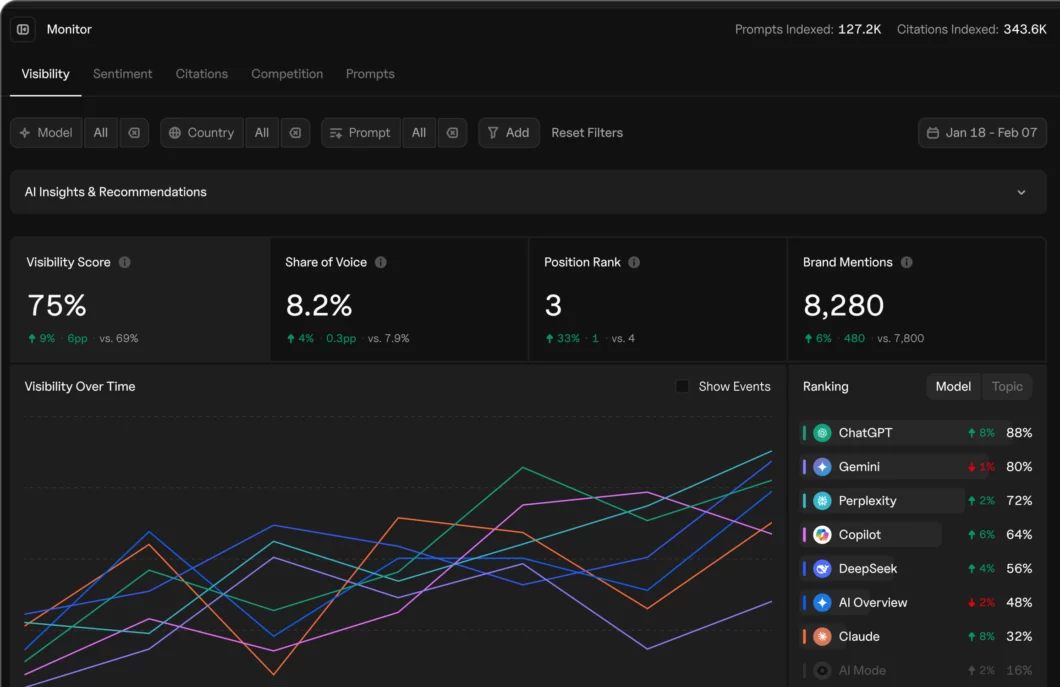
Monitoring includes citation frequency, rank position, sentiment and competitive share of voice. The more interesting screen is the Optimization Actions hub, where gaps become ranked jobs. Those jobs can concern owned pages, off-site sources, structured data, crawler access or content. Enterprise teams can export work to Jira. The Content Studio drafts articles and FAQs around a detected gap rather than acting as a general copy fountain.
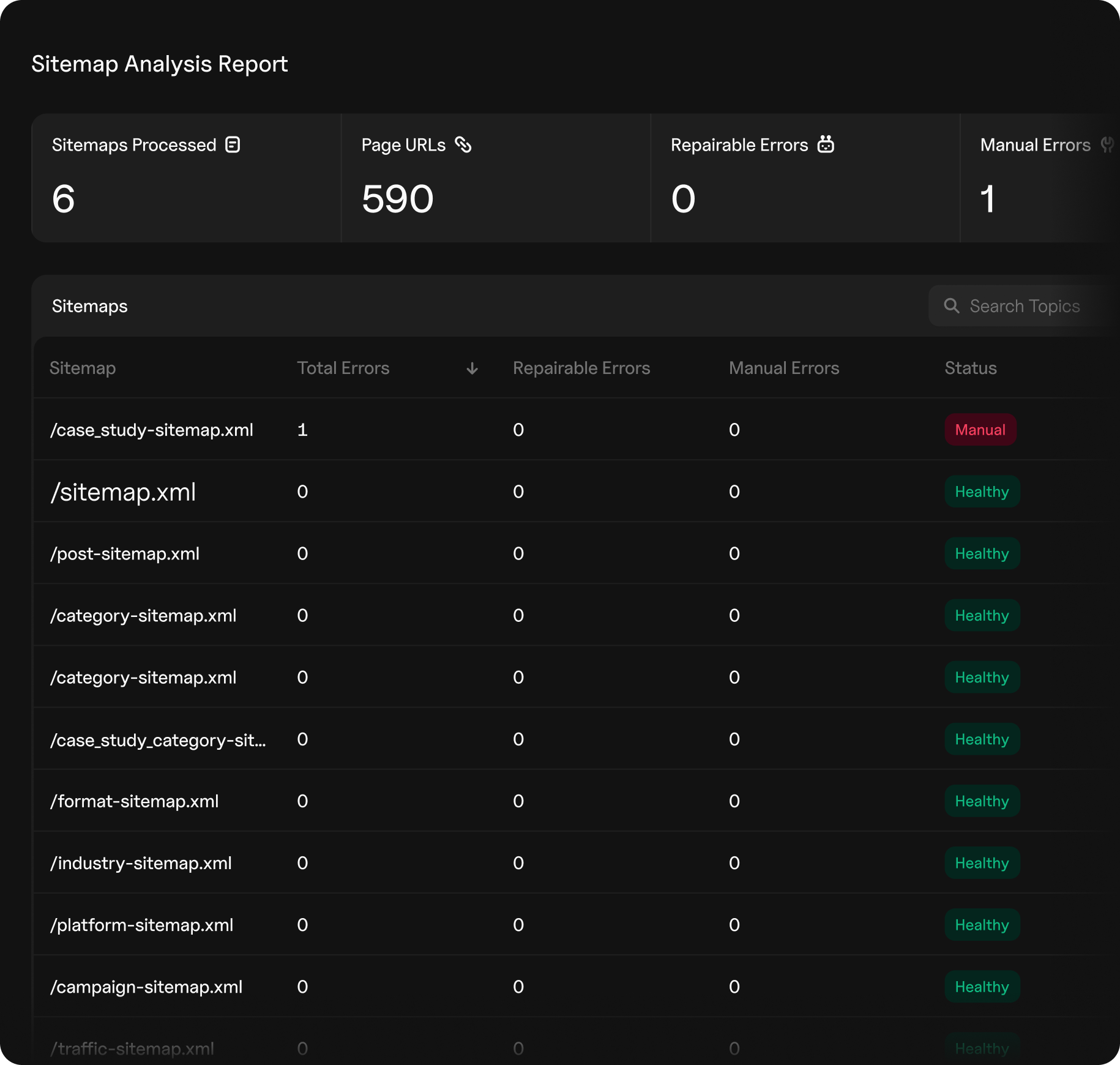
Two specialist modules widen the brief. Agent Experience shows which AI crawlers reach a site and where signals such as sitemaps, structure, robots rules or llms.txt need attention. Agentic Commerce tracks product discovery at SKU level in AI shopping experiences. Brand Command, introduced in August 2026, lets a team approve a set of brand facts, checks AI answers against that source of truth, and flags inaccurate claims or recommendations lost to a rival.
“This platform tells me where my revenue is.”Verified Goodie user on G2, August 2026
The dashboard is not the result
Goodie’s sharpest product decision is to treat measurement as an ending, not an opening flourish. Its analytics layer connects visibility to Google Analytics on Core, with broader attribution and integrations higher up the range. The company frames the problem well: an AI answer may shape a purchase even when the customer later arrives through direct traffic or branded search. Revenue Attribution tries to model that influence alongside the easier trail of AI-referred sessions and conversions.
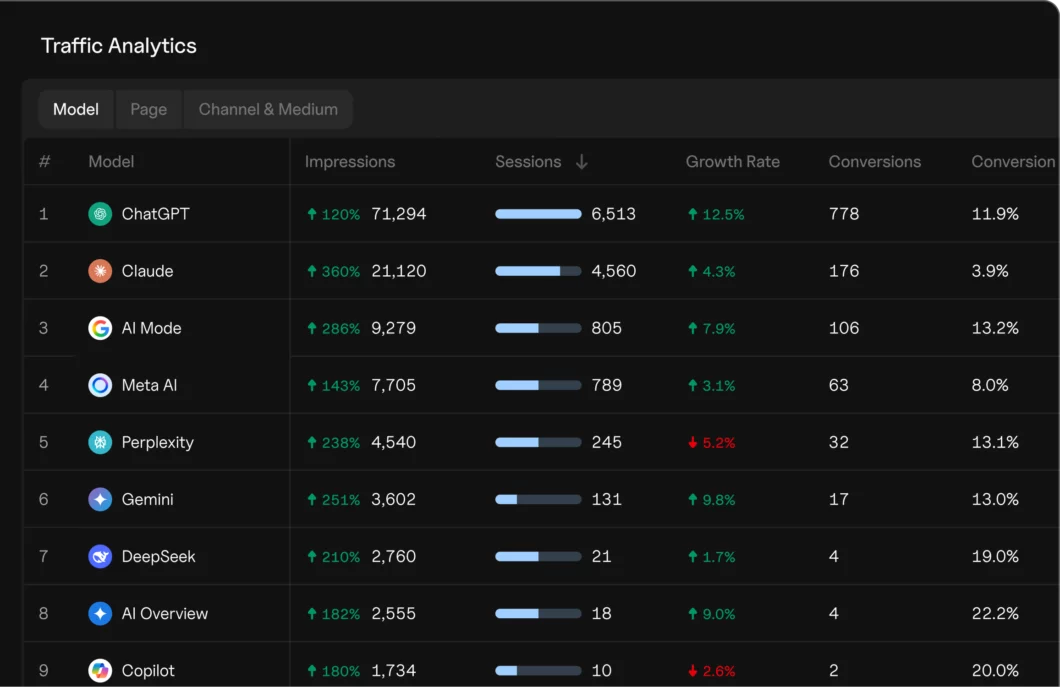
Buyers should keep their skepticism switched on. Attribution in a zero-click journey is partly inference. Goodie’s own writing says it looks at correlation, lift and contribution rather than pretending every influence is directly trackable. That honesty matters. A chart can organize evidence, but it cannot turn a fuzzy path into a receipt from the universe.
Results, with the asterisks attached
Goodie publishes substantial case studies, which is more useful than a carousel of floating logos. SteelSeries reports a 3.2-times increase in AI-search conversions over six months and visibility gains across ChatGPT, Gemini and Perplexity. Dermalogica reports an 85 percent rise in AI-driven sessions, a 127 percent rise in conversions and 2.5-times the competitive visibility average for priority categories. Rathbones reports a 106 percent increase in total AI citations.
All figures are reported by Goodie in customer case studies. They are outcomes from named programs, not guaranteed benchmarks.
NoGood, the growth agency also founded by ElBermawy, reports 335 percent growth in AI-sourced traffic and 48 high-value leads in one quarter. It is a revealing example of the workflow, but an affiliated one. The independent review pool remains small. G2 showed two reviews when we checked, both five-star. One praised navigable dashboards and revenue measurement; another highlighted model tracking, crawler tools and llms.txt generation. Encouraging, yes. A census, no.
The case-study playbook is consistent. Find the prompts that matter, identify the domains models repeatedly cite, repair weak product or category pages, improve technical readability, and measure changes. This is less sorcery than disciplined digital marketing with a new set of observers. That may be Goodie’s most reassuring quality.
What your money buys
| Plan | Monthly price | Useful limits | Best fit |
|---|---|---|---|
| Core | $399 | 100 prompts, 10 actions, 3 seats, 5 core surfaces | One brand starting a serious program |
| Pro | $999 | 250 prompts, 30 actions, 5 seats, commerce and demand research | AEO as an active growth channel |
| Enterprise | Custom | 500+ prompts, 60+ actions, 10+ seats, up to 12 models | Regions, brands and governance |
| Agency Growth | $350* | 10 pitch workspaces, unlimited seats | Agencies proving demand before a sale |
Current public pricing researched September 2026. Annual billing advertises two months free. Agency Growth is billed quarterly or annually; full client workspaces cost extra and start at $399 per month.
Core is self-serve with a trial. Pro and Enterprise begin with a sales conversation. Every brand tier includes the closed loop, Google Analytics revenue attribution and MCP server access; the ceilings, surfaces and support change. Goodie’s seven-day agency pitch workspace is a clever wrinkle. It lets an agency gather a prospect’s baseline before asking that prospect to fund a complete workspace.
Goodie versus the crowded shelf
The market includes Profound, Peec AI, Scrunch AI, AthenaHQ, Otterly, Writesonic, AirOps, Semrush and a growing row of smaller trackers. Choosing by logo is hopeless. Choose by bottleneck. Peec and Otterly are common candidates when a team mainly wants monitoring. Scrunch emphasizes how agents experience a site. Writesonic and AirOps have deeper roots in content production. Semrush makes sense for teams that prize a broader SEO suite, while HubSpot’s tooling appeals to buyers already living in its CRM.
YesPress editorial assessment, based on published capabilities, pricing, case studies and the available review pool.
Goodie’s distinction is breadth inside one AEO workflow. Prompt discovery, daily visibility, actions, crawler diagnostics, commerce, content, brand accuracy and attribution can live in the same workspace. The cost of that breadth is cost itself, plus onboarding and operational commitment. If your need is “tell me whether Claude mentioned us,” this is a large machine for a small errand.
The buyer’s five-question test
Before booking the demo, list the models and markets that genuinely influence your customers. Estimate the prompts needed to cover products, categories and competitors. Name the person who will own technical fixes, the person who will own content, and the person who will defend the attribution method. Then ask Goodie to demonstrate one complete chain using your brand: prompt, answer, citation, recommended action and measured outcome.
Also ask how often each model is sampled, how volatility is handled, which capabilities are live on your tier, and how historical data behaves when prompts change. AI answers vary from run to run. A single result can be a mood; a repeated trend is the material. Finally, price the client workspaces, extra scale and internal labor, not merely the subscription.
Goodie is most convincing when it behaves like an operating system for an actual team. It is least convincing as an expensive weather vane. The product’s central observation survives every acronym in this young category: knowing the machine’s opinion is useful only when somebody knows what to do on Tuesday morning.