Ramp had a problem that would have sounded peculiar a few years earlier. The financial software company existed. Its accounts-payable product existed. Yet when AI systems discussed that category, Ramp barely appeared. In Profound’s published case study, its visibility stood at 3.2%. A business could occupy a perfectly respectable corner of the internet and remain a stranger to the machine introducing buyers to it.
- Profound measures which brands AI answers mention and which pages they cite.
- Its tools connect that evidence to content research, crawler analysis and automated workflows.
- The practical lesson: investigate the missing answer before ordering more content.
This is the opening Profound found. Traditional search gives marketers a page of competitors to inspect. An answer engine gives the customer a composed recommendation. The marketer’s uncomfortable question becomes: who supplied the information, and why did somebody else get invited?
The missing name
James Cadwallader and Dylan Babbs founded Profound in August 2024 after meeting at South Park Commons. Cadwallader became CEO; Babbs, CTO. Their starting proposition was unusually specific: companies would need to understand how AI described them. Before selling a way to improve that description, they needed a way to observe it.

Answer Engine Insights sends prompts to answer engines and records their responses. It examines mentions, sentiment and citations across the chosen questions. Its visibility score divides responses mentioning a brand by responses mentioning at least one brand. That denominator matters. The figure describes a monitored sample, rather than every conversation happening inside ChatGPT.
Think of it as a recurring mystery-shopper exercise. Ask the questions prospective customers might ask; inspect the answers; repeat. The quality of the experiment depends partly on the questions. Monitoring only prompts containing your company’s name would be rather like surveying a fan club about name recognition.
Follow the citation
Ramp used Profound to investigate which material answer engines cited. Automation and comparison content offered clues. The team created pages addressing accounts-payable software for small and large businesses. The case study reports more than 300 citations for the two pages and visibility rising to 22.2% within a month.
The claim comes from the vendor, not a controlled experiment. Still, the sequence is instructive: locate an omission, study the cited material, answer a more precise buying question, measure again. The useful thing to copy is the investigative habit. Publishing another broad article because the calendar demands one misses the point.
Prompt Volumes adds conversation-derived keyword and intent data to help choose those questions. Agent Analytics examines a different part of the chain: which AI crawlers visit a website and which human visitors arrive from AI services. A crawler visit, a citation and a referral each describe a different event. Confusing them makes an impressive report and a poor diagnosis.
The dashboard’s unfinished business
Profound’s own account of its expansion identifies a mundane obstacle. Customers learned something in the platform, then exported data into other systems to act on it. Measurement had improved; the distance between discovery and execution remained.
“You logged in, found insights, decided what to do, then went elsewhere to act.”
Dylan Babbs, May 2026 product post
The answer was to connect analytics to Agents: editable workflows for research, writing, content refreshes and publishing. A marketer can combine steps for scraping pages, consulting visibility data and drafting material. Brand guidelines supply context; human approval supplies judgment. Sheets lets teams process many inputs while retaining access to intermediate results.
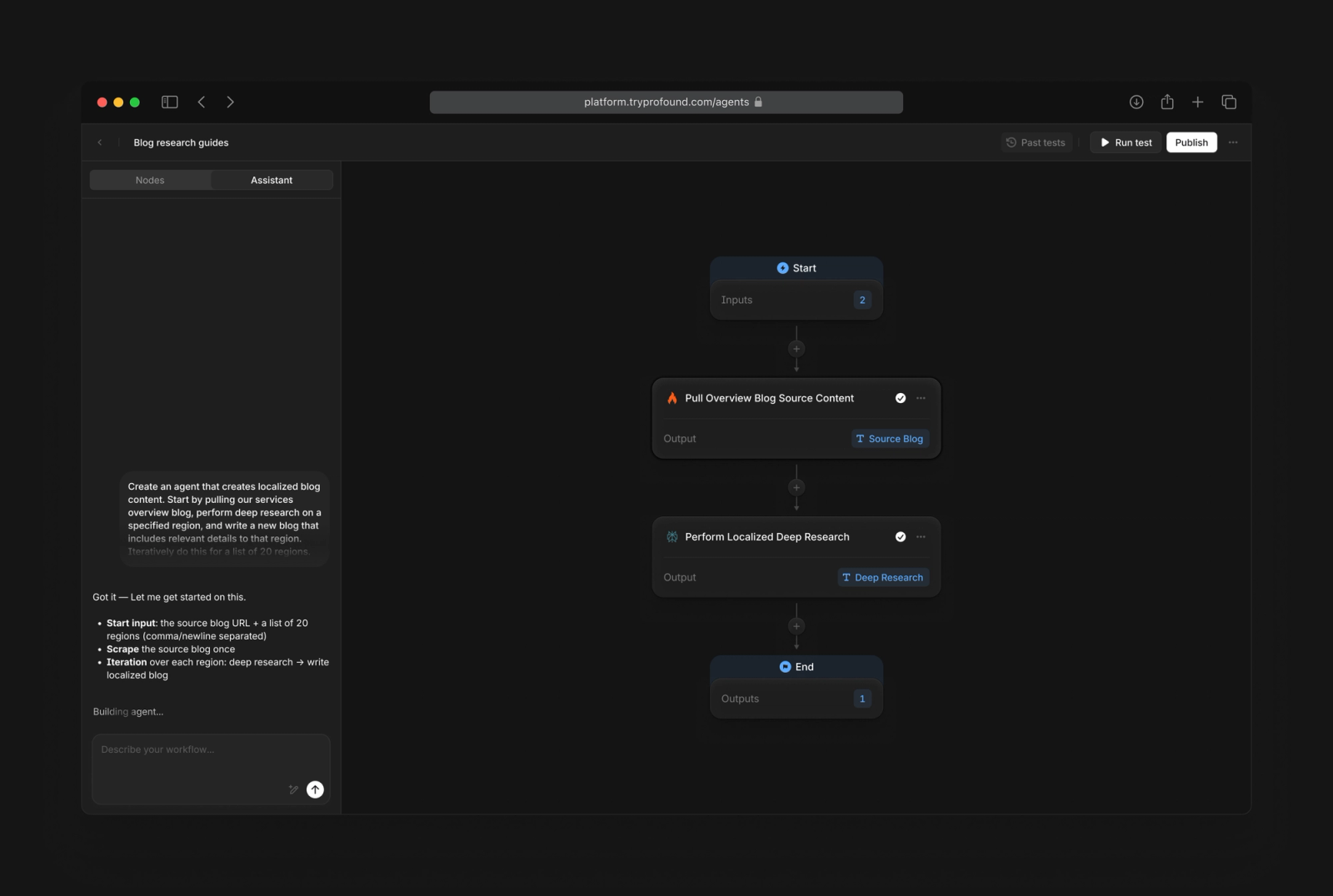
By September 2026, Profound had introduced AI Marketer, or Aim, as an agent orchestrator. The ambition had widened from observing AI search to supporting marketing functions with shared brand context. That is a consequential expansion: the product now competes for the place where work happens, as well as the place where results are counted.
A crowded shortlist
Profound sells subscriptions to brands and agencies. Its published brand plans list Starter at $99 a month and Growth at $399, with custom Enterprise pricing and annual billing options. Starter tracks ChatGPT; Growth covers three answer engines. Agent runs consume credits. Buyers are purchasing a defined scope of observation and work, so prompt limits and engine coverage belong in the decision.
The category has company. Peec AI tracks visibility, position, sentiment and citations. Scrunch also addresses AI presence and website optimization. Profound’s proposition combines answer measurement, conversation-demand data, crawler analytics and execution. Those capabilities should be compared against actual requirements, rather than treated as proof that one vendor owns the category.
The September funding announcement reports more than 1,000 enterprise brands, including Walmart, Estée Lauder, Royal Bank of Canada, Zoom and Figma. A $180 million Series D valued Profound at $1.8 billion. The customer mix explains its attention to workflows and governance: a global retailer and a software company have different products, but both need a defensible account of what their marketing machinery is doing.
What the score cannot promise
The sensible first experiment is small. Choose one commercially meaningful topic, preserve the prompt set, inspect the cited pages and improve a specific omission. Then compare mentions with referrals and conversions. A changing question set can make a changing score difficult to interpret.
Technical access matters too. Profound’s Pages documentation points out that content rendered through client-side JavaScript can be invisible to bots. A lovely page that the crawler cannot read has rather limited powers of persuasion. More generated prose will not repair that access problem.
Nor does producing content guarantee a recommendation. The company controls its software; answer engines control their answers. Profound’s appeal lies in making the gap between those two things inspectable. Its broader bet is that marketers will pay to shorten it. The enduring skill belongs to the human who decides which gap is worth closing.