The call arrives with no patience for novelty. Somewhere, a person has a question about a balance. Somewhere else, a lender wants the question answered quickly, consistently and within a thicket of rules. Between them sits a voice that may not belong to a person at all. It must listen, respond, know when to stop and leave a trail that a compliance team can inspect later. A fluid demo is the easy scene. The contract is where the plot thickens.
Prateek Gupta has spent most of his working life in that thickened plot. He joined the company now known as Skit.ai in 2016, its founding year, after a short spell in marketing and strategy at Wooqer. The business was then called Vernacular.ai, a name that announced its first ambition neatly: make voice technology work across the languages and accents of India. A decade later, Gupta is a founding member and sales lead in New York, selling AI into collections, one of enterprise software's least forgiving rooms.
There are shinier places to put a talking machine. Collections involves consent, identity, payment, disputes and people who may have no desire to be called. Its customers do not merely ask whether the software can talk. They ask whether it can handle volume, follow policy, connect with existing systems, improve recovery and avoid making tomorrow's legal meeting more exciting than anyone planned.
“In a typical Skit.ai sales process, conversion ratios are small but build over time.”Prateek Gupta, on opening a market for conversational AI
01 / An engineer learns the buyer's language
Before the talking machine, there was a small car that could read the road
Gupta studied at the Indian Institute of Technology Roorkee from 2012 to 2016. His student work already showed an appetite for automation with consequences in the physical world. One project turned an ordinary energy meter into a connected device for remote monitoring, theft detection and power cut-off. Another was an automated vehicle prototype that recognized traffic signals and directional symbols, using digital image processing in MATLAB, infrared and ultrasonic sensors, and an Arduino controller.
The vehicle won first prize at Srishti 2014, IIT Roorkee's annual techno-hobbies exhibition. It is a charmingly literal prelude to his career: a machine observes a signal, works out what it means and decides whether to go, wait or turn. Enterprise sales adds more people, more spreadsheets and better coffee, but often asks for precisely the same sequence.
After graduation came seven months at Wooqer and then the long bet. Gupta did not hop from one fashionable acronym to the next. He stayed as Vernacular.ai became Skit.ai, as the company pushed into the United States, and as its wide conversational-AI proposition narrowed toward collections. In 2021, when Skit announced its $23 million Series B, he described the journey as “amazing” and looked forward to building the company further. The funding made a loud milestone. The quieter story is the continuity on either side of it.
IIT Roorkee, with award-winning work in automation and embedded systems.
A brief marketing and strategy role at Wooqer, followed by the founding team at Vernacular.ai.
The business, now Skit.ai, announces a $23 million Series B and accelerates its international push.
As director of sales, Gupta lays out his thinking on pricing, early adopters and compliance.
Skit.ai names Gupta as a representative at ARM Tech in Dallas, deep inside the collections industry.
02 / The patient sale
The first customer buys the software. The useful customer explains it to the second.
Gupta's account of enterprise sales is wonderfully short on magic. Educating a young market takes time. Conversion ratios begin small. The company finds early adopters, works to make them successful, and hopes they become evangelists. Talking with prospective customers teaches the seller about the industry while teaching the industry about the product. Educational content carries the explanation farther than a sales team can travel.
This is category creation without the ceremonial fog. A buyer in a regulated industry is not waiting to be dazzled. The buyer is waiting to learn whether another company with similar constraints tried the product and lived to recommend it. An early adopter therefore does double duty: customer and translator. The testimonial matters because the person giving it knows which ugly questions came after the handsome demo.
“Delivering value to customers is the only way to achieve long-term success.”Gupta on pricing conversational AI
His pricing rule is just as plain. Different industries define value differently, so Skit.ai tries to quantify a buyer's perceived value in dollars and charge a fraction of it. The company also watches gross margins and avoids pricing wars. This sounds obvious until one remembers how often new software is priced according to anxiety: a competitor discounts, a quarterly target looms, and suddenly strategy is a coupon with a logo.
The value ladder, in Gupta's own commercial logic
Conceptual, not financial data. The principle: quantify value, then charge a sustainable fraction.
His preferred markets have many interactions between institutions and customers, initially clustered around a limited set of use cases. Better and faster model fine-tuning should loosen that second constraint. In Gupta's telling, any industry with enough interactions may become viable, but underserved markets deserve priority. Falling generative-AI costs could eventually open price-sensitive geographies too.
03 / The rules are part of the product
A bot can learn a broader conversation. Regulation keeps changing the subject.
Gupta is enthusiastic about what generative AI and faster streaming text-to-speech have changed. Bots can range across more subjects; the pause between analysis and reply has shrunk; exchanges feel less mechanical. Yet the part of his public thinking that lingers is not about fluency. It is about boundaries.
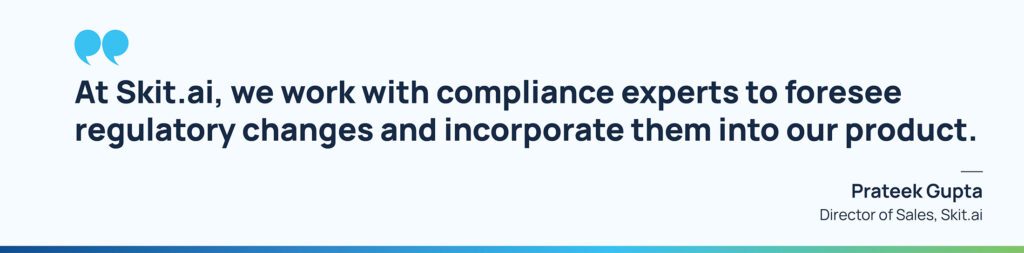
Regulation evolves for reasons that may have little to do with one vendor or niche, but smaller companies must still absorb the result. Gupta calls this a source of delay. Skit.ai's response, he says, is to engage compliance experts continuously and to have product owners develop internal expertise, since they understand the machinery closely enough to know where a rule must become a feature. Compliance, in this arrangement, is not a certificate framed in reception. It is maintenance.
Even the familiar claim that robocalls are simply illegal is, in his view, a headline in need of fine print. Permission and prior express consent matter. So does the exact activity, channel and jurisdiction. The sales job is partly corrective: explain what the technology does, what the law allows, and which controls keep those two things acquainted.
This may be why collections became such a revealing market for Skit.ai. The work is repetitive enough for automation to matter and sensitive enough that automation cannot be casual. A successful system must combine reach with restraint. It must make more conversations possible while preserving a route to a human when the conversation ceases to be routine.
04 / The long middle
Ten years at one startup is less a straight line than a collection of careful turns
The names tell part of it. Vernacular.ai spoke to language. Skit.ai gave the company room to travel. Its present focus speaks to specialization: collections, multichannel outreach, regulated consumer contact. Gupta has occupied the commercial side through those turns, carrying technical possibility toward people whose professional reflex is to ask what could go wrong.
He is not the loudest figure in the company's public story. Co-founders and chief executives tend to collect the origin myths. Gupta's record is the less cinematic business of remaining: from an early team in Bengaluru to enterprise conversations in New York; from broad voice automation to a sharper vertical; from a student robot that obeyed road signs to systems expected to obey policy.
Remaining does not mean standing still. The product vocabulary around him changed from speech recognition and vernacular access to generative AI, omnichannel orchestration and collection intelligence. The customer map crossed an ocean. The questions moved from whether a machine could understand a caller to whether it could negotiate a useful next step across voice, text, email and chat. Each expansion created another department with reason to care. An engineer asks about latency. An operations leader asks about throughput. Finance asks about recovery and margin. Compliance asks to see the controls. Sales has to make those questions coexist without pretending they are the same question. Gupta's public answers keep returning to the one currency every department recognizes: demonstrated value, earned slowly enough to survive scrutiny.
There is an aspiration visible in his comments, though it arrives dressed as market analysis. As model costs fall, more price-sensitive markets become reachable. As fine-tuning improves, the number of useful cases expands. Underserved industries with heavy interaction volumes move closer to the front of the queue. The ambition is broad; the method remains narrow. Find the use case. Learn the rules. Prove the value. Let the customer tell the next customer.
The machine on the phone may sound increasingly natural. Gupta's decade suggests that natural speech is only the opening line. The rest of the conversation belongs to economics, trust and the patient accumulation of permission. In enterprise AI, the future often arrives as a familiar voice followed by a very long procurement form.