The dent came before the deal. A young founder named Jason Lin had driven to the Sanas office to discuss what might become an acquisition. He was nervous, turned too sharply in the parking lot, and clipped a stealth-black Range Rover. The car belonged to Anant Singh, then Sanas’s vice president of sales. In the meeting, Lin was thinking less about language software than about insurance deductibles and professional ruin.
That evening, Singh sent him a photograph of the damage and a note. There was no need to feel bad, he wrote. One day, when they had a working demo, they would frame the moment. He called it a happy accident. The acquisition went ahead. Lin and his co-founder joined Sanas to work on instant voice translation. And the photograph of the dent, true to Singh’s promise, acquired a frame and a place in the office.
This is an oddly useful introduction to a sales executive. Revenue leaders are generally presented through clean funnels, rising curves and verbs with their sleeves rolled up. Singh’s parking-lot episode offers something more revealing: he recognized that a frightened person and an awkward moment mattered more than a pristine door panel. Later, he joked that the story was not an invitation for future founders to hit his car. “Please innovate responsibly,” he advised. Grace first, punchline second, business eventually.
The listener has a job, too
Singh is now Chief Sales Officer and a founding member of Sanas, a Palo Alto company whose software changes speech as it travels through a call. It can translate an accent in real time, remove background noise and carry speech between languages while attempting to preserve the speaker’s own voice. The technology lives in a sensitive neighborhood. An accent is sound, but it is also biography. Alter it carelessly and convenience begins to resemble correction.
Singh’s answer is to move responsibility away from the speaker. The old contact-center ritual was accent training: teach an agent to sand away the audible evidence of where they came from, sometimes pair the new voice with a Western name, then call the performance “neutral.” Sanas says the listener should receive greater clarity without asking the agent to rehearse a different identity. The software sits between two people and handles friction neither should have to carry alone.
It is a distinction Singh repeats because his own career began on those calls. He has described the work as draining and thankless, a job in which millions of agents face verbal abuse while trying to help strangers. When executives discuss automating service, he keeps returning to the stubborn human reason for the call. People want a problem solved, certainly. They also want to be heard. Remove the second need and the first may become faster, yet trust slowly leaks out of the relationship.
The sales argument has three channels
That makes Singh’s sales pitch both practical and philosophical. The practical ledger contains fewer repetitions, transfers and dropped calls; wider hiring pools; less accent training; and agents who sound clear in a busy room. The other ledger records confidence, cultural identity and relief. Buyers can budget for the first. The second explains why the product exists.
A number with a human voice
At a customer town hall, Singh heard an agent say that it had been 45 days since they were last abused on a call. The remark stayed with him. In enterprise software, 45 is the sort of number normally followed by “percent,” converted into a slide and given an optimistic arrow. Here it measured quiet: a month and a half without a stranger turning the agent’s voice into an excuse for cruelty.
Singh said the moment changed the scale of the problem for his team. They were not only improving operations; they were restoring dignity. The word can sound suspiciously grand in a product demonstration. From an agent describing 45 ordinary days, it becomes exact. A calmer shift is not an abstract mission. It is Tuesday without an insult.
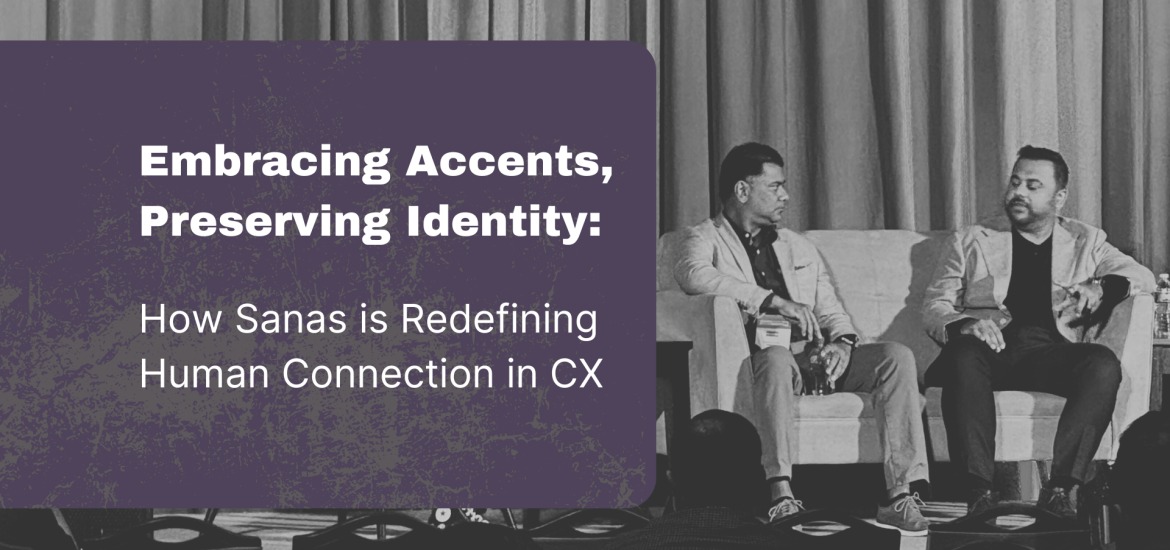
The message travels because Singh can connect the moral argument to an operating one. He worked at Akamai Technologies, where his LinkedIn record lists sales honors in 2016 and 2018, then helped shape sales at Observe.AI. Sharath Keshava Narayana, the Sanas chief executive and an Observe.AI co-founder, has known him for roughly 15 years. Narayana describes Singh as the person he calls when a startup must graduate from founder-led selling to a dedicated sales leader.
That handoff is delicate. A founder sells possibility from memory and instinct. A sales organization must make the story repeatable without embalming it in process. Singh’s role has been to build the machine while keeping the original grievance visible: brilliant people are judged by the sound of their speech before anyone bothers to weigh what they know.
The commercial results arrived. Narayana credited Singh with a pivotal role as Sanas moved from zero to $12 million in annual recurring revenue over five quarters. Singh later celebrated the company crossing $20 million in annual revenue. By 2025, Sanas said adoption had passed 750,000 users globally. In 2026, Inc. ranked it No. 8 among America’s fastest-growing private companies, with reported three-year growth of 17,426 percent.
Numbers that large tend to flatten the people who made them. Singh pushes in the other direction. When he wrote about the $20 million milestone, he called it a privilege and immediately returned to agents. He was not coy about ambition. He simply located the value of growth in the lives reached, not in the pleasing roundness of the number.
The controversy inside the product
Accent translation attracts suspicion for good reason. Technology has often made difference legible by making it disappear. A product that can alter the sound of a person’s speech invites questions about conformity, bias and who gets to decide which voice is easiest on the ear. Sanas encountered blunt versions of those objections. Singh has written about rooms in which the team was dismissed before it finished explaining the mission.
His response is neither to pretend the tension is imaginary nor to abandon the category. Instead, he stresses choice, authenticity and augmentation. The aim, as he tells it, is not to replace the contact-center worker with a synthetic agent or to make a Filipino speaker perform an American character. It is to let talent pass through a telephone line with less distortion from noise and prejudice.
This position has consequences for product design and sales language. Tone, emotion and the small irregularities that make a voice recognizable cannot be treated as debris. Clarity without those qualities would be a polished failure. The phrase Singh and his colleagues favor is “voice authenticity,” a technical goal carrying a moral burden: improve intelligibility while keeping the speaker audible as themselves.
Beyond the single accent
Sanas has widened its scope from accent translation to a speech platform that includes language translation, speech enhancement and noise cancellation. In public conversations, Singh now talks about communication between regions and languages, not only one agent speaking to one customer. The ambition is easy to state and difficult to engineer: two people should be able to speak differently and still meet in the same conversation, with the voice on each side retaining its owner.
The company’s geography follows that ambition. Contact centers in India and the Philippines gave Sanas a proving ground. Enterprise customers took the product into more industries and territories. Singh, based in San Francisco, became the commercial bridge between a Palo Alto technical team, global service providers and the agents whose daily experience decides whether the system feels helpful or imposed.
His public persona is unusually consistent with that bridge. Colleagues describe contagious energy. One remembered the nickname “Rocket Singh.” The car story reveals a taste for turning mishap into lore. A separate bit of office life involves watches: Singh helped Narayana develop an interest in them and, years later, helped him find a Rolex Daytona to mark Sanas reaching $50 million in annual recurring revenue. These are small details, but operators are made of small details. The work is a sequence of calls, introductions, remembered promises and occasions worth marking.
The framed dent is the better emblem. It commemorates neither the automobile nor the acquisition by itself. It marks a moment when Singh could have made another person feel smaller and chose not to. For someone selling the right to be understood without humiliation, the gesture has the pleasing shape of internal consistency.
What remains after the software
Speech AI works in milliseconds. Trust takes longer. Singh’s career sits between those clocks. He has to persuade large companies that an unfamiliar layer of technology can survive procurement, security review and daily use. He also has to make the case that efficiency need not become another polite word for removing people.
His answer is that the human conversation remains the product. Software can strip out the barking dog, soften a communication barrier or carry a sentence into another language. It cannot manufacture the relief of reaching someone who listens. The technology earns its place by helping that moment arrive with less effort.
This is why Singh’s strongest sales material is not a feature list. It is an agent counting days without abuse, a founder forgiven before a deal was signed, and a customer who does not have to ask for the third repetition. The business of being understood turns out to be full of numbers. Its meaning lives in the pauses between them.