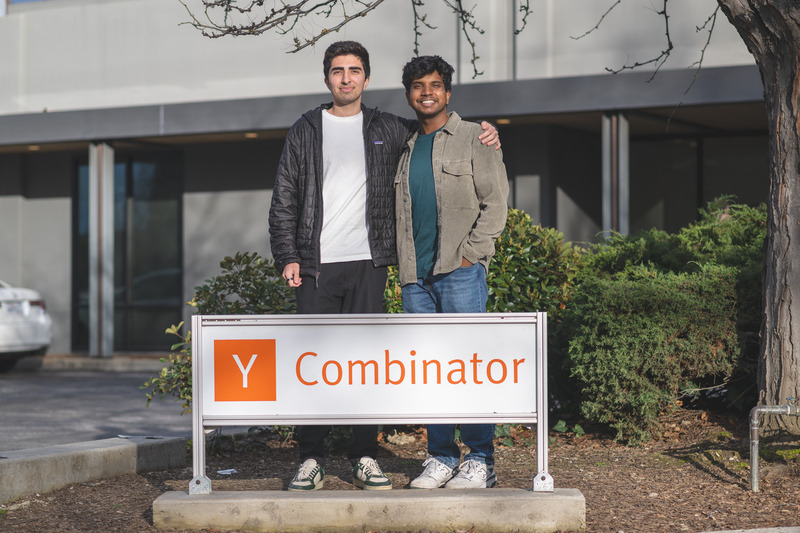
The first week of the new plan involved 27 building suppliers around San Francisco. Praneeth Guduguntla and his co-founder, Arman Rafati, went door to door. They were not carrying a triumphant launch story. They had just reached the end of Y Combinator’s Winter 2024 batch with a construction product that, in Guduguntla’s own blunt accounting, nobody really needed. An elegant answer had arrived before a durable question.
There are gentler ways to discover this. A quiet churn chart. A politely unused feature. A sales call that ends with “circle back.” Guduguntla and Rafati chose a noisier correction. Over the next six months they visited factories, warehouses and offices across 13 states, meeting 263 C-suite executives. Some represented Fortune 100 companies. Others ran family businesses. The founders took long drives and multiple flights for meetings that could last half an hour.
The mileage changed more than their product. It changed their grammar. “What’s your biggest problem?” was too roomy; people filled it with respectable abstractions. A question about what happened last week when an order was delayed demanded a scene. It had actors, a sequence and consequences. The answer could not float above the work.
“The real stuff happens on the floor, not the boardroom.”Praneeth Guduguntla
A builder before the company
Guduguntla’s instinct to move between code and the person using it appeared early. At the University of Illinois Urbana-Champaign, where he studied computer science, he made Spotify Party, an open-source Chrome extension that let friends listen together from separate devices. It included synchronized playback, messaging and a Node.js backend using realtime web sockets. His LinkedIn project description reported more than 1,200 weekly users. It was social software in the literal sense: a machine for being in the same room while apart.
He also wrote about artificial intelligence before every product acquired an AI adjective. In 2021, his essays explained how sound becomes data, how recurrent neural networks process sequences and how machine learning can remove background noise. HackerNoon named him its Contributor of the Year in Artificial Intelligence. The writing is technical without dressing the machinery in mystery. Filters have tradeoffs. Neural networks have memory problems. Computation comes with latency. Magic, on inspection, has a budget.
At Hack4Impact, he served as product manager on a platform for KadaKareer, an organization helping students in the Philippines build career knowledge and work experience through virtual apprenticeships. The existing program sprawled across email, Discord and Google Drive. The student team’s job was to gather those pieces into one navigable place. Here was another recurring Guduguntla problem: useful information exists, but the route to it is needlessly fractured.
The PDF was larger than the pitch
Guduguntla and Rafati met as freshmen at UIUC. They built software for nonprofits and later made generative AI apps used by more than 50,000 people. Their professional apprenticeships supplied another useful contrast. Rafati worked at Mercury, Affirm and Amazon Web Services. Guduguntla built AI video editing tooling for Facebook Reels at Meta, then computer-vision annotation tools at Palantir. At Palantir he also worked on AI for a Fortune 50 manufacturer, an experience that would become more important after their first startup idea met reality.
Their YC company began as Glimmer, a natural-language search tool for enormous PDFs. Its origin story featured a commercial HVAC project manager named James and an 8,000-page construction specification. Ordinary keyword search produced a thicket of results. ChatGPT could not accept the file because it exceeded 200 megabytes. Glimmer indexed documents up to 10,000 pages and returned answers with page references. It was an orderly little bridge over a swamp of paper.
The specificity mattered. “AI search” can mean almost anything, which is another way of meaning very little. An 8,000-page specification is less accommodating. A project manager needs the fire-damper manufacturer or the motor speed for an HVAC fan, then needs to know where the answer came from. A plausible paragraph without a page is merely fresh uncertainty. Glimmer’s promise joined natural-language retrieval to verifiable locations in the original document. The interface was new; the standard of proof belonged to the work already being done.
That product also carried fingerprints from Guduguntla’s earlier jobs. Facebook Reels taught him to place AI inside a consumer workflow, where the tool had to be immediate enough to feel ordinary. Palantir exposed him to computer-vision annotation and a large manufacturer, where usefulness depends on fitting a complicated operating environment. Neither experience guaranteed the right startup idea. Together they offered a useful suspicion: the model is only one component. The surrounding decisions, evidence and handoffs determine whether anyone can rely on it.
The company later became Ambria and turned toward production-ready AI agents for manufacturing and distribution back offices. Names and interfaces changed, but the central fascination remained: old industries contain vast reservoirs of information and repeated decisions, much of it trapped in documents, inboxes and personal memory. Software can help, provided its makers understand the actual day.
The useful question has a timestamp
The most portable thing Guduguntla has published is not a model architecture or a market prediction. It is a correction to an interview question. Broad prompts invite people to perform expertise. Recent, specific prompts invite them to remember. Memory carries the ugly details: the spreadsheet downloaded twice, the call to the warehouse, the order copied into a second system because the first did not expose a field.
This is why Guduguntla preferred meeting in person even when it cost a flight. A video call can capture a sentence. A visit captures the room around it. The executive sees the operating model; the worker knows which printer jams and which approval waits until someone returns from lunch. One view supplies scale. The other supplies texture. Products need both, but texture is usually the rarer ingredient.
The practice also matches his stated philosophy of software. On his personal site, Guduguntla calls himself a designer and developer, then makes a case for taste: “I spend a lot of time on things most people won’t notice.” Taste here is not polish sprinkled over a finished machine. It is the discipline of noticing. The extra step nobody complains about because everybody assumes it is permanent. The hesitation before a click. The document everyone keeps open because the system forgets context.
“I believe the best software is built with taste. I spend a lot of time on things most people won’t notice.”Praneeth Guduguntla
A family vocabulary for risk
Entrepreneurship in the Guduguntla family has a second narrator. Praneeth’s older brother, Sriharsha, co-founded the sales-coaching company Hyperbound. When Praneeth left school to build a company and applied to Y Combinator, Sriharsha later wrote that his first response was panic. He understood the sleeplessness, doubt and sacrifices available on that road. The worry was not disbelief. It was recognition.
Then he watched Praneeth deliver an hour-long talk about the startup and the founders’ travels. Sriharsha described his younger brother as someone he had leaned on repeatedly, a person who embraced that responsibility without complaint. Praneeth answered publicly with affection and gratitude: he could not do it without his brother. The exchange punctures the lonely-founder cliché. Risk may be personal, but stamina is often borrowed.
In 2025, when Hyperbound announced a $15 million Series A, Praneeth returned the public applause. He celebrated the team and his brother’s work. The two careers are separate, but their encouragement runs like a small shared utility between them: always on, seldom the headline, essential when the lights flicker.
After the active verb
Public company histories prefer a clean tense. Founded. Launched. Raised. The present is messier. Y Combinator now marks Glimmer inactive and identifies Guduguntla and Rafati as former founders. Guduguntla’s current personal site says he co-founded Ambria, where they built AI agents for manufacturing enterprises. His next line is quieter: he is currently tinkering, designing and experimenting with new ways to use agents.
That is an honest place for this story to pause. There is no need to turn a company’s status into either tragedy or teaser. Glimmer and Ambria produced a body of work, an education in industrial operations and an unusually legible record of revision. The founder who began by making huge PDFs searchable ended up making his own learning process visible.
The useful lesson is pleasantly inconvenient. Insight does not scale before it exists. Someone has to enter the building, watch the handoff and ask about last Tuesday. Someone has to resist polishing the broad answer. Guduguntla’s 263 conversations offer no shortcut around that work. They offer a better reason to do it.