Ray Liao’s goodbye to Boston had a distance: 15.10 miles. On June 7, 2026, he recorded a run through the city and Cambridge, then shared it as part of his announcement that he was moving to San Francisco. After ten years in Boston, a moving notice apparently required a pair of running shoes.
Liao likes to run in new places. This time, he explained, he was running to say farewell. The reversal gives the departure its character. He had spent a decade making a life there; before changing cities, he went over some of the ground once more.
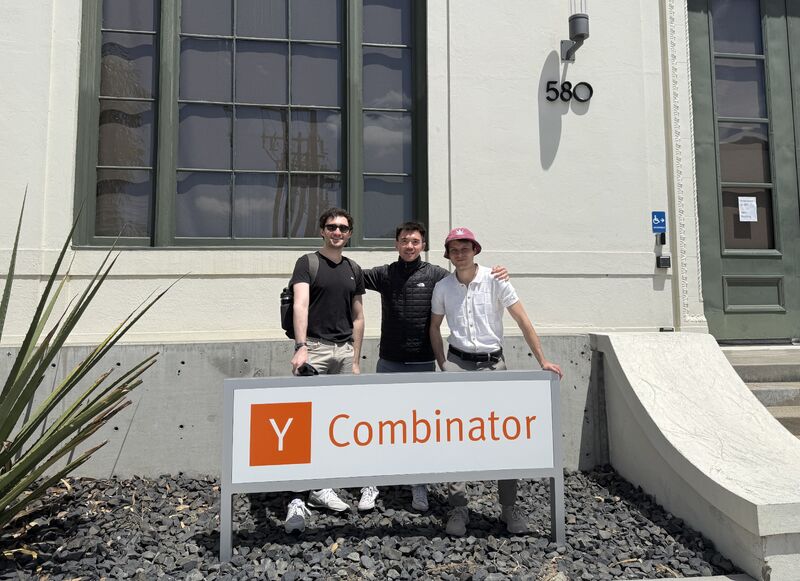
He was heading west with Alex Wilcox and Dima Vremenko. Their company, Inkbox, was joining Y Combinator’s Summer 2026 batch. In a photograph accompanying the announcement, the three stand behind a YC sign, Liao in the middle. The company they were bringing concerned a peculiar form of homelessness: software capable of doing work, but lacking a dependable identity through which the world could reach it.
“Every time I visit a new place, I like to run it.”Ray Liao, announcing his move west
The train ticket before the inbox
Ruizhi Liao, who also uses Ray, earned his bachelor of engineering degree at Tsinghua University, studying there from 2011 to 2015. He then went to MIT, where he completed a computer science PhD in 2021 under Polina Golland. His doctoral work received support from the Merrill Lynch and Siebel fellowships. Machine learning occupied the academic years; building companies followed.
He previously cofounded Empallo and served as its chief technology officer. Later, his public demonstrations of Vectorly took up a problem familiar to anyone who has watched an automated system struggle with a website: the information exists, but it sits behind an interface built for somebody with a mouse.
One demonstration used Amtrak. The question was specific: what was the cheapest train from Boston to New York City on October 22? Liao showed a connector designed to retrieve live pricing from the railway’s website. A plausible paragraph about trains would have been easy to produce. A current fare required reaching the system that actually held it.
Another Vectorly demonstration explained how a user’s interactions with a website could become a reusable data-extraction routine. The example searched for US patents. Once the routine was created, keywords could be supplied as parameters. The point was to make an interactive service available programmatically, so the same operation could be performed again.
Those examples give his later work a useful backdrop. Liao was already dealing with the inconvenient space between an agent’s instructions and the outside world. Inkbox addresses a neighboring problem: after software acts, it may need a reply, a confirmation, or a message from someone who was unavailable when the task began.
In the founders’ account of Inkbox’s origins, their own automation work exposed that need repeatedly. Receiving confirmation messages and reaching agents on the go meant joining separate services together. Each solved a portion of the problem. The founders wanted the pieces to belong to a single identity, carrying context from one channel to another. A reply arriving by text should still belong to the same ongoing work.
Two and a half hours to make it useful
In Boston Back Bay, Liao and his collaborators hosted Inkbox’s first hackathon. More than one hundred people registered; the event was capped at fifty. The brief was direct: build an AI agent that made people more productive. The time allowance was two and a half hours, which discouraged the sort of planning meeting that acquires a planning meeting of its own.
The projects wandered across everyday work. Adhithyan Aravind built a career agent to find roles from a CV and handle outreach. Manthan Admane worked on aggregating notifications and identifying follow-ups. Michael R. Schulte made a tool that accepted a PDF and emailed annotated notes back. Brad Egan used AI to digest Reddit and send selected material by email.
One participant, Kannan Karthikeyan, described making a support system for cursorboston.com. He spent more than half the allotted time deciding what would be useful. The result answered questions using the website’s content and escalated cases by emailing the appropriate people through Inkbox. Calling for urgent cases was a possible next step; it had not made it into the timed build.
That account contains a useful distinction between a demonstration and a working process. An answer can end a conversation. An escalation starts another one, with a person who has to be reached. Liao’s infrastructure becomes relevant at that handoff. The supporting machinery is easy to overlook until a tool needs to get somebody’s attention.
The hackathon also put Liao among people willing to test the product in directions its creators could not fully script. His recap named participants and projects, including people who shared repositories without presenting. It records a founder’s work in a room full of other builders, where the product’s possibilities are expressed through somebody else’s deadline.
An agent may arrive before its owner
Liao took Inkbox’s identity problem onto the stage at Imagination in Action in Kendall Square. At The AI Runtime meetup, his subject was agent self-signup. Both appearances concerned what happens when a system built around human users encounters software trying to establish its own presence.
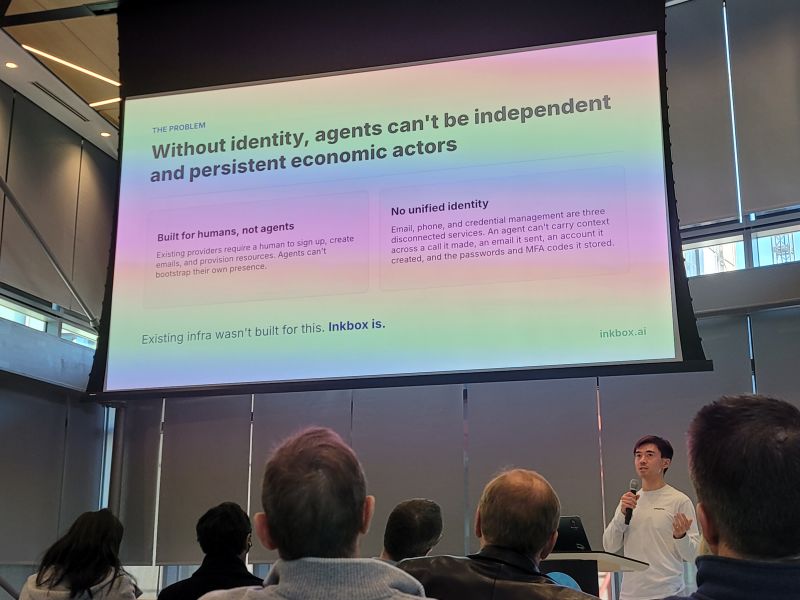
His April 4 explanation, coauthored with Wilcox, begins with a sequencing problem. Ordinarily, a person creates an account and then adds resources. With self-registering agents, the software may appear before a verified human account does. It can supply an owner’s email address, but that address alone establishes neither consent nor authority.
The team’s design places a newly registered agent in a provisional workspace. It can receive email, while outbound email is limited to the supervising human. Claiming the agent moves it into a real workspace with broader allowances. The order matters: useful resources arrive first, wider trust follows verification.
These are the sorts of distinctions that disappear inside the phrase “autonomous agent.” Who is the owner? Who approved it? What may it reach before that approval? Liao and Wilcox made those questions part of the product’s behavior. A machine can arrive early without being handed the keys to everything.
Leave the task where it can be found
By August 10, Liao and Vremenko were explaining another design choice: Inkbox brokers agent-to-agent communication. If one agent gives another a task, Inkbox receives and records it. The recipient can return later to find the work. A running process does not have to be present at the exact instant somebody needs it.
The design also puts access control in one place. Agents authenticate to Inkbox, and communication requires permission. Their explanation describes collaboration across organizations as something people opt into. It is a more considered version of delegation than simply allowing any program to call any other program that happens to have an address.
These explanations are collaborative documents, too. Wilcox joins Liao on the signup account; Vremenko joins him on the communication design. The company has a CEO, but the public technical record carries several names. Its decisions are presented as choices the team made and can explain.
A July customer account by Liao makes the identity idea tangible. At Vendo, two founders each had a personal-assistant agent, alongside dedicated agents for engineering, go-to-market work and operations. Five agents had five identities, reachable over text. The arrangement put different responsibilities behind different points of contact.
That example explains more than a list of integrations can. People already know how to message a colleague with a particular responsibility. Giving an agent its own identity offers a similar point of contact without demanding that every interaction begin inside a separate chat window. For Liao, the product’s promise is tied to that familiar action: send a message to the entity doing the work.
The comment that outlasted the launch
Liao’s account of an earlier release is considerably less formal than his technical writing. The team had launched a different product in December. Tyler Bosmeny tried it and left a comment that helped them fix the interface. Later, Bosmeny became one of their YC group partners.
The episode is useful because its scale is small. There is a product, somebody using it, a comment and a repair. The consequential connection begins with an ordinary act of feedback. Liao’s advice was equally compact: launch early and keep launching. In his telling, the chance that nobody remembers a release leaves room to try again.
“Launch early, always be launching.”Ray Liao, reflecting on an earlier product release
There is a consistent method in these public episodes. The train-price demonstration gives a technical claim a concrete test. The hackathon gives other builders a short runway. The signup explanation makes permissions explicit. Each moves an idea into a setting where somebody can use it or examine how it works.
The details are also unusually recognizable for a subject surrounded by technical vocabulary. Liao talks about tickets, notes, support requests and messages. These provide a way to judge the work without first accepting a grand prediction about artificial intelligence. Did the system reach the right information? Did the note arrive? Could the person responsible for the next step be contacted? His examples keep bringing the discussion back to those questions.
San Francisco brought a new setting for that work, along with Wilcox, Vremenko and YC. Boston supplied the long preceding stretch: graduate school, companies, collaborators and a final run. Liao’s next ambition has a deceptively everyday shape. Give an agent an identity, let people reach it, and keep the next task from disappearing while it is away. Somewhere, eventually, the reply has to arrive.