Ray Liao likes to run in every new place he visits. In the summer of 2026, he reversed the ritual. Boston was no longer new. It had been home for ten years, long enough to hold a graduate education, a research career, two startups, hundreds of conversations and the sort of friendships that make a city resist being called a chapter. So before leaving for San Francisco, Liao ran it once more.
The route was a farewell and a declaration. At the other end waited Y Combinator's Summer 2026 batch and a company called Inkbox, built with Alex Wilcox and Dima Vremenko. Liao described the move plainly: he was heading west with his cofounders to give AI agents an identity - email, a phone number and an internet address. A future crowded with autonomous software, he reckoned, would require a good deal of administrative plumbing.
That idea is less cinematic than a robot walking through a laboratory. It is also easier to recognize in ordinary life. Intelligence may draft the message, but an inbox receives the reply. Reasoning may decide what to do, but a phone number collects the code that lets the software do it. An agent can be clever for a minute and still vanish between sessions. Liao's wager is that persistence will matter as much as cleverness.
“Every time I visit a new place, I like to run it.”Ray Liao, before leaving Boston
The long education of a practical builder
Liao's formal route began at Tsinghua University, where he earned a Bachelor of Engineering between 2011 and 2015. Then came MIT. He joined the computer science program in 2015, earned a master's degree in 2017 and completed his PhD in 2021 under Polina Golland. His doctoral work focused on multimodal representation learning - methods for teaching a system to make use of different forms of information rather than treating each one as an island.
His publication list has the recognizable density of a machine-learning researcher: image-text models, mutual-information estimators, registration methods and public code to accompany the papers. The Merrill Lynch Fellowship and Siebel Fellowship supported the work. Yet the more revealing detail may be what survived when he left the lab. Liao kept returning to the problem of context. Information becomes more useful when the walls between channels come down.
At MIT, research and company-building began to overlap. Liao cofounded Empallo with Claire Beskin, whom he met in graduate school, and served as its technical leader. The venture passed through MIT Sandbox, where the team did the foundational chores that rarely fit into a pitch: roughly one hundred stakeholder conversations, a prototype and early institutional partnerships. It was a first education in converting a model into a system that other people might actually use.
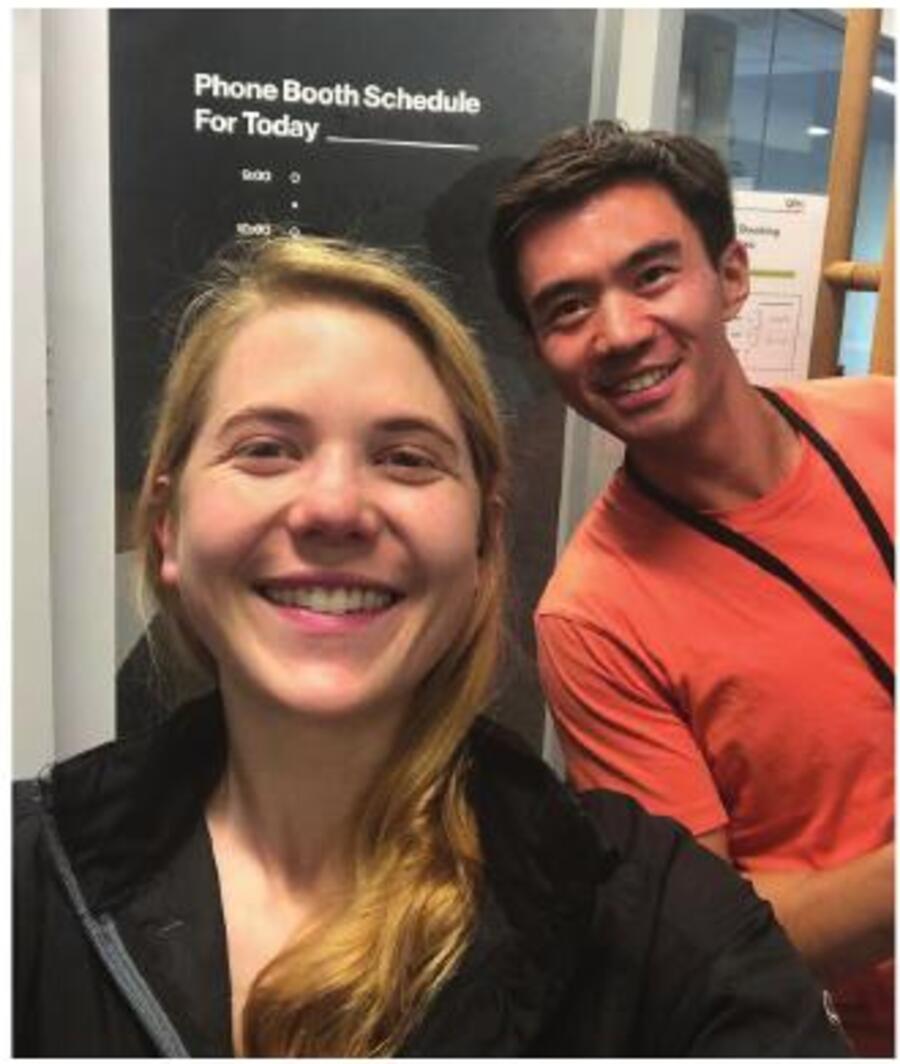
There is an important difference between a research result and a product. The first must hold up under scrutiny. The second must also answer emails, survive strange inputs, fit a workflow and explain itself to someone who did not attend the seminar. Liao's path has been a steady migration across that gap.
The workaround points to the company
By 2025, Liao was working with Wilcox and Vremenko on Vectorly. The product turned web applications into stable, machine-usable interfaces. In one public demonstration, the team made a live travel website accessible to an AI assistant so it could retrieve current train options instead of returning a vague search result. The ambition was broad: make the web programmable for agents.
The work revealed a more basic obstruction. Whenever an agent needed to log into a service, a confirmation email arrived somewhere else. Two-factor codes lived on a phone. Incoming internet traffic required another utility. And if a founder wanted to contact an agent while away from a desk, the supposed autonomous worker had no number to text.
The team stitched together Gmail, Twilio and ngrok. Each service did its own job. None understood that the inbox, phone and web endpoint belonged to the same software actor. The humans became a switchboard, passing bits of context among tools built with people in mind.
Workarounds have a habit of disguising markets. The moment a team says, “we always have to glue these three things together,” it has produced the rough outline of a product. Liao and his cofounders followed that outline. They built Inkbox as one identity and communication layer, with an email inbox, custom domains, phone calls and texts, iMessage, an HTTPS endpoint, and a vault for credentials and time-based codes.
“We didn't need another email or voice API. We needed one service to tie its identity together with rich context. So we built it.”Inkbox launch note
The shared context is the consequential part. An agent that receives a call and an email from the same person should not behave as though two unrelated universes have touched it. Inkbox is designed to gather those interactions around a persistent identity. The company also offers an agent-to-agent channel, so software can delegate work without making a person serve as courier.
Persistence also changes the relationship between a developer and an agent. A disposable chat can be judged one prompt at a time. An agent with an address can be contacted later, can receive an answer after the person on the other end has gone to lunch, and can return to a task with the conversation intact. The glamorous phrase is autonomy. The practical experience is continuity: the work does not collapse simply because one browser tab closed.
Inkbox packages that continuity as infrastructure rather than a single assistant. Its intended customers are teams running many agents, each of which may need its own accounts, contacts and history. This creates a useful inversion. Instead of asking a person to keep every agent's state in mind, the system gives each agent somewhere to keep its own. The agent becomes easier to reach and, just as importantly, easier to distinguish from the others.
One agent, fewer disconnected rooms
The product thesis in one frame: communication channels feed one durable identity, so the next action can carry the context of what came before.
Launches are probes, not parades
Inkbox did not emerge fully named and neatly boxed. Months before the YC announcement, the team released another product. Tyler Bosmeny, a YC partner, tried it and left a comment that helped the founders repair the interface. He later became one of their group partners. Liao turned the episode into a compact rule: “Worst case nobody remembers your launch. Launch early, always be launching.”
It sounds glib until one notices the discipline underneath. An early launch asks reality a question. The answer may be a customer, a bug report, a rejection or an introduction. Silence is also data, and usually less expensive than months spent polishing a private mistake. Liao's formulation makes room for the bruised ego. If nobody remembers, the founder is free to try again.
That instinct extends beyond product releases. In spring 2026, Inkbox hosted its first hackathon in Boston's Back Bay. More than one hundred people registered; attendance was capped at fifty. The brief was deliberately tight: two and a half hours to build an agent that made its creator more productive.
The results were cheerfully specific. Builders made a market-validation agent, a career-outreach agent, a system that annotated uploaded PDFs by email, and a tool that decided which notifications deserved a reply. The evening supplied a catalogue of actual jobs rather than abstract capability. Liao promised more events and called Boston an underrated builder hub, even as his own departure approached.
A forwarding address for the future
Liao's collaborators are central to the current chapter. Wilcox, Inkbox's CTO, brought machine-learning engineering and networking research. Vremenko brought experience building production data pipelines. The company credits NFX and Night Capital among its backers, and the YC batch gave the three founders a reason to move together to San Francisco.
The interesting continuity in Liao's career is not a particular industry. It is the movement from isolated signals toward usable systems. His graduate research joined different forms of information. His first company pushed technical work toward operational use. Vectorly tried to make web applications legible to machines. Inkbox now gives those machines the stable channels through which work arrives and leaves.
There are unsettled questions around any infrastructure that lets software sign up, communicate and hold credentials. Identity creates responsibility as surely as it creates convenience. Inkbox's own framing puts trust and permissions beside capability, not after it. The company is entering the part of the story where careful defaults will matter as much as breadth.
For now, the image that lingers is simpler: Liao running through the city that trained him, about to leave for the city where he plans to build. A runner does not teleport between points. The route is continuous, even when the scenery changes. Tsinghua, MIT, Empallo, Vectorly, Inkbox - each step has made the software less theoretical and more present in the world.
The AI industry spends lavishly on brains. Ray Liao is building the address book, mailbox and front door. If agents are going to behave like teammates, someone has to decide where they live.