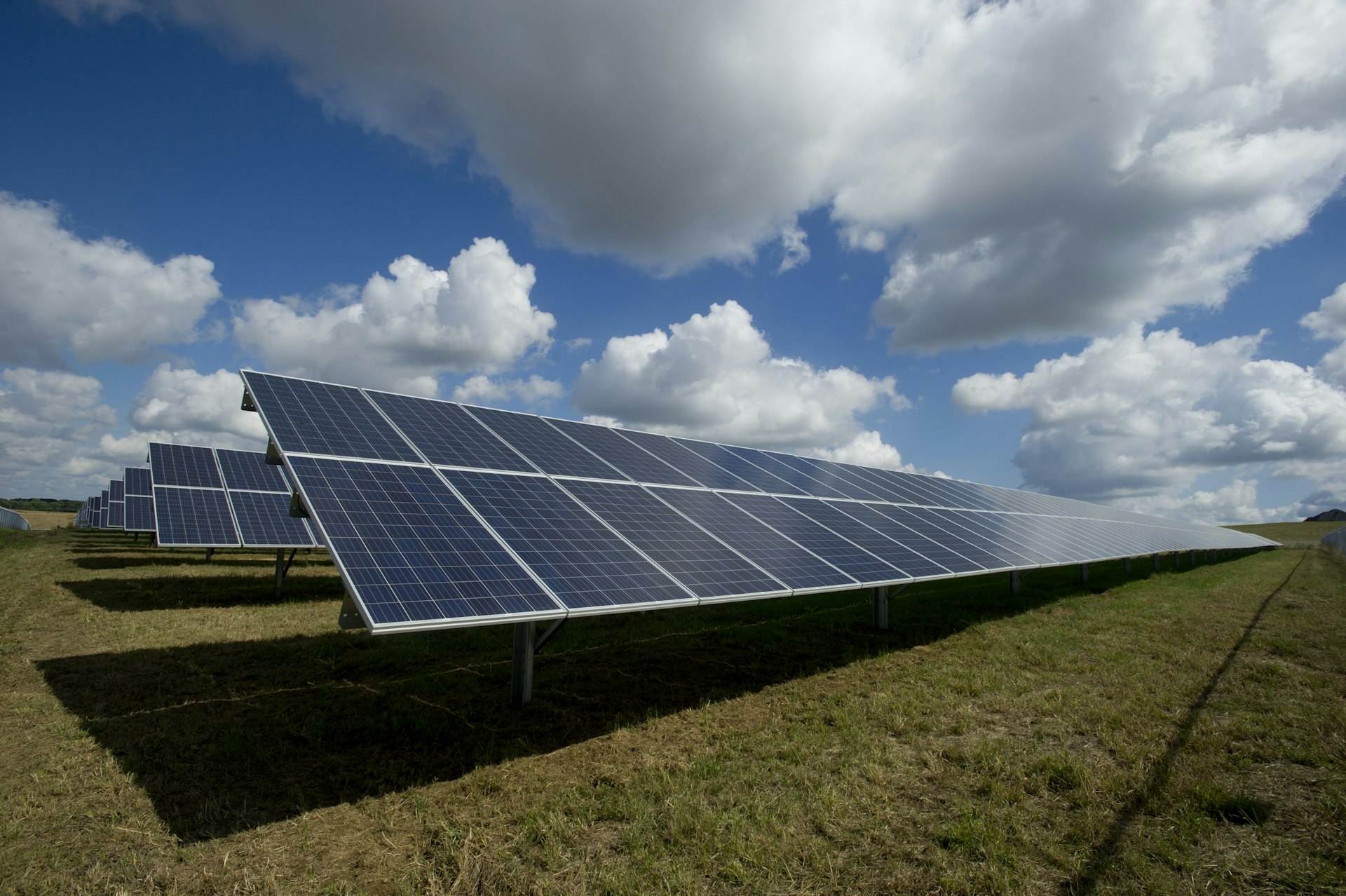
A solar farm can produce a magnificent silence. The panels make no speeches. The inverters do not ask to circle back. Yet behind the blue geometry is an operations desk full of alarms, contracts, technicians, spare parts, weather, warranty clocks, impatient owners, and machines that sometimes lie. Phillip Yan has chosen this untidy office as a place to ask a crisp question: can an AI agent do the job for a week?
Yan is the cofounder and CEO of Maingen, a two-person company in Y Combinator's Summer 2026 batch. With cofounder David Yang, he builds reinforcement-learning environments from industrial work. The ambition is broader than solar. The company describes factories, power plants, and physical infrastructure as the next territory for capable agents. But its first public proof, SolarBench, begins with the daily theater of solar operations.
The choice suits Yan's particular stack of experience. At Columbia University, where he is in the class of 2026 studying computer science and mathematics, he took advanced work in operating systems, algorithms, abstract algebra, and programming. His internships led through institutional crypto financing at Coinbase, signal classification for IARPA at Expedition Technology, energy-trading tools at Axpo US, and DEX execution research as the first engineering intern at 0x. Each stop supplied a different piece: markets, models, energy, infrastructure, and the uncomfortable fact that a software decision eventually lands on somebody's ledger.
The exam lasts until Sunday
SolarBench does not hand an agent a neat question with a neat answer. It places the model at a simulated remote operations desk responsible for 14 solar sites in upstate New York. The agent receives alarms, telemetry, revenue-meter readings, work orders, manuals, parts inventory, and an inbox populated by owners and technicians. It can inspect, order, dispatch, write, wait, and advance the clock. Then the consequences arrive.
That last sentence is the entire game. A cheap part ordered Monday might prevent an expensive delay Wednesday. A critical alarm might be nothing more than a dark communications channel while electricity continues to flow. A site that never raises an alert can quietly stop producing. The stakeholder who sounds most urgent might have the least accurate picture. The agent has to discover the work before it can do the work.
At launch, the benchmark ran eleven models through eight tasks ten times each: 880 graded weeks. The strongest model fully resolved its issues in 53.8 percent of runs. The rule was strict. Miss one pass-tier criterion and the week failed. That sounds severe until one remembers that an actual desk cannot preserve Tuesday's broken transformer as a charming partial success.
“Solar is just the start.”Phillip Yan on Maingen's next industrial environments
The invoice is part of the intelligence
Correctness alone is not enough. SolarBench also prices the agent's actions. Sending a technician costs simulated money. Ordering a part costs money. Waiting can cost production. Acting too soon can erase the value of information that would have arrived for free. One run sent a $650 technician to recover $12 of lost production. It is an anecdote with the efficiency of a parable: the agent did something, perhaps even something defensible, and still made the desk poorer.
Maingen therefore measures both whether the week was completed and how much value the agent captured. The distinction catches a familiar performance. A model can produce a competent checklist while spending four to eight times what the situation required. Eloquence has a dangerous habit of arriving before arithmetic. SolarBench gives the arithmetic the last word.
The benchmark's most revealing scenarios reward an almost old-fashioned temperament. Read the documents before touching the alarms. Check the revenue meter before trusting the monitoring feed. Carry both plausible parts when a second truck roll would cost more than the hedge. File the warranty claim before its deadline. Verify the repair at the meter before closing the work order. Intelligence here resembles competent fussiness.
A builder with a crowded desk
Yan's own project shelf suggests he enjoys problems that refuse to stay in one department. He built FlareInsure, a decentralized marketplace for rainfall insurance that won two prizes at ETH Oxford. GitInsight lets developers ask natural-language and voice questions about public code repositories. Polyhymnia generates original sheet music and adapts exercises to a student's recorded performance. Other projects have modeled plant-biome evolution under drought, optimized bicycle investment in New York City, simulated income-tax policy, and built an autonomous agent to play an AI grand-strategy game.
The mathematical modeling project brought a conspicuous result. In 2023, his team was named an Outstanding Winner in the international Mathematical Contest in Modeling and received the Mathematical Association of America award. The work used a spatial-temporal differential-equations model to simulate how plant biomes evolve through drought cycles. The subject differs from SolarBench, but the appetite is recognizable: construct a world, define how it changes, then ask the model to survive the consequences.
Even the origin story with David Yang contains a pleasing loop. The future cofounders met as opponents in a middle-school, Department of Energy-sponsored New Jersey Science Bowl championship match. Years later, at a solar-industry event in New Jersey, they ran into Andrew Zwicker, the Princeton Plasma Physics Laboratory physicist and state senator who had judged that match. School rivals had become company builders, now discussing the operating burden of solar. Fate occasionally files excellent meeting notes.
“Be the bee”Yan's shorthand for consuming selectively and producing work that lasts
The grid behind the idea
Yan also writes, and his subjects wander productively through institutions, markets, philosophy, internet money, pubs, gifts, and the hidden economics of ordinary purchases. His public reading shelf mixes books on the electrical grid and energy trading with Plutarch, Siddhartha, Dune, the Bhagavad Gita, and histories of South Africa, Switzerland, and Turkey. The shelf does not reveal a single doctrine. It reveals a preference for systems with long memories.
In an April 2026 essay, he argued that America's power grid, not merely chips or algorithms, would constrain the next phase of AI. Power plants take years to connect. Transmission takes longer. Transformers do not materialize because a model release moved up the calendar. Yan introduced “Joule Diplomacy” as a phrase for routing AI training toward countries with surplus energy. It is an engineer's geopolitical coinage: whimsical enough to remember, material enough to have a substation behind it.
Maingen turns that interest in energy into a narrower commercial discipline. Industrial knowledge often lives in maintenance systems, vendor portals, contracts, operator habits, and the experienced person's suspicion that this particular alarm is lying. Much of it never becomes public training data. Yan and Yang embed with operators, translate their decisions into environments, and create settings where models can train or be evaluated against the texture of the work.
Agency, with receipts
On his personal site, Yan lists “organized curiosity,” agency, an appetite for risk, and tolerance for being weird among the ingredients of great work. He also writes, “Everything can be learned, but not everything can be taught.” SolarBench lives in the tension between those two lines. It packages some hard-won operator judgment into a learnable environment while acknowledging that the polished instructions are never the job itself.
The benchmark is careful about its own authority. Its random draws are seeded so weeks can be replayed. Criteria grade the simulated world state wherever possible, rather than admiring the agent's prose. The team audited cases where a grader demanded the right answer in the wrong form and cases where the environment accidentally leaked its own answer. The corrections matter because a benchmark can become another loud alarm: official-looking, numerically precise, and still pointed at the wrong thing.
There is a useful modesty in beginning with a desk. The popular image of physical AI is a gleaming robot. Maingen starts with an inbox, an inventory list, a contract, and a person deciding whether a truck should leave the yard. Industrial intelligence may arrive wearing work boots one day. Before that, it has to learn not to dispatch them for twelve dollars.
For Yan, the week is the unit that makes the thesis visible. It is long enough for consequences to mature and short enough to replay. Monday's uncertainty becomes Wednesday's constraint. A confident sentence becomes a purchase order. An ignored meter becomes a quiet loss. By Sunday, the agent has left a trail of evidence that no amount of verbal polish can rescue. The physical world, with its invoices and weather, is a merciless editor.