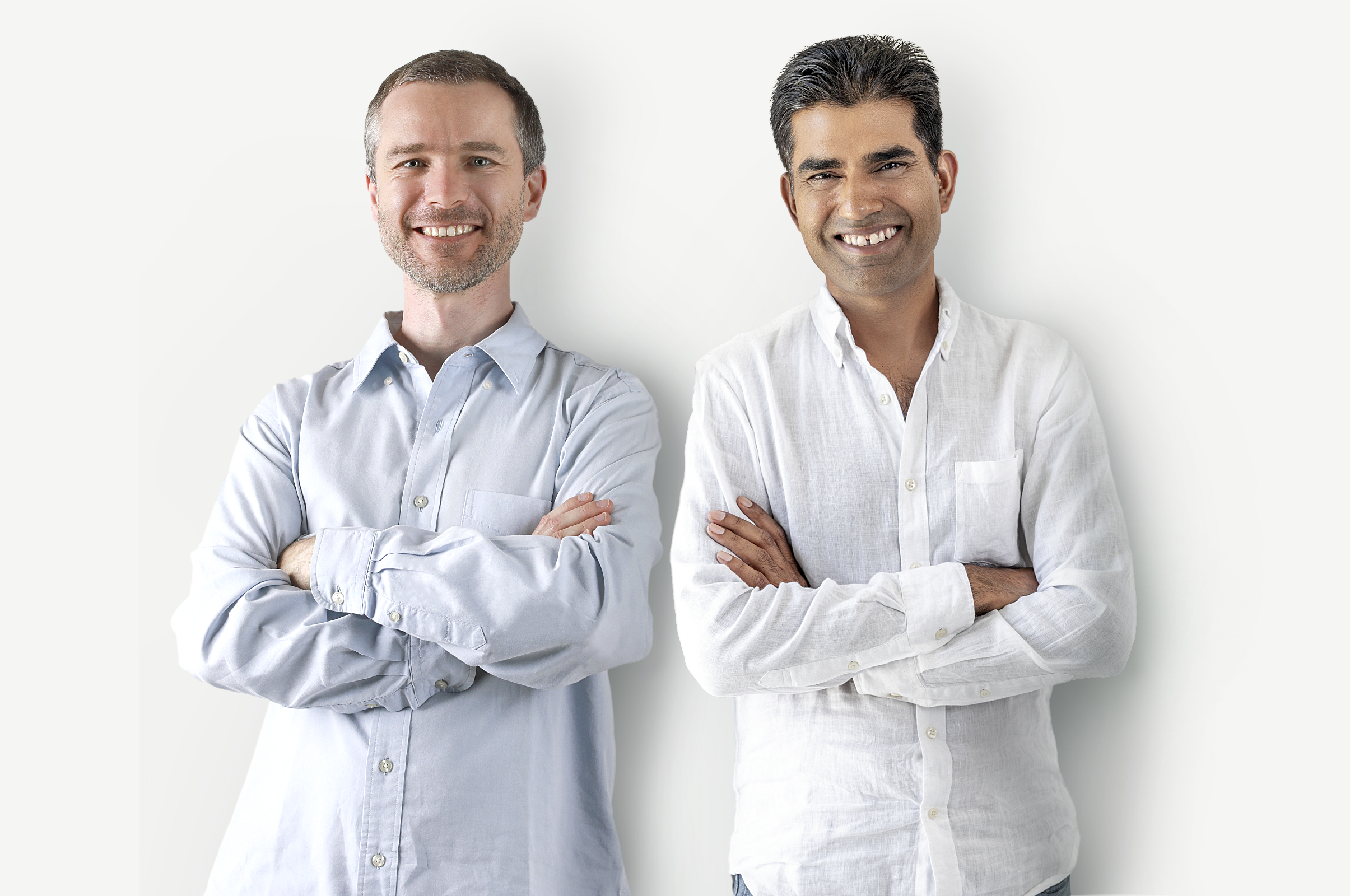
There is a specific kind of frustration Pramod Sharma knows by heart: you have the idea, you can see the shape of it, but the moment you try to hand it to someone else, it flattens. It becomes a paragraph. Paragraphs become decks. Decks become meetings where someone eventually scribbles on a whiteboard and the room suddenly understands. Sharma decided the scribble was the product. Napkin AI is the scribble, automated.
He did not arrive at this conclusion quickly. He spent three years inside the problem before he showed it to anyone. That patience - almost eccentric by Silicon Valley standards - is a signature. At Google, it took him eight years to leave. At Osmo, it took six before Byju's showed up with $120 million. At Napkin, the stealth period stretched until August 2024. Sharma is not in a hurry. He is in the business of being right.
"An amazing visual truly captures the essence of an idea."- Pramod Sharma
The origin story matters here because it is not what you expect. He was born in a small village in Rajasthan. His father was a farmer. The local government school was fine. Private tutoring was not an option. He taught himself math and physics - not because it was romantic, but because there was no alternative - and cracked the IIT Delhi entrance exam. One detail that never comes up in his press mentions: he extended a three-month Tokyo internship into eighteen months because he could not stop absorbing Japanese culture. This is what Pramod Sharma does with interesting environments. He stays.
Stanford followed IIT, then NVIDIA, then Google in 2005. His first assignment was not product management. He was asked to design book-scanning machines for Google Books - the hardware and the computer vision that read each page. He was, quite literally, building robots to read. Something about that problem, physically ingesting the world's written knowledge and making it navigable, never left him.
Sharma co-founded Osmo with Jerome Scholler after noticing that the daycare at Google's campus lacked the kind of technology they were building ten feet away. Osmo combined tablet apps with physical toys using computer vision - children manipulated real objects while the software responded in real time. TIME Magazine and Fast Company noticed. Byju's paid $120 million in 2019. Sharma served as President of Products at Byju's for a year, then started looking for the next problem.
The next problem was hiding in plain sight during his years running Osmo. Corporate communication was broken. Not in a vague, aspirational sense - it was measurably, documentably terrible. Endless slide decks. Dense documents. Occasional moments of clarity when someone drew something. Sharma and Scholler started sketching a drawing-based AI tool, but pivoted when large language models matured enough to make text the input. The insight was clean: people already write. Make the writing generate the visual automatically.
"The goal is to minimize the time and headache of the design process by turning it into a mostly generative flow."- Pramod Sharma, on Napkin AI
Napkin AI works exactly the way the name suggests. You paste text. Small spark icons appear beside paragraphs. You click. A diagram, flowchart, infographic, or Venn diagram materializes - editable, exportable, polished. No Figma skills required. No design department to route through. Rich Wong at Accel, who had backed Osmo early and watched it exit cleanly, led the seed round. CRV joined. $10 million landed in August 2024 alongside the public launch.
The team is 22 people spread across Los Altos, France, and India - a geography that reflects the founders' roots. Scholler is French. Sharma is from Rajasthan. Napkin is, in some ways, a globally distributed product made by globally distributed people solving a globally experienced problem. Nobody in any country finds it easy to communicate a complex idea through text alone.
What Sharma is building is not a design tool. He is categorical about this. It is a communication tool with a design layer underneath. The distinction matters because designers are not the customer - writers are. Marketers are. Engineers explaining architecture. PMs presenting roadmaps. The person who has genuinely never considered whether their document needed a visual until they clicked a spark icon and discovered it did.
The ambition declared in early 2025 - Napkin as a "design agency of AI agents" - is consistent with how Sharma has always thought about product. Not the minimum viable version of a thing, but the version where the technology does the heavy lifting and the human shows up at the end to say yes or no. He designed machines that scanned books so humans would not have to. He is designing machines that generate visuals so humans will not have to think twice.