Wireless electricity, sent through open air on a beam of light. A 39-person engineering shop in Kent that just kept a Pentagon drone aloft for hours - without a battery swap or a fuel tank.
It is the spring of 2026 at the Poinsett Electronic Combat Range. A fixed-wing UAS circles overhead. Its battery is at 22%, then 24%, then 31%. It has been in the air for hours. There is no tether, no aerial tanker, no exotic chemistry on board. On the ground, a small team from PowerLight Technologies is doing something the textbooks said could not be done outside a lab: they are running an extension cord made of light.
Power beaming, in flight, to a fielded military aircraft. A few people in Kent, Washington built the cable. The cable is invisible. The cable, technically, is a kilowatt-class laser tracked across kilometers of sky with the precision of a guidance system that never lets the beam drift onto anything it shouldn't. The drone keeps flying. The Pentagon takes notes. The textbooks get rewritten.
The company you are reading about started life in 2006 with a different name and a slightly absurd ambition. Two physicists - Tom Nugent and Jordin Kare - founded LaserMotive in Kent, Washington, with the goal of winning the NASA Centennial Challenges Power Beaming competition. The competition asked teams to climb a long cable using nothing but laser light. Most thought it was a stunt.
On November 6, 2009, LaserMotive's 4.8 kg climber went up a 900 meter cable dangling from a helicopter, powered entirely by a ground-based laser. It moved at an unhurried 8 miles per hour. It also moved fast enough to win the $900,000 prize. Nobody else finished.
That was the prologue. In 2017 the company quietly rebranded as PowerLight Technologies, formalized its power-over-fiber product line, and started selling laser-delivered electricity to customers who needed it badly enough to pay for the strangest extension cord on the market. Power-over-fiber is exactly what it sounds like: instead of stuffing copper into a sheath, you fire a focused laser down an optical fiber and convert the light back to DC current at the far end. It is quiet, electromagnetically invisible, and ignites less stuff. Industries where copper is dangerous - or where being seen on a sensor is dangerous - paid attention.
Then came the call from DARPA. Then a second one. Then CENTCOM. Then a partnership with Kraus Hamdani Aerospace to integrate the beaming kit into the K1000ULE, an ultra-long endurance UAS used by the Navy and Army. Then a seat at the LunA-10 table, where DARPA is sketching out the moon's future electricity grid. Each contract added another zero to the ambition.
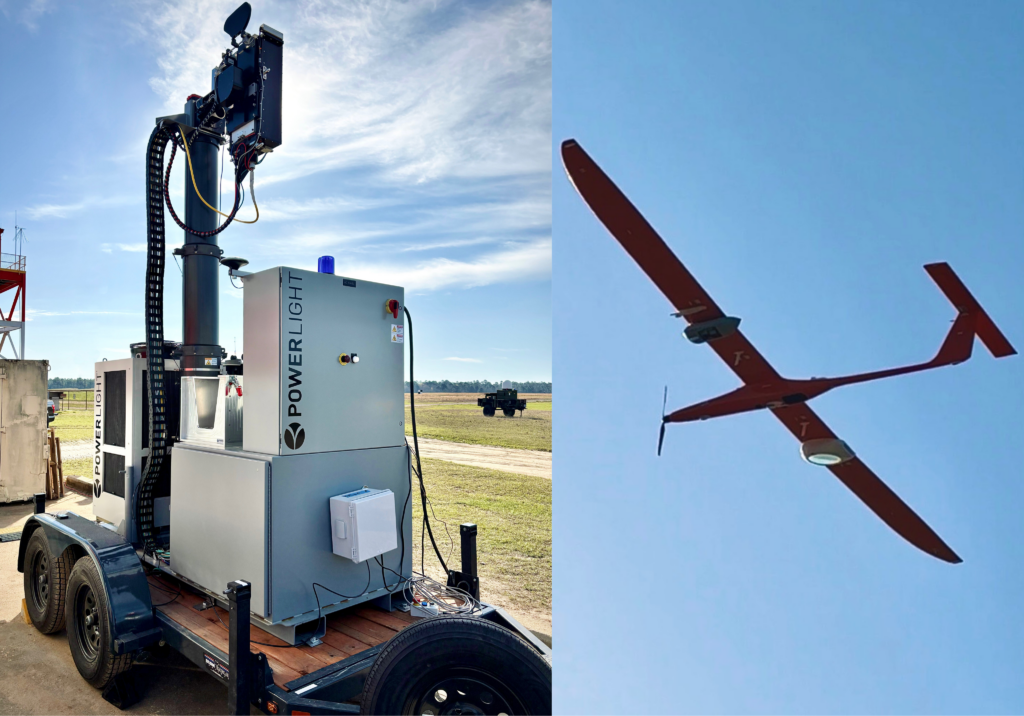
A matched transmitter and receiver that send kilowatt-class power across open air to a drone, vehicle, or remote sensor. Beam tracking holds the link as the target moves.
High-power optical energy down a single optical fiber - immune to electromagnetic interference, safe in flammable environments, hard to spot on a sensor.
The unglamorous engineering that lets you fire a kilowatt laser through shared airspace without harming birds, planes, or operators. Patents and detection layers all the way down.
Custom integration work for DARPA programs, DoD demonstrations, and aerospace primes pursuing persistent ISR, edge AI, and energy relay missions.
Physicists Tom Nugent and Jordin Kare set up shop in Kent, WA. Stated goal: win a NASA prize for climbing a cable with light.
A 4.8 kg climber rides a laser up a 900 m cable suspended from a helicopter. No other team finishes.
The prize was the prologue. The company formalizes commercial power-over-fiber and becomes first to market.
Selected to provide power beaming expertise for the Lunar Architecture Power & Energy Transmission Infrastructure initiative.
Backers include Puget Sound Venture Club, Sage Venture Partners, and Seattle climate-tech fund E8.
Selected to deliver a prototype wireless power beaming solution for Group-2 UAS in 2025.
Multi-hour in-flight laser power delivery to a fixed-wing military UAS at the Poinsett Electronic Combat Range. An industry first.
PowerLight's customer list reads like a Pentagon procurement spreadsheet crossed with a moon-landing prospectus. That is the point. The hard problems live where wires can't go.
Fly drones forever. A UAS that never lands changes intelligence, surveillance, and reconnaissance from a duty cycle into a posture. Persistent presence becomes possible without the cost of constant battery swaps or fuel logistics.
Power forward operating bases. Remote outposts that depend on diesel convoys for electricity are vulnerable in two directions at once: the convoy and the dependency. A power beam from a safer distance reduces both.
Send electricity where wire can't follow. Underwater. Across canyons. Between rooftops. Up to satellites. Down from satellites. The list of places where a copper cable is too heavy, too flammable, or simply too visible is longer than the list of places where it isn't.
Build a moon grid. The DARPA LunA-10 program is preparing for permanent lunar infrastructure. On the moon, you do not bury cable. You aim a beam.
The original company name, LaserMotive, was a nod to a NASA challenge most people never heard of - one that handed out $900K like it was nothing.
Jordin Kare, the late Caltech physicist, was famous in his community for proposing laser-driven spaceflight before laser-driven anything was fashionable.
Kent, Washington. Closer to Boeing's part suppliers than to Sand Hill Road. The work happens where the aerospace talent is.
The pitch deck includes the moon. Not as a metaphor.
Product demos, beaming footage, and conference appearances directly from the company.
Demo SearchCompiled clips of laser power beaming demonstrations, including UAS recharging tests.
Founder InterviewsConversations with CTO and co-founder Tom Nugent on the physics and the business of beaming light.
Return to where we started. The drone is circling. The laser is tracking. The battery is, somehow, charging. The Pentagon team on the ground is no longer running an experiment - they are running a system. The textbooks have been quietly updated. Power beaming, it turns out, is not science fiction. It is a 39-person company in Kent, Washington that won a NASA prize twenty years ago and never stopped pulling on that thread.
The implications stretch in every direction the wire used to. Forward operating bases. Disaster zones. Underwater sensors. The moon. The vocabulary of the grid is being expanded, one beam at a time. The company that does it does not call itself a startup with a vision. It calls itself an engineering firm. The work shows up at trade shows looking like crates of optics. The customer list reads like a budget line.
The drone above the range will eventually land. But the next one might not. That is the shift PowerLight is selling: not better batteries, not bigger fuel tanks, but a quietly radical assumption - that the cord can be made of light, and that light is everywhere you need it to be.