An inverter can be online, reporting for duty, and quietly producing less electricity than it should. That is an awkward little fact for an industry accustomed to celebrating installed capacity. Building a power plant creates the possibility of energy. Getting the expected energy out of it requires another kind of work: noticing small losses, understanding them, and sending someone to fix the right thing.
- Power Factors connects renewable plant controls, performance, maintenance and commercial work.
- Its customers manage wind, solar, batteries and combinations of all three.
- The useful lesson: make the numbers trustworthy, then make the findings actionable.
The green light problem
Power Factors sells the tools for that second job. Its Unity Asset Performance Management software validates incoming data, tracks equipment performance and classifies lost production. A plant’s status light offers one answer. Comparing actual production with a credible expectation offers a more demanding one. The difference can point to dirt, vegetation, equipment degradation or a restriction on output.
Consider Origis Energy. In a September 2026 customer account, its team describes targeting at least 98% of expected energy across roughly 4.6 GW of solar and storage. Disconnected calculations had undermined confidence in the numbers. Origis chose a shared platform and began aiming to bring monitoring online before commercial operation. The lesson is practical: agree on the measurement while the people who can repair early defects are still on site.
“every little loss of energy, responding to it, and correcting it.”
Chad Nelson / Origis Energy

A suite assembled around the work
The breadth of Unity makes more sense when you look at how Power Factors grew. Its current corporate history dates the business to 2013 in San Francisco. In 2021, it acquired Greenbyte, adding renewable performance software, and 3megawatt, bringing commercial asset management. Inaccess followed in 2022, supplying the controls expertise that connects software decisions to physical plants. Unity launched in 2023.
This history explains a product range that can look rather crowded on first inspection. SCADA, short for supervisory control and data acquisition, gathers equipment signals and gives operators visibility and control. The power plant controller adjusts plant behavior to grid and contractual requirements. Performance software investigates losses. Field Service Management organizes the resulting work. Commercial Asset Management follows contracts, obligations and invoices. Each answers a different question about the same asset.
- 01CaptureEquipment signals
- 02DiagnosePerformance losses
- 03AssignField work
- 04OverseeCommercial obligations
The expertise predates the product names. Co-founder Steve Hanawalt worked on power-plant performance before overseeing solar operations at SunPower. His published writing treated technical performance and financial decisions as connected problems. That background helps explain the company’s insistence on linking the condition of an asset to the choices its owner makes.
A battery changes the arithmetic
Storage adds a delicious complication. Producing more electricity immediately is no longer the only useful objective. A battery operator has to consider when to charge, when to discharge, what the grid requires and how each decision affects the equipment. An apparently attractive market opportunity can carry a cost in battery wear or conflict with a warranty constraint.
Unity’s Energy Management System addresses that coordination. It combines forecasts, operating limits and market signals to schedule and control storage and hybrid plants. Power Factors also offers engineering, testing, commissioning and ongoing support. This is enterprise software with a physical assignment: decisions ultimately have to reach equipment, through controls that suit the site and its grid connection.
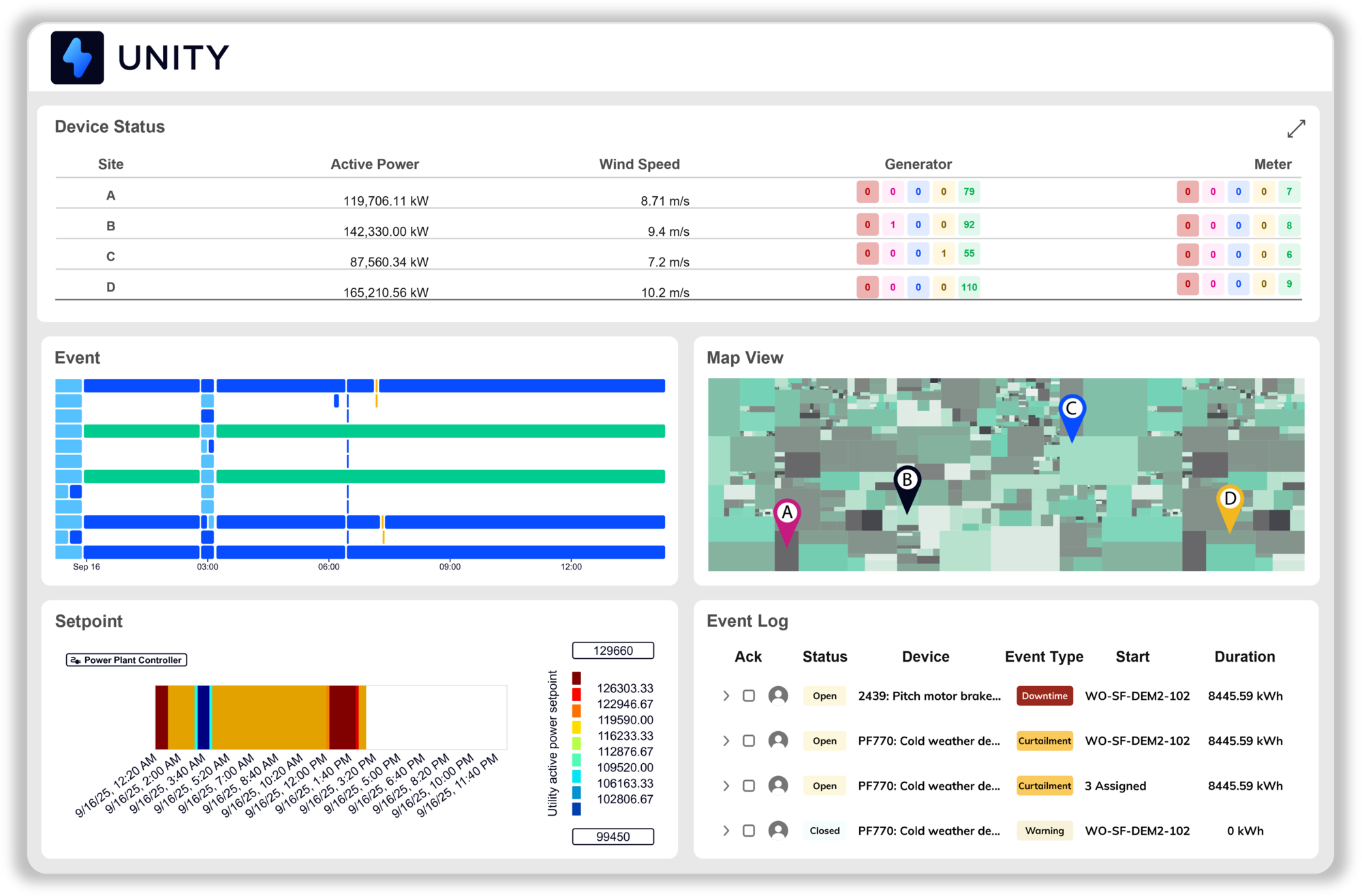
The customer buys a workflow
The buyers are renewable asset owners, independent power producers and operators. Inside those organizations, a control-room operator, performance engineer, commercial manager and field technician may all need different views of the same plant. Power Factors’ proposition is that their work can share a data foundation without requiring everyone to do the same job.
BNZ provides a concrete example of standardization. In May 2025, the companies announced an exclusive monitoring and controls partnership. Power Factors’ SCADA and controllers were already installed at six BNZ sites in Spain and Italy, totaling 174 MW. The agreement contemplated further projects as BNZ expanded. ACEN Australia selected Unity APM in December 2025, another example of a growing operator choosing portfolio visibility.
There are alternatives. Meteocontrol’s VCOM Cloud combines renewable monitoring and service management; its mc Assetpilot handles financial asset workflows. Buyers can also integrate their own stack. Power Factors’ distinguishing proposition is the span of its suite, including wind, solar, storage, controls and commercial work. The sensible comparison is the workflow a buyer needs to complete, rather than the length of a feature list.
AI has to earn its screen time
In April 2026, Power Factors launched Unity REMI, its embedded intelligence engine, initially available to Unity APM users. It described data interrogation, predictive analysis and tasks such as extracting contract and compliance information. The company reported REMI active across more than 30 GW at launch and announced expansion into other Unity products during 2026.
That places a useful burden on the product. An answer needs an intelligible connection to the equipment, calculation or document behind it. In operations, a confident sentence has little value unless a person can use it to make a sound decision. The test for REMI is time saved and work completed within the customer’s actual operating process.
The company’s working culture has its own mechanisms for that exchange. Its careers page describes twice-yearly Impactathons and employee councils on subjects including AI and environmental issues. Those are employer descriptions, but they reveal an emphasis on bringing people together around problems that cross technical boundaries.
Start before the first invoice
Power Factors combines enterprise software with hardware and delivery services, selling through demos and project quotes. A buyer should evaluate the whole assignment: data connections, configuration, commissioning and support alongside the selected applications. That follows directly from the product’s reach into both operational systems and business processes.
The company reported 310 GW served, 600-plus customers and 18,000 sites in May 2026, when it announced Mubadala as a minority investor alongside Vista. Those figures describe customer assets served, rather than plants it owns. The approach depends on usable telemetry, sensible models and teams able to act. The part another operator can copy starts smaller: agree on expected output, establish a trusted measurement and assign responsibility for the gap. A green light is a beginning.