In the Kalahari, a solar panel could solve one problem and leave another waiting in the dust. Electricity reached a household. Keeping the equipment working still meant finding somebody who could travel out and fix it. Andrew Mears, working on renewable energy in Botswana, encountered the awkward distance between installing a useful machine and providing a dependable service. His answer involved a SIM card. Years later, back in Newcastle, that small intervention would help shape the idea behind SwitchDin.
The systems served isolated communities where extending poles and wires was impractical. Remote monitoring let technical support respond to what was happening at a site, rather than treating every installation as a distant mystery. The lesson travelled well: scattered energy equipment becomes more useful when somebody can see how it is performing. A solar panel catches the sun. A communications link helps people look after the investment.
Mears’s career has moved between workshops, universities, international development and company building. The settings change; the troublesome gap between a technology and its usefulness keeps reappearing. His work invites a less glamorous question than the usual discussion of renewable energy: once you have bought the equipment, how do you make the whole arrangement work?
The apprentice who changed departments
He began at BHP as a trainee engineer, going through the fitter-and-turner apprenticeship programme. It was a practical introduction to engineering, with rotations through the steelworks. But the mechanical route did not match the interests he had developed as a child, tinkering with radios, electronics and software. He wanted electrical and computer systems. When changing streams at BHP proved unworkable, he left and finished university full-time.
His academic record connects Newcastle and Sydney: a Bachelor of Engineering and a Master of Engineering in Manufacturing and Process Control at the University of Newcastle, followed by a doctorate at the University of Technology Sydney. He later lectured at UTS in management, practice and policy. Those subjects are a useful clue to the breadth of his work. Making a device function and making it function within an institution are rather different assignments.
He also had an early venture commercialising satellite communications control technology with university friends. Then came renewable energy projects and advisory work across the Pacific, Africa and Asia, including positions with the United Nations Development Programme, the World Bank and AUSAID. In 2011, Newcastle recognised that international work with its Alumni Award for International Leadership. SwitchDin, founded in 2014, came after an established career rather than before one.
A washing machine in the hills
One of the people Mears remembered most vividly was a young electrician in Bougainville in the late 1990s. The electrician had made a small hydroelectric generator using an electric motor and scavenged washing-machine parts. It powered a few lights. He then established a workshop and taught others to make similar systems. Mears recalled standing at a military camp in Arawa after its diesel had run out, looking up at lights shining in the surrounding hills.
The anecdote places the ingenuity where it belongs: with the local electrician and the people who copied his work. Mears described farmers, mechanics and teachers among the innovators who inspired him. It is a revealing choice of company. A workable solution assembled from available parts can be more instructive than an elegant proposal awaiting the perfect circumstances.
“Think big and play the long game … with compassion and grace.”
Andrew Mears, 2015
The washing-machine generator and the Botswana communications link offer two versions of the same practical ambition. Get more usefulness out of the resources within reach. In one case, spare parts became electricity. In the other, a small addition made existing solar systems easier to support. The scale was modest enough to understand, and the consequences mattered to the people living with the equipment.
The batteries refused to talk
Back in Australia, Mears took on a problem that sounds almost comically domestic for an energy engineer. Newcastle City Council had solar installations at sporting facilities. Demand was low during the day and greater at night, so adding batteries made sense. Unfortunately, the solar inverters came from one manufacturer and the batteries from another. The equipment could occupy the same building without communicating with each other. An expensive sort of silent treatment.
SwitchDin connected the systems and brought them online so that control software could improve battery operation. By 2017, Mears was discussing the use of predictive control and machine learning to manage small energy systems for both customers and utilities. The council example made the purpose legible: generation, storage and consumption needed to work together. Otherwise, buying another piece of equipment could simply add another isolated piece of equipment.
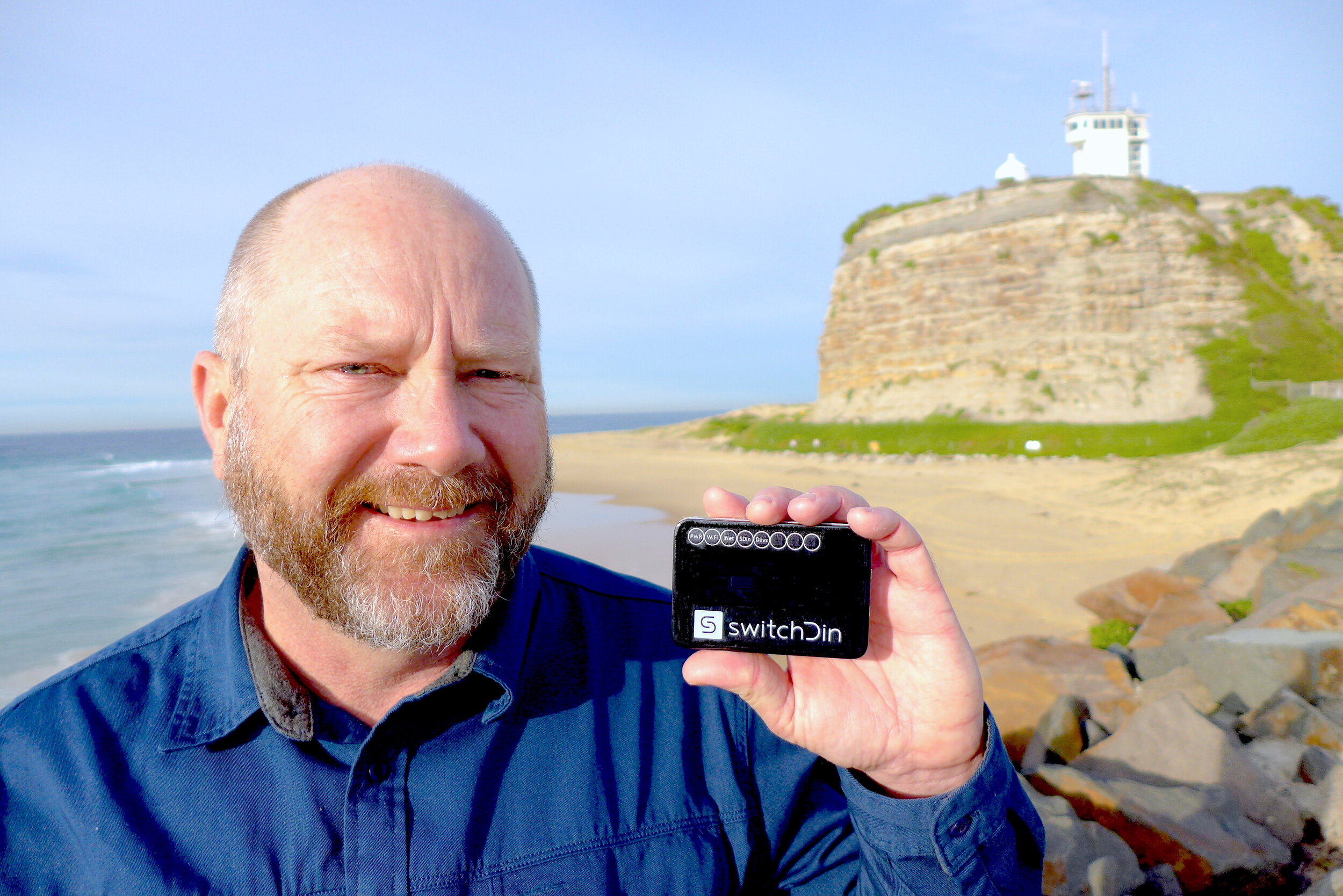
The company’s Droplet gateway and Stormcloud platform gave that coordination a physical and digital form. A gateway could communicate with equipment at a property; cloud software could coordinate assets across multiple properties. In industry language, these are distributed energy resources. In ordinary language, they are the solar panels, batteries and controllable appliances already scattered through people’s homes and businesses.
Finding a customer for the connection
Building the company involved some uncomfortable arithmetic. Mears put his own money into its early development. At one point, with only a few thousand dollars left, he went to a trade show to test the idea and came away with encouraging feedback and customer leads. The venture also changed its route to market: an initial consumer offering gave way to serving the organisations managing fleets of energy systems. Hunter Angels provided investment and mentoring along the way.
That change made the audience larger in responsibility, if smaller in number. An electricity retailer or network operator could use the platform across many sites. The household still stood to benefit, but the company selling it a useful energy service became an important customer for SwitchDin. Mears had to connect a technical capability to a buyer with a reason to pay for it.
In June 2020, Hanwha Q Cells invested A$5 million and became a minority shareholder. The relationship had started with work on smart energy management in 2018. SwitchDin software was being integrated into Q Cells’ European residential battery systems by 2019. Mears saw the investment as access to distribution channels and utility relationships, as well as funding for development. Money bought time; the partner could also help the product reach customers.
Eighty minutes, carefully counted
Onslow, in Western Australia, supplied a concrete demonstration of what coordinated equipment could do. Horizon Power’s 2020/21 annual report recorded an 80-minute run in which the town’s power requirements were met entirely by customer and utility distributed energy resources, with hydrocarbon generation switched off. SwitchDin contributed secure gateway devices that provided communications and control at customer properties. Horizon Power worked with PXiSE Energy Solutions on the broader energy management system.
Onslow’s renewable-only trial, reported in 2020/21. Customer and utility resources supplied the power; SwitchDin contributed gateway technology.
The duration matters. It describes a particular trial, with several organisations and participating customers involved. It also makes the achievement tangible. For those eighty minutes, the coordination was doing a job that could be observed at the scale of a town. The machinery in separate places had become part of one operating arrangement.
By July 2021, SwitchDin employed around forty people, mostly in Newcastle, and was supplying energy management services for virtual power plants including Simply Energy’s in South Australia and Origin Energy’s in Victoria. The person who had started with remote energy services was now helping build connections within an established electricity industry. Geography had changed the requirements, while the need to coordinate remained familiar.
Newcastle as a place to make things
Mears helped establish Eighteen04, a Newcastle incubator and coworking space for clean technology and smart-city ventures. Its launch brought together local government, CSIRO and people building new businesses. The premise was practical: shared space could put technical, commercial and research experience within reach of young companies. Newcastle’s existing energy knowledge could support another generation of employers.
That effort fits his view of the Hunter as a place with skills worth carrying into new industries. Company building has a local consequence as well as a global market. Engineers need somewhere to work, founders need people who understand their problems, and ideas need a route out of the laboratory. An incubator makes those encounters a little less dependent on luck.
There is also a life outside the product diagrams. Mears studied drama alongside engineering and once considered pursuing acting or filmmaking. He has described sailing and the outdoors among his interests. Those details make an agreeable interruption to a career full of control systems. Apparently, a university timetable could accommodate both electrical engineering and the possibility of a different sort of performance.
The next obstacle was the invoice
In October 2024, as SwitchDin’s former CEO, Mears launched Tesseract ESS into Australia’s commercial and industrial market. The proposed service offered businesses solar and battery systems without an upfront capital payment, using long-term power purchase agreements. Farms, food processors and manufacturers were among the intended customers. The premise addressed a familiar obstacle: a business could want the benefits of equipment without wanting to buy and manage all of it.
Tesseract announced a partnership with HyperStrong at All-Energy Australia in Melbourne. The Unity Energy Plan offered arrangements lasting ten years or more, while modular storage systems provided the hardware. Mears identified upfront cost and technical complexity as barriers for businesses in the middle of the commercial market. The work extended his interest from connecting energy assets to packaging the investment and operation around them.
He also wanted better performance data to help investors understand projects and faster delivery to reduce the time spent getting batteries installed. These were ambitions described at launch. They brought finance into the same discussion as engineering: a useful system needs somebody to fund it, somebody to operate it and an arrangement that makes sense for the business using its electricity.
The argument returns to the Hunter
In 2026, Mears’s public activity included an objection to the HVO North and South coal continuation proposals and a submission on the Integrated System Plan framework. He argued for a planned transition for Hunter workers and greater responsibility for demand-side planning. His LinkedIn profile now identifies Majority World Technology, placing his current public identity beyond the company he founded in 2014.
These arguments bring the career back to its starting region. The former BHP trainee is still concerned with what energy infrastructure allows people to do, and what happens when institutions lag behind the available technology. A workshop, a remote household, a sports facility and a factory each make the question slightly different. Mears keeps working on the arrangements between them: the connection, the maintenance, the customer and, eventually, the bill.