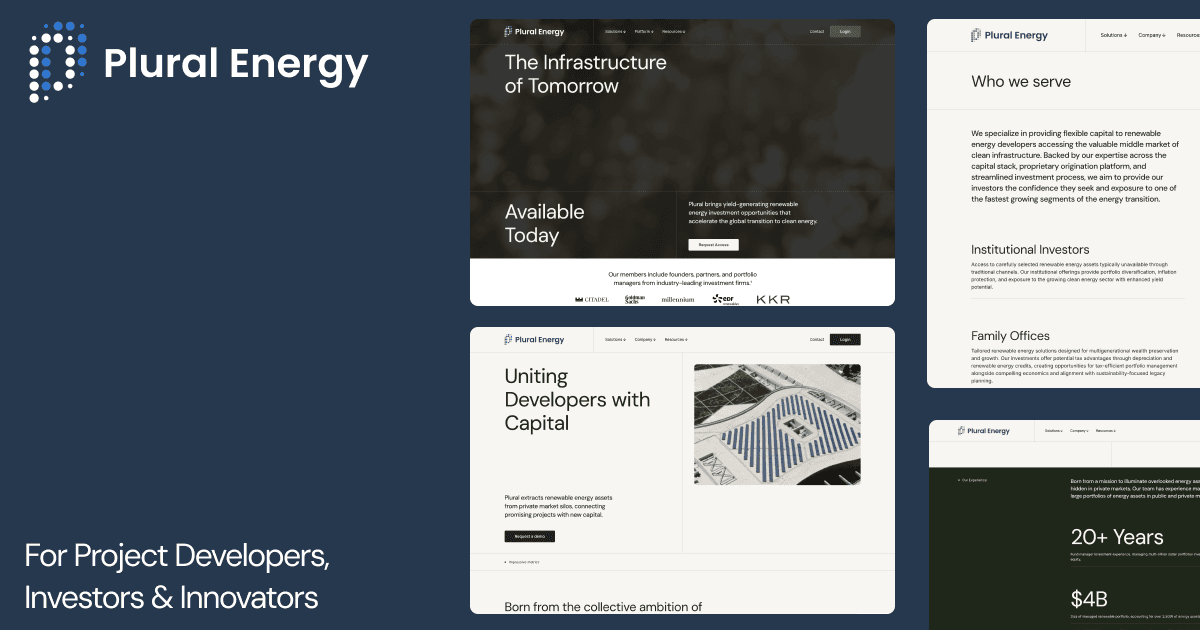
Here is a boring truth that turns out to be worth a lot of money: the hardest part of building a solar farm is not the solar. It is the spreadsheet. Plural, a San Francisco fintech, has decided that the spreadsheet is the actual product - and that if you fix it, several billion dollars of clean energy suddenly become investable.
Let me back up. There is a category of energy project - a commercial solar array, a battery installation, a small microgrid, a data center humming somewhere in Texas - that is too small for Wall Street and too big for a credit card. Call it the missing middle: projects under roughly $100 million. They generate perfectly good cash flows. They are exactly the kind of thing the world says it wants more of. And they have historically been miserable to finance, because the machinery of infrastructure project finance was built for the billion-dollar deal, and pointing that machinery at a $4 million solar farm is like hiring a moving company to relocate a houseplant. The overhead eats the deal.
Plural's insight is that the overhead is mostly paperwork, and paperwork is software's favorite thing to eat. Through tokenization and smart-contract automation, the company turns a real-world energy asset into a programmable investment product - one where ownership issuance, capital deployment, compliance, and reporting are handled by code that doesn't need a lunch break. They call the underlying layer AssetOS, which is a name that tells you they think of a power plant the way an engineer thinks of a computer: as something that should have an operating system.
“Plural is building the financial infrastructure for the electron economy.”
“The electron economy” is the phrase Plural keeps coming back to, and it is doing a lot of work. The idea is that electricity - generation, storage, movement - is becoming its own asset class, one that mostly can't be bought by ordinary institutional or alternative investors because the plumbing to buy it never existed. Plural is building the plumbing. On one side, renewable-energy developers who need capital. On the other, institutional investors, family offices, and alternative retail investors who want exposure to clean-energy yield. In the middle, where there used to be a stack of intermediaries taking a cut and a quarter, there is now a platform.
The Numbers
What Plural has put on the board so far
In September 2025, Plural closed an oversubscribed $7.13 million seed round led by Paradigm, with Maven11, Volt Capital, and Neoclassic Capital along for the ride. The round came in at nearly double its original target and pushed total funding to around $10 million. The interesting detail here is the lead investor. Paradigm is a crypto fund - the kind of firm you'd expect to be underwriting the next token, not the next transformer. That it chose to fund electrons instead of a memecoin is either a sign that real-world-asset tokenization has finally grown up, or a sign that crypto has run out of digital things to tokenize and has started looking outside. Possibly both. Paradigm's own framing was that Plural “enables transparent, scalable capital markets for the physical world,” which is venture-speak for “this could be big and we would like some of it.”
How It Actually Works
Developer to investor, minus the intermediaries
From power plant to portfolio
A simplified path through AssetOS
Vet
An energy asset is diligenced and structured - the broker-dealer sits inside this step.
Tokenize
Ownership is issued on-chain as a programmable investment product.
Fund
Institutions and investors deploy capital directly into the asset.
Operate
Smart contracts automate distributions, compliance, and reporting.
The part that separates Plural from a pitch deck full of the word “blockchain” is what it did about regulation. Most fintechs treat compliance as a tax - an annoying cost you minimize and outsource. Plural went the other way and bought an entire broker-dealer. In 2025 it acquired Northstar Financial Services LP, a FINRA member, and renamed it Plural Brokerage LLC. This is a genuinely revealing move. If your business is convincing serious institutions to buy a novel, tokenized, never-before-securitized slice of a battery installation, the thing you are actually selling is trust. And you don't rent trust. You own the license, you embed the due diligence directly into the tokenization process, and you get to say - accurately - that the compliance is not bolted on afterward but built into the pipe.
“We transform real-world energy assets - like solar, batteries, and data centers - into scalable, programmable investment products.”
The 2% That Matters
Why cheaper capital is the whole game
Plural says project sponsors using its platform have saved an estimated 2% on their cost of capital by streamlining asset-level fundraising and eliminating unnecessary intermediaries. Two percent sounds like a rounding error until you remember what it's a percentage of. In infrastructure, where projects live and die on thin, decades-long margins, two points on the cost of capital is frequently the difference between a project that pencils out and one that quietly dies in a financial model. The chart below is illustrative, not audited - but it's the shape of the argument.
The pitch, drawn as bars
Illustrative · directional, not a benchmark
Figures per Plural and press coverage, Sept 2025. Bars scaled for readability.
Who Built It
Three founders and a name that got shorter
Plural was founded in 2023 - as Plural Energy - by Adam Silver, Jason Grissino, and Alexander Fong. Silver, the CEO, is the front of the house. Before Plural he ran a finance-automation product team at ServiceNow, advised industrial clients on digital transformation at Deloitte, and did the seed-and-Series-A advising circuit as an investor. He also, by his own account, spent a long stretch pitching large developers on the inefficiencies of renewable-energy financing and being told, repeatedly, that his idea was bad. Founders learn to hear “that's a bad idea” and “that's a hard idea” as the same sentence delivered in different moods; Silver apparently decided it was the second one and raised roughly $10 million to prove it.
The company started smaller and scrappier. Its first raise, around $2.33 million from Compound and Necessary Ventures, funded the original thesis: let people invest directly, on-chain, in renewable-energy projects. Plural says it went on to release what it describes as the first blockchain-based distributions for a solar energy asset - the unglamorous milestone of actually paying investors their yield through a smart contract rather than a spreadsheet and a wire. Somewhere along the way “Energy” came off the name, because the ambition had widened from energy specifically to infrastructure generally. When a company shortens its name, it's usually telling you where it thinks it's going.
Adam Silver
Ex-ServiceNow (finance automation) and Deloitte Consulting. The public face of Plural's electron-economy thesis; grew up in a family of entrepreneurs.
Jason Grissino
Part of the founding trio that launched Plural Energy in 2023 to let investors put capital directly into renewable projects.
Alexander Fong
Co-founder of the original Plural Energy team building the financing stack for the clean-energy transition.
Paradigm
Crypto-native venture firm that led the $7.13M seed - a notable bet on tokenizing physical, cash-flowing infrastructure.
The Weird, Good Deals
Where energy, crypto, and carbon collide
The most fun thing about Plural is the shape of the assets that end up on it, because the missing middle is where the genuinely strange projects live. One offering was preferred equity in a Texas microgrid powering next-generation biofuels and carbon capture - a sentence that contains roughly four industries and a blockchain, and which is exactly the kind of deal traditional project finance would rather not touch. Another leaned into Plural's “Mining With Impact” idea: bitcoin mines that run on renewable energy, turned into investable assets, where the pitch is that the hashrate and the clean electrons are the same token. You can decide for yourself whether renewable-powered bitcoin mining is climate progress or a very elaborate way to feel good about a mining rig. Plural's position is more modest and more interesting: whatever it is, it produces cash flows, and cash flows want to be financed.
“Plural's tokenization platform enables transparent, scalable capital markets for the physical world.”
Timeline
From bad idea to broker-dealer
Plural Energy is founded
Silver, Grissino, and Fong start the company in San Francisco to let investors back renewable projects directly.
First raise, first distributions
~$2.33M from Compound and Necessary Ventures; Plural touts the first blockchain-based distributions for a solar asset.
$7.13M seed, led by Paradigm
Oversubscribed round with Maven11, Volt Capital, and Neoclassic Capital; total funding reaches ~$10M.
Buys a broker-dealer
Acquires FINRA member Northstar Financial Services LP, renamed Plural Brokerage LLC, completing its regulatory stack.
Stranger, bigger deals
Texas microgrid preferred equity and a renewable-powered bitcoin-mining asset go live on the platform.
What You Can Actually Do With It
The product, minus the jargon
Strip away the vocabulary and Plural is a two-sided marketplace with a compliance engine bolted into the core. If you're a developer with a solar farm or a battery project, you can raise capital at the asset level without assembling a bespoke syndicate of intermediaries, and potentially do it cheaper. If you're an institution, a family office, or an alternative investor, you can underwrite, monitor, and trade the cash-flow streams from energy assets you previously had no clean way to touch - with the diligence and the distributions running through software. The promise is not that tokenization is magic. It's that the administrative burden which made small energy deals uneconomic can be automated down to something a screen and a click can handle. That's a less thrilling story than most crypto pitches. It's also a more durable one.
Whether Plural becomes the operating system for infrastructure finance or one interesting experiment among many is genuinely unknown, and anyone who tells you otherwise is selling something. What's clear is the bet: that the clean-energy transition is bottlenecked not by panels or batteries but by plumbing, and that the company which fixes the plumbing gets to sit in the middle of a very large flow of money. Plural has decided to be that plumbing. It even bought the license to prove it's serious.