A dress on a phone has no awkward seams. It never pulls across the shoulders. It never looks wonderful on the model and faintly ridiculous on you. For an online fashion company, this is a difficult problem: the photograph can help you want something without helping you know whether you should buy it. Pomelo Fashion built a business around the distance between those two decisions.
- The offer: women’s fashion, selected online and tried in person.
- The twist: with Tap.Try.Buy., payment follows the fitting.
- The tension: convenience won customers; operating costs still mattered.
The promise that needed a mirror
Founded in Bangkok in 2013, Pomelo brought together David Jou, Casey Liang and Win Thanapisitikul. Jou and Liang had run Lazada Thailand. They understood e-commerce, and their new company had a conviction to match: fashion could live online. Stores were outside the plan.
Customer opinion was less tidy. In a 2022 interview, Jou recalled surveys in which roughly half of respondents wanted physical stores. The request kept coming back. For the first two years, he resisted. By the third, the customers had outlasted the theory.
There had also been an intermediate experiment. Pomelo tested delivery services waiting while shoppers tried on purchases. It brought the fitting room to the customer, but Liang later said the logistics would not scale. The idea answered the clothing question while creating a transport question. Someone else’s next delivery depended on how long you spent looking in a mirror.
Tap.Try.Buy. offered a different arrangement. Browse online, choose a participating location, try the selected pieces there, and pay for what you keep. The important change is the sequence. A shopper can reach the garment before reaching for her money.

“Discovery for fashion is going online”
David Jou, 2018
A wardrobe with a local accent
Pomelo makes its own women’s clothing and carries other labels. Its official brand description puts the Southeast Asian woman at the centre of the design process. The assortment covers work clothes, casual looks and party pieces, with accessories alongside. It is a wardrobe proposition for people moving between ordinary occasions, rather than a specialist shop for one ceremony or sport.
That puts it among familiar alternatives: Zara and H&M for trend-led clothing, Shein for online fast fashion, and regional fashion platforms such as Zalora. Pomelo’s useful distinction is the connection between digital selection and physical evaluation. A large online assortment becomes more approachable when the shopper can postpone the final decision until she has felt the fabric.
For someone using the service, the practical job is straightforward: build a shortlist, select an eligible try-on location, and make the trip. Location availability matters. A fitting room across town may be less convenient than delivery at home. The advantage grows when the place fits into a journey the shopper already makes.

The brand also sells a sense of participation. Pomelo.Perks gives the relationship a loyalty program. Purpose, launched in 2018, promotes selected fabrics and production choices, including linen, hemp and natural dyes. Those claims describe a collection’s approach; they do not settle the environmental cost of the whole business. Fast-moving wardrobes still have material consequences.
The fitting room has a balance sheet
Pomelo’s investors bought into an ambitious operation. A $19 million Series B in 2017 included JD.com and Provident Capital Partners. In September 2019, a $52 million Series C brought in investors including Central Group and Provident Growth Fund. The company planned regional expansion and further investment in Henry, its supply-chain automation platform.
The name Henry is a pleasing detail. The customer sees a dress and a fitting room; behind them sits a system with a remarkably unglamorous name. Coordinating what is available, where it moves and what comes back is part of the expertise that makes the shopping promise possible.
Reported loss: $31.9 million. US dollars; rounded figures. Expense and revenue bars are not a reconciliation of net loss.
The figures make the cheerful shopping proposition more complicated. Reported 2022 sales grew 34%, yet the company lost $31.9 million. Thailand supplied around 80% of revenue, while sales fell in several other markets. Around 55 employees were cut that year. Jou subsequently said losses narrowed by more than 65% in 2023.
A better fitting experience can attract people while the business carrying it remains expensive. Inventory, employees and marketing all require cash. The $52 million financing round was capital to pursue the plan, not a price tag for installing Tap.Try.Buy.
Selling the machinery behind the clothes
In 2021, Pomelo launched Prism, offering other brands access to creative, marketing, technology and commerce capabilities. Levi’s and Urban Revivo were named among early users. The logic was understandable: if you have built the machinery to sell one label, perhaps another label will pay to use it.
Later developments brought retail partners into the picture. Crusade Partners announced financing in April 2024 for expansion and working capital. In November 2025, FJ Benjamin announced exclusive Malaysian distribution rights for an initial five years. Its current brand page lists a Pomelo location at Sunway Carnival in Penang. Regional ambition now includes an experienced local operator.
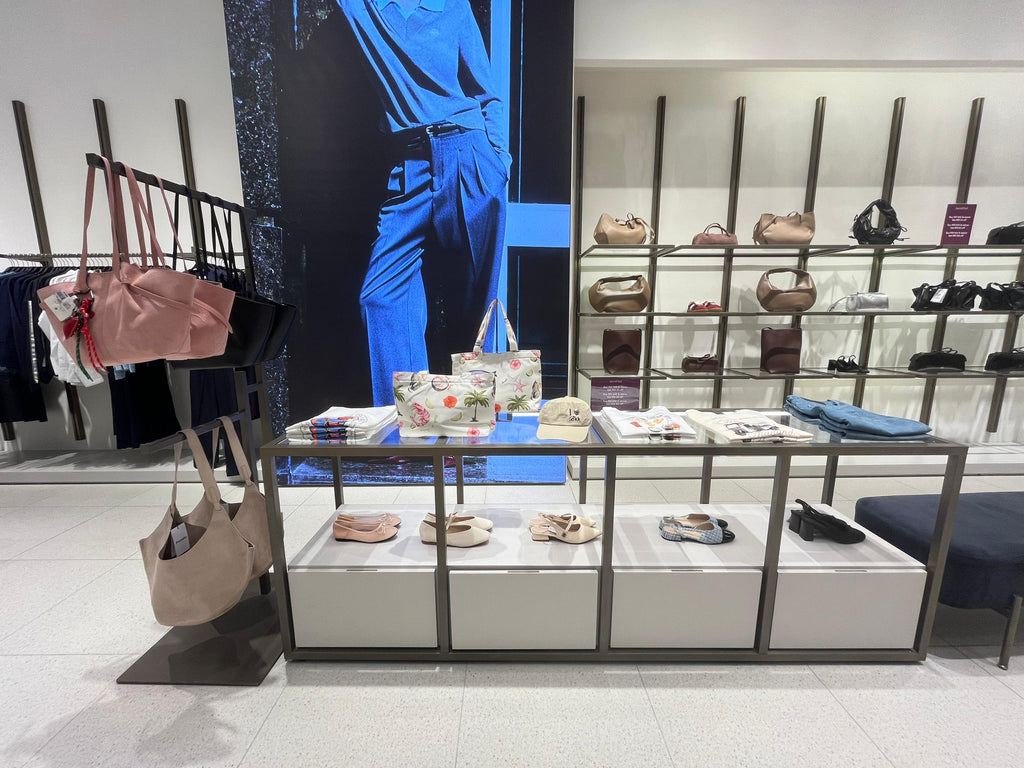
Copy the question before the shop
The transferable lesson starts before the lease. Find the uncertainty that stops the purchase. Test a way to remove it. Then measure the work your answer creates: handling, transport, staff time and unsold stock. A convenient customer experience has to be convenient enough for the business to keep providing it.
Physical try-ons need accessible locations and enough nearby demand to justify the operation. Where customers are scattered, or margins cannot absorb the movement of rejected items, the arithmetic gets harder. Pomelo’s story leaves a useful question for anyone selling through a screen: what does your customer still need to discover in person?