A dress has a small advantage over a business plan: it can be tried on. Casey Liang helped found a fashion company whose early proposition was that shopping could happen online. Eventually, the company made room for a rather old-fashioned activity. The customer could walk in, find a mirror, and see whether the thing actually suited her. Technology had brought her this far. A fitting room would finish the job.
That change is a useful entrance into Liang’s story. Pomelo’s co-founder came to fashion through finance and e-commerce, with experience at Barclays Capital, Vector Capital and Lazada Thailand. The career sounds orderly when reduced to a list. The company he helped build has been less obliging. It has moved from a fashion brand selling online into stores, try-on services and a platform carrying other labels. Each move has changed the work behind the original idea.
The thread running through those changes is a practical question: what does a customer need before she is willing to buy? In fashion, an attractive image gets only so far. The sleeve still has to land in the right place. There are limits to the persuasive powers of a zoom button.
Before the clothes, the numbers
Liang attended Northwestern University from 2003 to 2007. His publicly listed undergraduate studies include applied mathematics and economics. His subsequent financial career included New York and San Francisco, with a stint at technology-focused private equity firm Vector Capital between 2010 and 2012. Later came a managing director role at Lazada Thailand. These were different kinds of businesses, but they put finance, technology and retail on the same professional itinerary.
One way to read that itinerary is as a gradual move closer to the purchase itself. Banking and investment work deal with businesses through their finances. E-commerce adds the daily machinery of orders and customers. A fashion brand adds a product whose appeal can change with the season, the occasion, or the person wearing it. A spreadsheet can hold the sizes. It cannot tell you how the dress feels on Friday evening.

By the autumn of 2013, Liang, David Jou and Win Thanapisitikul were working on Pomelo. The public launch followed early in 2014. Their experience at Lazada gave the founding team a place to start, but they chose a more concentrated business. They would build around fashion, a category in which product selection and the shopping experience could be developed together.
Bangkok mattered to that choice. Jou described the city’s fashion talent as part of the reason to establish the brand there. The founding logic joined an existing creative community to the possibilities of e-commerce. Liang’s story therefore belongs to a team and a place. The finance executive did not have to become the designer of every garment. The business needed people with different kinds of knowledge to make the same promise hold together.
A brand before a shopping basket
Pomelo’s early pitch gave the founders considerable responsibility. In September 2014, the company announced $1.6 million in pre-Series A funding, led by Jungle Ventures. It described a fashion brand with an online sales channel and substantial control over its value chain. Korean fashion trends were part of the initial offering. Singapore was already on the map; Malaysia was in the expansion plans.
That distinction between a brand and a general online shop matters. A marketplace can give customers access to a great many sellers. A brand must persuade them to want its particular products, and then keep doing so. The founding team had chosen a category that rewarded a point of view while requiring frequent renewal. Yesterday’s successful collection was useful history. Tomorrow’s collection still had to earn its orders.
Financing entered Liang’s public account early. In 2016, he discussed venture debt from InnoVen Capital as a way to support growth, market expansion and new capabilities. InnoVen announced loans totaling $5 million across Pomelo and a second company. That combined figure was never a $5 million cheque solely for Pomelo. Even a growth story needs its arithmetic kept tidy.
The significance of Liang’s comments lies in the connection he made between money and work. Expansion requires capabilities before it produces dependable returns. For a fashion retailer, that can mean stock, systems and the people needed to serve another market. Financing determines which improvements can be attempted and how quickly. The ambitions may be fashionable; the bills are usually quite conventional.
The mirror gets a vote
Liang later recalled Pomelo’s original determination to avoid physical retail. The team even tested having delivery services wait while customers tried on purchases. The experiment was impractical to scale. By 2018, the business had opened its first physical store in Bangkok, connecting online selection with in-person fitting. A customer could choose first, try next, and pay for the pieces she wanted to keep.
“strong opinions that are loosely held”
Casey Liang, 2019
There is an agreeable modesty in allowing the mirror a vote. A customer need not know the company’s strategy to appreciate being able to check a garment before paying. Tap.Try.Buy. makes that sequence explicit. The current service description still follows the same three steps: select styles on the app, try them at a store, and buy the items you love.
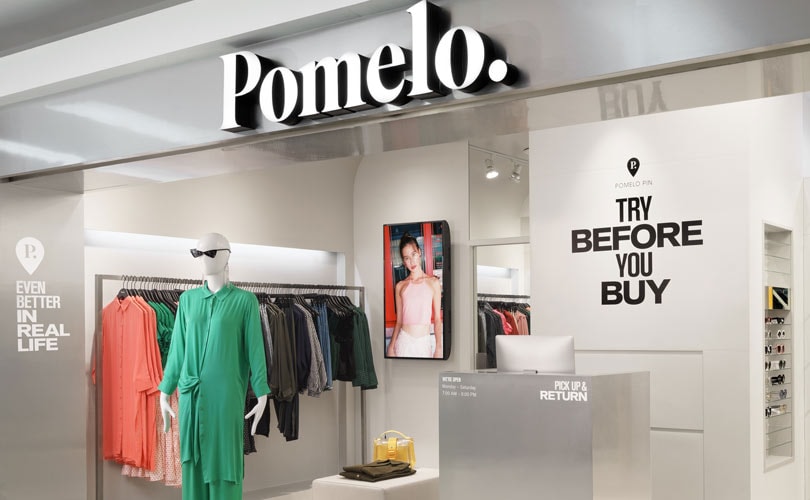
This arrangement also makes the store do more than display whatever fits on its rails. The customer’s selection can begin with a larger online assortment, with the location becoming the place where the decision happens. That is the appeal of connecting the two environments. The phone is good at presenting choices. The fitting room is good at resolving a particular uncertainty.
The convenience carries costs. Clothing travels between warehouses and locations. Items set aside for a try-on are temporarily unavailable to other shoppers. In 2021, Pomelo’s retail leadership described efforts to manage those pressures through delivery operations, consolidated returns and forecasting. A service that feels relaxed to the customer can require a very alert operation behind the scenes.
Another job inside the same company
Liang’s own responsibilities changed as Pomelo grew. In March 2019, the arrival of Jim Boland as CFO accompanied Liang’s move into the growth team, covering performance marketing and business intelligence. It was a shift from one set of business questions to another: how to bring customers in, understand their behavior and encourage them to return.
Earlier, the company had described collecting store feedback and connecting it with browsing and purchase histories. The operating idea was to identify where an experience failed and change the process responsible. That gives some context to Liang’s move. A try-on service produces more than sales. It creates encounters whose quality depends on stock, staff, software and timing working together.
The arrangement makes coordination consequential. Creative teams can make something people want; technical teams can make it easier to discover. A fitting location then has to deliver the experience promised on the screen. The growth role sits near those intersections. At that point, the founder’s task included helping departments work toward the same customer outcome.
In October 2020, Liang appeared in a 51-minute episode of The Pomelo Podcast, billed as CFO and co-founder, in conversation with Jou about the company’s beginnings. A public executive listing updated in April 2026 again gives his title as co-founder and chief financial officer. Through the changing responsibilities, his association with the business remains the continuous line.
Growth has two columns
In September 2019, Pomelo announced a $52 million Series C, bringing reported funding above $83 million. Investors included Central Group, Provident Growth Fund and InterVest Star SEA Growth Fund. The company planned to use the capital for regional expansion, technology and supply-chain automation. These were plans for a more complicated enterprise than the online brand of its early days.
A financing round for the company Liang co-founded. Capital raised is separate from revenue or profit.
Another revision followed in 2020: Pomelo announced its transition into a multi-brand platform. It would continue its own collections while offering products from other labels. The app became a place to discover a wider selection. That decision expanded the meaning of the original brand, adding the work of choosing and presenting somebody else’s products alongside its own.
Growth eventually made the financial questions more visible. Results for 2022, reported in March 2024, showed revenue of $38 million and a loss of $31.9 million. Revenue had risen 34 percent year on year. Thailand supplied around 80 percent of sales. The figures describe a business finding substantial demand while still carrying a costly operation.
Later in 2024, investor 500 Global reported that Pomelo had reached positive EBITDA in March and was expanding through distribution partners in Cambodia and the Philippines. EBITDA is a different measure from net profit. The update nevertheless marked a change in the financial account, alongside another change in how the company intended to reach customers.
Those two columns belong in Liang’s story together. A founder with a finance background helps build a company that must make clothes appealing and make the operation pay. Each additional market, brand and fitting location adds possibilities, along with obligations. The work continues well beyond the announcement that makes the easiest headline.
Pomelo’s original idea has survived through revisions to its form. Liang’s career offers a way to follow those revisions without treating every turn as a fresh invention. The customer still wants something worth wearing. Before she commits, she would quite reasonably like to see it on. A business plan can be revised. A badly fitting sleeve is harder to negotiate with.
Continue the conversation
- Casey Liang on LinkedIn
- Pomelo’s Beginnings - the 2020 podcast
- Liang’s 2019 interview
- The founding team’s early account
- Pomelo’s 2014 financing
- 2016 venture debt announcement
- The 2019 CFO transition
- The $52 million Series C
- Pomelo’s platform announcement
- Inside the try-on operation
- The 2018 customer-feedback approach
- 2022 financial results, reported in 2024
- 2024 expansion update
- 2026 executive listing
- Education and early career
- Pomelo website
- Pomelo Instagram
- Pomelo YouTube
- Pomelo Facebook
- Pomelo on X
- Pomelo TikTok