A cardboard box has obliging corners and flat surfaces. Put it beside a crumpled polybag and an overlapping padded envelope, however, and the scene becomes a small argument about geometry. A warehouse worker settles that argument almost without thinking. An industrial robot needs instructions. Plus One Robotics has spent a decade making those instructions useful - including the instruction to ask a person.
- The work: giving robots vision to pick parcels, unload pallets and build them again.
- The twist: remote Crew Chiefs help machines recover from uncertain scenes.
- The buying lesson: price the exceptions alongside the equipment.
In April 2026, the company announced more than two billion successful picks across its fleet. The first billion had taken eight years; the next took two. These are company-reported production totals. Still, they suggest something more interesting than a clever demonstration: the same awkward problem has been solved repeatedly, in working warehouses.
The parcel has no manners
Plus One sits at the point where goods must be separated, moved and presented to another machine. Parcel induction means taking packages from a cluttered flow and placing them individually onto a sorter’s conveyor. Depalletizing means removing goods from a pallet. Palletizing reverses the operation. Every missed pick or prolonged pause makes these ordinary jobs consequential.
PickOne, the company’s vision software, combines two-dimensional images, three-dimensional information and AI to identify items and possible picking locations. It supplies the robot controller with the information needed to act. A camera supplies the view; an industrial arm supplies the movement. Plus One sells the coordination, along with integrated systems for customers who want the pieces assembled.
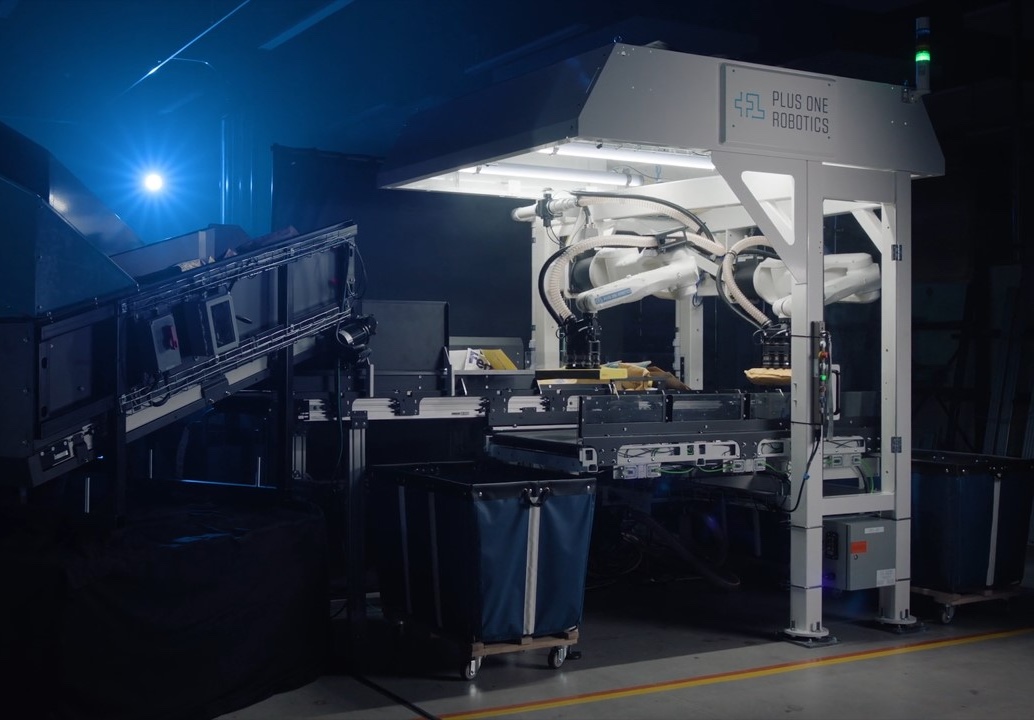
There is useful modesty in the workflow. If confidence is too low, the system can shuffle the parcels and look again, or send the scene to Yonder. A remote Crew Chief selects an item, and the robot receives the revised information. Placement is checked afterward, too. Picking something up is only half the assignment; putting it down badly can simply move the problem along the belt.
The expensive walk
Yonder makes the human contribution an operating feature. Its queue management lets one Crew Chief support multiple systems, while dashboards track performance and downtime. The person’s job becomes intermittent judgment rather than continuous lifting. Managers must stretch a limited workforce across repetitive tasks.
The company’s account of its early operations supplies the revealing detail. Before Yonder, a failure meant someone physically walking to the cell. Recovery took minutes, much of it spent getting there. A confusing picture could require the same journey as a physical obstruction. Sending that picture to a remote person shortened the route between uncertainty and a useful decision.
Remote judgment handles visual uncertainty. Physical problems still need physical help.
Four arms in Memphis
In 2020, FedEx installed four robotic arms for small-package sorting at its Memphis World Hub. Yaskawa Motoman supplied the arms, grippers and integration; Plus One supplied vision, AI and the computing system. The division of labor explains the company’s place in the market. It brings perception and supervision to industrial hardware, without requiring customers to treat every part of the cell as a proprietary invention.
MSC Industrial provides another example. Its Harrisburg fulfillment center deployed a Plus One robotic packaging system in 2019. The distributor subsequently described plans to expand the technology across its network, citing productivity and the ability to redirect associates toward other work. That is a more concrete test of usefulness than an impressive pick performed for a camera.
“After experiencing the productivity of Plus One’s solutions”Doug Jones, MSC Industrial, explaining the company’s interest in expanding deployment
The founders arrived with relevant industrial experience. Erik Nieves had been technology director at Yaskawa Motoman. Shaun Edwards and Paul Hvass had worked on ROS-Industrial, the effort to bring open-source robotics capabilities into industrial applications. Nieves founded Plus One in 2016, Edwards joined as co-founder, and Hvass followed in 2017.

The price of a useful pair of hands
InductOne, launched in May 2024, puts two coordinated arms into one induction lane. At launch, Plus One reported sustained rates of 2,200 to 2,300 picks per hour and a peak of 3,300. The difference deserves attention. A peak tells you what a machine can briefly do; sustained output is closer to what an operator can schedule around.
DepalOne, officially launched with hardware partner beRobox in June 2025, packages pallet handling into a portable cell. Its current advertised starting price is $155,000. PickOne tiers offer different capabilities, from simpler level-layer picking to mixed layers and more elaborate package handling. Buyers must match those capabilities to their actual goods. A starting price is the beginning of a project calculation.
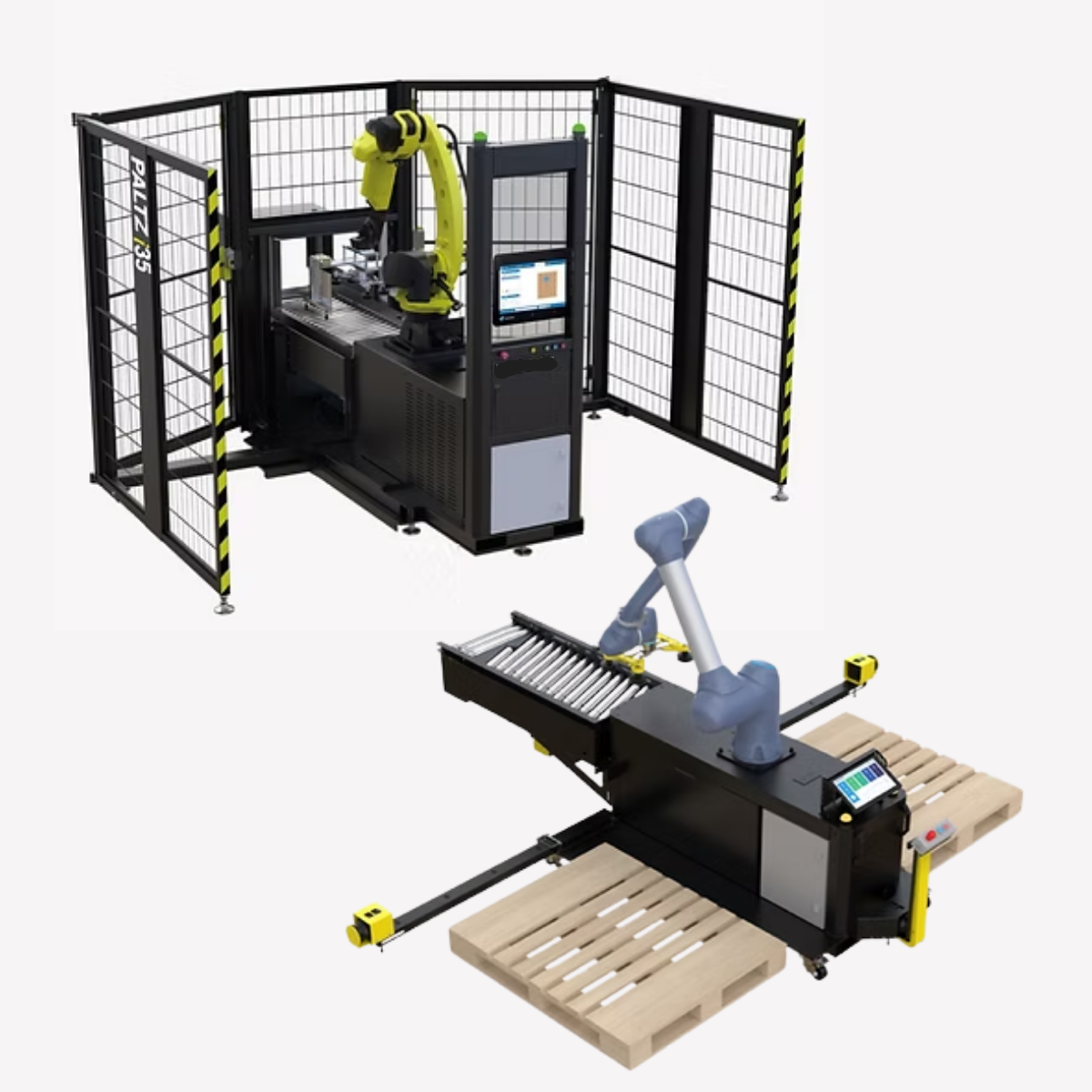
The commercial model spans complete cells, software for partner-built cells, integration, training and ongoing support. A $33 million Series B in 2021 financed expansion and development; a $50 million Series C followed in 2023. Partners extend the company’s reach into existing operations. RightHand Robotics offers adjacent picking and induction technology, making workflow fit a more useful comparison than the word “AI.”
The human keeps the deciding vote
Even the remote helper is being studied. In an experiment with Google DeepMind and 66degrees, Plus One tested a cloud-based AI Crew Chief. Its reported accuracy gap prevented independent operation; the team instead described exploring assistance with pre-labeling. The recovery system was itself subject to the same practical test as the robot: could it make sufficiently reliable decisions?
The lesson a reader can copy is straightforward. Define the ordinary task, then design and measure the exception route. Test the real package mix. InductOne lists a 15-pound parcel limit; oversized or unsuitable items need another path. A torn belt cannot be repaired by selecting a better pixel. Reliable automation needs boundaries, maintenance and people who know when to step in.
Plus One’s motto is “Robots Work. People Rule.” The company’s wager is that a machine can remain productive without being self-sufficient. For anyone responsible for getting tonight’s parcels onto tomorrow’s trucks, that is a proposition worth examining.