Philippe d’Offay’s first million dollars took the scenic route. He founded pMD in 1998 and reached that annual revenue milestone in 2009. Eleven years is a considerable interval in which to keep believing in an idea. It is also enough time for an entrepreneur to acquire an education that no graduation photograph can adequately commemorate.
There had been a promising contract, a frightening reversal, and a succession of customers won with considerable effort. There had been colleagues working without salaries. The business moved from Atlanta to New York and eventually to the San Francisco Bay Area. The founder remained; his assumptions kept needing revision.
Today, d’Offay is still identified as pMD’s founder and CEO. His account of building the software and services company is unusually useful because he remembers the awkward parts: the customer he could not afford to lose, the small team that stopped feeling small, the responsibilities he could no longer hold personally. Independence, it turns out, comes with quite a lot of administration.
The first million took the scenic route
Early on, pMD won business representing 500 licenses. For a company accustomed to finding customers individually, this was a substantial advance. It also concentrated an alarming amount of power in one relationship. D’Offay acknowledged that he had negotiated the contract poorly. When the business disappeared, the company came close to bankruptcy.
He returned to finding smaller customers. In the earliest arithmetic, he calculated that twenty customers would keep the doors open while the team went unpaid. As the business grew, the amount required to sustain it grew too. The finish line had developed an irritating habit of moving.
The lesson is contained in the sequence. Winning something large did not remove the need to understand its terms. Revenue could arrive accompanied by fragility. The first million eventually came in the same year as the Bay Area move. There was no tidy escape from the intervening work, and d’Offay makes no attempt to invent one.
Annual company revenue reported in his 2016 interview. Historical figures, shown on the same scale.
A ticket to Paris, a question at Deloitte
D’Offay’s route to that Atlanta starting point was hardly provincial. Born in South Africa, he lived in Seychelles until he was eight, then moved to the United States. His family eventually settled in Oklahoma. He studied mechanical engineering at Oklahoma State University and flew to Paris the day after graduation. Some people celebrate finishing university with a lie-in; he preferred a departure gate.
At Deloitte Consulting, his work involved business process reengineering and Oracle enterprise software. He examined how companies operated and how their systems might work better. Repeated assignments gave him repeated exposure to the same limitation: standard software could solve much of a problem while leaving an inconvenient remainder.
“What about the 20%?” he asked. The workarounds for that remainder often depended on people doing things manually. He began considering a business that would build software and services around those gaps. By 1998, he had started pMD in Atlanta. The idea had an engineer’s practical curiosity: look carefully at the part everyone else has learned to tolerate.
“What about the 20%?”
Philippe d’Offay, on the gaps left by standard software
A product waiting for its pocket
Development began in 1999. Former Deloitte colleagues joined him, with programmers and an operations colleague working from his Atlanta condo. They worked for free. The setting was domestic; the commitment was considerably less casual.
The software emerged in 2001 after its development and beta period. Mobility was central to the proposition, but the early hardware created a selling problem of its own. D’Offay had written for the Palm platform. Persuading a customer to adopt the software also meant persuading that customer to adopt a device.
He remembered believing the first sale meant the next ones would be easy. They were difficult. Customers who adopted the product became enthusiastic supporters, and their recommendations helped bring others. Enthusiasm travelled more slowly than the founder had hoped.
The BlackBerry changed the equation by combining functions people already carried separate devices to perform. Later, the iPhone altered it again. There is a useful humility in this part of his story. A founder can be committed to a direction and still have to wait for the surrounding habits and hardware to catch up. Product judgment includes knowing what the customer must change before the product can fit.
- 1999Development begins
- 2001Mobile software introduced
- 2006BlackBerry version released
D’Offay corrected the BlackBerry release year to 2006 later in his interview.
Five people were easy. Seven were an education.
By the time pMD arrived in the Bay Area in 2009, d’Offay said it had already sustained four years of positive cash flow. Customers were recommending it. Yet he wanted a more deliberate way to generate leads, rather than leaving the company’s future entirely dependent on referrals. Learning to market beyond the existing circle proved demanding.
Inside the company, another difficulty arrived in miniature. Five people had worked closely together. At six and seven, the familiar chemistry began to disappear. The expansion was small enough to seem harmless and large enough to require a different arrangement.
D’Offay read about group dynamics and began assigning people to specific parts of the business. The old assumption that everyone could sit together and work across everything had reached its limit. Responsibility needed a clearer address.
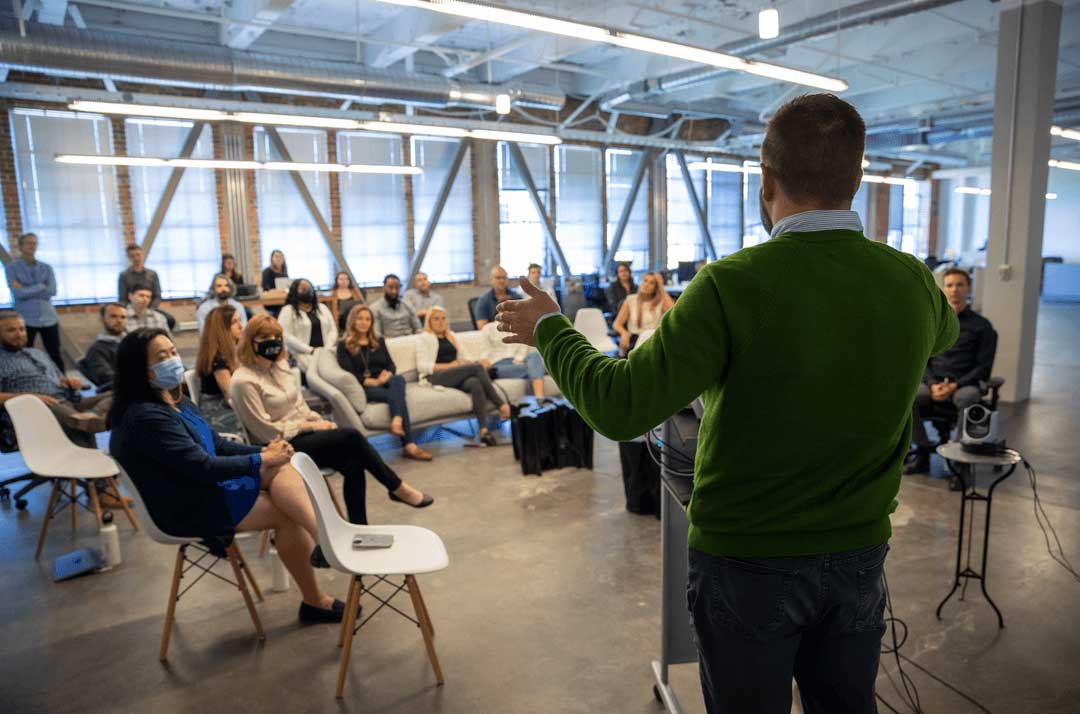
The next difficult threshold came around fifteen people. Communication no longer worked simply because everyone had attended the same meeting. Some colleagues felt excluded; others did not understand what was happening elsewhere. D’Offay had fourteen people reporting directly to him, an arrangement that left him stretched across too many demands.
He needed leaders able to take charge of their own groups, speak with those groups and carry responsibility beyond a conversation with the founder. He also needed to change what he looked for when hiring. People joining a larger organization could reasonably want structure, guidance and experienced managers.
That distinction matters. The early company had depended on people prepared to take on whatever appeared. The growing one needed a structure in which people could understand their work and develop within it. His answer required him to reduce the number reporting directly to him and ask other leaders to apply the same discipline.
There is a pleasing irony here. D’Offay valued control over his company, but making it function required him to surrender personal control over more of its daily decisions. Ownership could preserve the freedom to choose a direction. It could not give him additional hours in which to conduct every conversation.
Permission to challenge the house
By 2015, pMD generated $6.4 million in revenue. D’Offay’s financing account was more nuanced than the word “bootstrapped” sometimes suggests: he began with savings, then brought in friends, family, colleagues and individual investors. In 2016, he put the money raised at a little over one-third of a million dollars.
Growth created fresh weaknesses. Customer relationships had once belonged naturally to everyone. Eventually, colleagues had too many customers to remain closely connected to each one, and dissatisfaction could escape their attention. The company needed dedicated account managers.
New products required a different kind of attention. Hearing Clayton Christensen discuss The Innovator’s Dilemma encouraged d’Offay to create an internal division intended to challenge the established business. Experiments could develop quickly; those attracting interest could then move into the mature organization.
The arrangement gave a detail-oriented founder a practical method for questioning what he already owned. A successful product deserves care. It also deserves the occasional well-organized threat from somebody in the next room.
A little altitude, a little perspective
Outside work, d’Offay’s company biography identifies two interests: cycling and private flying. Aviation also found a place inside pMD’s employment offering. Its learn-to-fly program allowed interested full-time employees to take flying lessons paid for by the company. In 2021, the program received an Inc. Best Benefits Award.
It is a rather more adventurous interpretation of professional development than a conference lanyard. The company connected the benefit with confidence, prioritization and time management. The personal ambition belonged to the employee; the organization helped make pursuing it possible.
His advice to undergraduates at Brown University brings the story back down to ground level. Begin working on ideas while still studying. Observe problems, try building something and find out whether anyone will pay for it. Be specific about the goal, because every additional ambition competes for the same finite resources.
He also urged founders to recruit colleagues willing to make decisions and share responsibility for the outcome. That advice has the texture of experience. His own company repeatedly required him to reconsider how people should work together, even as he remained committed to owning its direction.
D’Offay’s career offers the quieter satisfactions of building something that can keep changing. There is the long first decade, the revised organization, the customer relationship that needs a named owner. And there is room, somewhere in the working week, for someone else to begin learning how to fly.