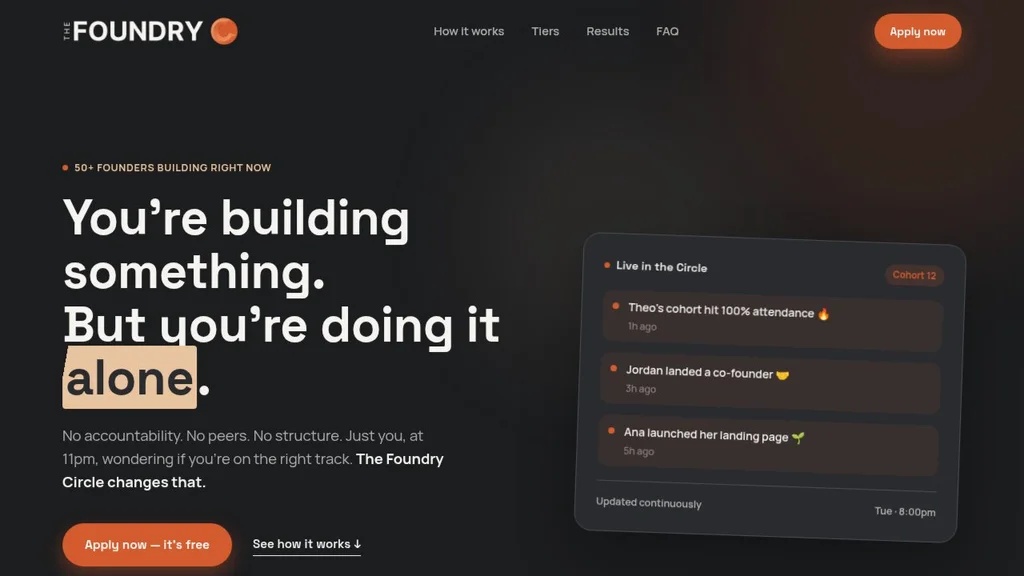
A side project can survive for months on the phrase “nearly there.” The landing page is nearly there. The prototype is nearly there. The brave email to a potential customer is sitting, nearly sent, in drafts. The Foundry Circle offers a small interruption to that private arrangement: a weekly meeting with other founders who will hear what happened next.
The network gathers eight to twelve people at a similar point in building a business. They bring obstacles, discuss possible fixes and return the following week. Membership is free. The work might be a startup, a product or a business being assembled around a day job. The proposition is easy to understand: give an unfinished project a regular audience with a memory.
That last part matters. A stranger at a networking event can wish you luck. Someone who heard last week’s plan can ask what stopped it. The Circle’s appeal lies in that second conversation, where encouragement can become specific enough to be useful.
An appointment for the after-hours business
The founder is Ali Liaquat, whose public professional profile describes a background in digital marketing automation. His published work ranges from marketing journeys to the difficulty of building a business in New Zealand’s relatively small market. The Circle’s own account ties its origin to his experience of working on a venture alone. The customer is someone in a recognizable situation: employed, busy and trying to make room for another ambition.
Consider the scheduling problem that creates. A full-time job comes with colleagues, meetings and consequences. A side venture often comes with a browser full of tabs. Moving it forward requires decisions about what deserves the next spare evening. A standing appointment can give those decisions a deadline, particularly when other people expect to hear the result.
This is the problem the Circle chooses to address. Its weekly peer format puts companionship and follow-through into the same hour. A founder brings a real piece of work; the group brings attention. For someone who has spent a week turning the same question over alone, even explaining it clearly to other builders may be a useful first step.
Bring the blocker, leave with a next step
The public Meetup description makes the meeting concrete. There are quick check-ins, then four or five founders bring a blocker or question for the group to work through. Everyone sets a goal for the following week. It is a format with a useful restraint: a few problems receive attention rather than every participant delivering a long status report.
The distinction between a blocker and an update is worth keeping. “I worked on the website” supplies little to discuss. “People visit the pricing page but do not sign up” gives peers something to examine. Those are illustrative examples, but they explain why the meeting’s usefulness depends on what participants bring into it. Vague inputs can consume a very precise hour.
The application reinforces the commitment. It asks what applicants are building, their current stage, how they balance it with a day job and whether they can attend Tuesday evening calls for eight weeks. It also asks what help they want. Before joining, applicants have a 30-minute conversation. The company says it aims to respond within 48 hours.
There is a practical lesson in the order of those questions. Before promising a founder access to a community, establish what they are doing and when they can participate. A good match on ambition is of limited use if the calendar never matches. Anyone considering joining should check the cohort’s actual time against their own working week.
School names, unfinished businesses
The Circle calls its stages Freshmen, Juniors, Seniors and Graduates. The vocabulary is faintly comic for adults squeezing product work around laundry and paid employment. It also does a job: each name points to a different kind of unfinished work. Freshmen develop an idea. Juniors build. Seniors launch. Graduates work on monetization and scale.
Matching by stage is the service’s most consequential design choice. A person searching for a first user and a person deciding how to support paying customers can enjoy the same conversation, but their immediate decisions differ. Put similar problems together and participants have a better chance of contributing relevant experience. The group can spend less time establishing context.
There is a limit to the shorthand. Two products at the same stage may face very different buying processes or technical constraints. A cohort label helps start a conversation; it cannot settle the question under discussion. The founder still needs to decide which suggestions fit the business and which belong to someone else’s experience.
Free has a time budget
The financial offer is straightforward: membership currently costs nothing, and the Circle says it takes neither equity nor revenue share. Its FAQ leaves room for possible paid options later. For now, the resource members must supply is time. An hour of attendance also asks for enough attention to be useful to someone else.
That exchange distinguishes peer support from buying an expert’s answer. If you join expecting the room to solve your business while you remain a spectator, the arrangement becomes lopsided. Every participant has work of their own. Reciprocity is therefore part of the product, even though it does not appear as a line item on an invoice.
The business also has an operating question built into its generosity. Matching founders, maintaining groups and keeping conversations useful require effort. A free entry point makes the decision to try easier; it does not make those tasks disappear. The model should be judged by the quality and continuity of its meetings, rather than by how inexpensive its invitation sounds.
For a potential member, a sensible test is personal and concrete: does this hour improve the use of the other hours available? A discussion that leads to one customer conversation may justify itself. A pleasant call that repeatedly replaces the evening reserved for building deserves a harder look.
There is also a difference between accountability and constant availability. A founder with a day job may be able to protect one weekly appointment while having little appetite for an endless stream of messages. The fixed meeting gives the relationship a boundary. Used well, that boundary can help participants arrive prepared and then return to their own work. Used poorly, the call becomes one more obligation to squeeze into an already crowded evening. The format asks each member to make that distinction for themselves, based on what changes between meetings.
A potential co-founder, observed over time
Co-founder connections are another part of the offer. The Circle describes an organic approach: people get to know one another through participation, with profiles indicating whether they are looking for a partner. Repeated contact provides opportunities to observe behavior that a polished introduction can hide.
Does a potential collaborator listen? Can they explain a problem without making everyone else responsible for it? Do they return having done what they said they would do? These are useful questions for any working relationship. A weekly group creates occasions to ask them through observation, before a partnership becomes a serious commitment.
Good chemistry on a call is still an early signal. Building together involves decisions about responsibility, pace and disagreement that conversation alone cannot test. The useful thing to copy is the sequence: meet repeatedly, observe how someone works, then consider a small shared project. Compatibility becomes easier to assess when there is actual work to discuss.
“Stop describing the outcome. Demo it.”
The Foundry Circle, in a public LinkedIn post
The next useful thing should be visible
That advice from the Circle’s public feed fits its central proposition. A demonstration gives other people something to respond to. The same principle can govern an accountability call: a page published, a prototype tested or a conversation completed is easier to discuss than a declaration of determination. Progress becomes an object the group can examine.
The Circle also describes tracking milestones and eventually using that history to help connect founders with incubators. That is an ambition for the network’s future. The immediate value of a progress record is closer to home: it lets a founder distinguish a difficult week from a month spent avoiding the same decision.
Readers can borrow the basic practice without inventing a complicated program. Find peers facing comparable work, agree a recurring time, bring one specific obstacle and finish with a commitment small enough to complete before meeting again. Write it down. At the next conversation, begin with what happened. A useful group needs permission to discuss a missed goal without turning the admission into a performance.
The Foundry Circle occupies the space between solitary building and more formal startup support. Its format suits someone who has a project, wants peers and can return consistently. A founder needing specialist expertise or immediate capital will have a different problem to solve. For the after-hours builder whose project keeps slipping into next week, the invitation has an appealing specificity: put it on the calendar, and bring something back.
Step into the conversation
Visit the website ↗Explore the application ↗Read the membership FAQ ↗Browse public events ↗Follow on LinkedIn ↗Find it on Facebook ↗Ali Liaquat’s profile and writing ↗