Levi Fawcett built himself a caravan to live in at university. Student accommodation usually involves accepting somebody else's questionable decisions about plumbing. Fawcett preferred to make the decisions himself. Years earlier, at 13, he had converted a shipping container into a sleep-out, adding insulation, windows, doors and electricity. Before he had a company to build, he had already found practical uses for the urge.
He grew up in rural Canterbury, New Zealand, was homeschooled, and learned by working on things: cars, farm equipment, motorbikes. These were objects that demanded an answer. A tractor does not become less broken because its owner has developed a compelling presentation about tractors. There is a satisfying severity to that kind of education. Eventually, something has to move.
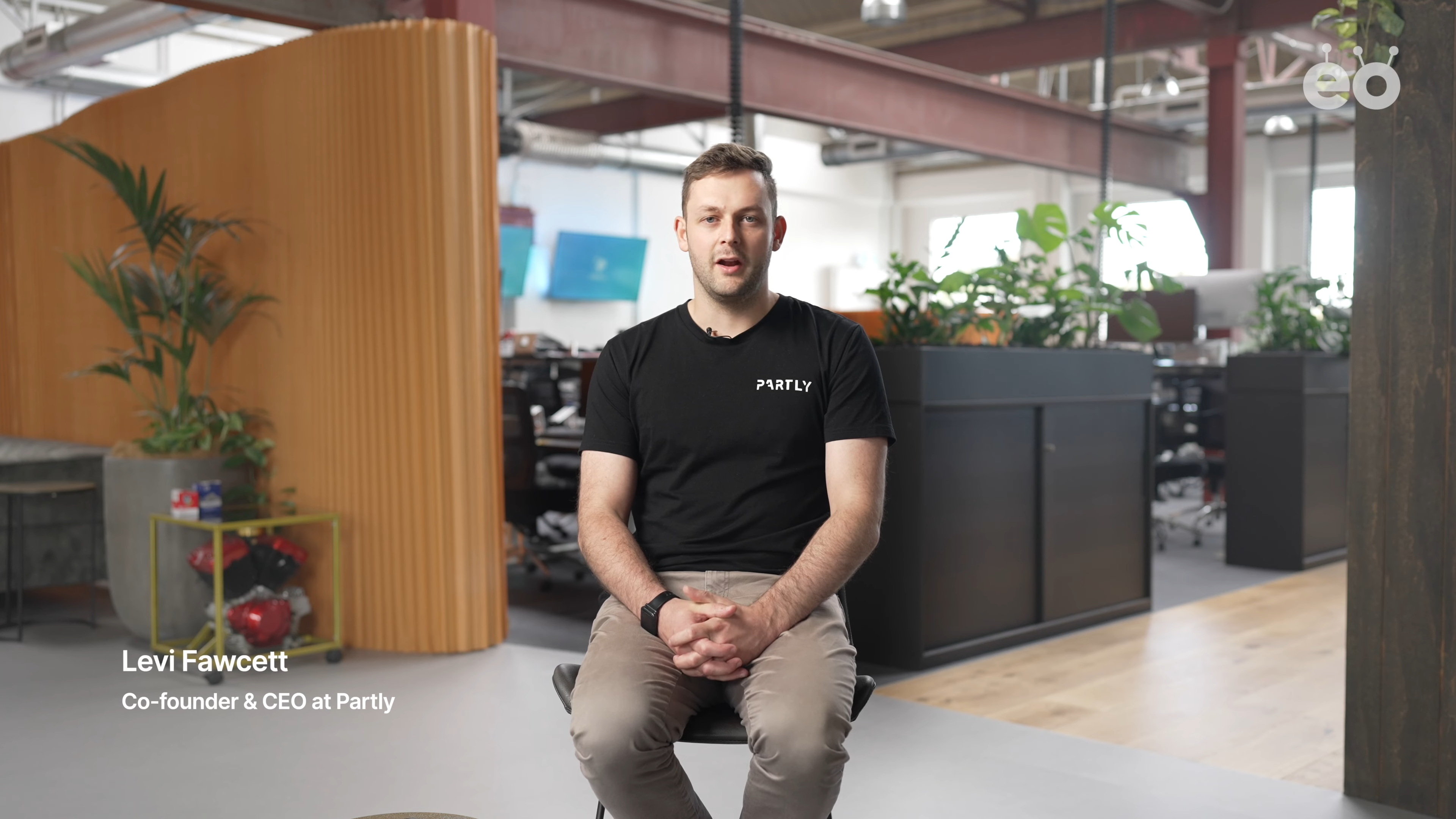
That early habit gives his subsequent career a certain continuity. The materials have changed, from accommodation and engines to databases and machine learning. The recurring question concerns the thing preventing another thing from working. Now the co-founder and CEO of Partly, he has made a business around a frustration familiar to anyone who has tried to buy a replacement car part: finding something that looks right is considerably easier than knowing it will fit.
The University of Canterbury lists his qualification as a Bachelor of Engineering with Honours, awarded in 2017. By graduation, he had already founded four businesses. It is a busy way to be a student. It also helps explain why the caravan belongs in this story. Fawcett was already inclined to build a solution when the available arrangements displeased him.
Rocket Lab raised the ceiling
At Rocket Lab, Fawcett worked on the engineering behind the Electron rocket. He became its first hardware simulation engineer and built teams for hardware simulation and internal infrastructure. Simulation asks a useful, unforgiving question: what happens when the equipment meets the conditions it will actually face? It is an education in consequences, conducted before the consequences become expensive.
Peter Beck's influence extended beyond the technical work. Fawcett has repeatedly credited Rocket Lab's founder with expanding his sense of what a New Zealand team could attempt. Working on a rocket changed the dimensions of an acceptable ambition. Geography began to look less like an explanation for modest goals.
There is an appealing incongruity in leaving rockets for car parts. One comes with launch footage. The other comes with catalogues. Fawcett's attachment to vehicles, however, preceded his aerospace career. He and childhood friend Nathan Taylor had built and raced go-carts; an early job involved preparing high-performance engines. The car parts business was a return to familiar machinery, carrying an altered idea of scale.
The engineering work also gave him a model for organising people around a difficult objective. A clear destination allows individuals to make decisions without waiting for instructions about every turn. That idea would travel with him into Partly, where the work increasingly crossed countries, occupations and time zones.
The useful thing inside the failed thing
Before Partly came AllGoods, a general marketplace founded with Taylor. The pair had known each other since childhood. Their early working arrangements were improvised: Taylor lived in a converted garage while Fawcett parked his caravan in the driveway. A shared property became the setting for the business. There were cheaper ways to organise an office, presumably, but few with such a short commute.
AllGoods attracted sellers and buyers, yet Fawcett came to regard its underlying economics and competitive position as inadequate. A marketplace can be busy while remaining a poor business. People already buy where the sellers are, and sellers already list where the buyers are. Persuading both groups to abandon that arrangement is a demanding use of a young company's money.
One category kept revealing a different problem. Sellers of vehicle parts struggled to list their stock properly; buyers struggled to identify what they needed. Part numbers alone could not express all the relationships between vehicles and components. The difficulty crossed borders. The founders were encountering a data problem while trying to run a marketplace.
They started Partly in 2020. Taylor, Mark Song, Evan Jia and Tony Austin are also identified as co-founders in the company's early public history. The shift required Fawcett to separate persistence from attachment to the original idea. AllGoods had provided an expensive education. Partly would put that education to use in a narrower task with international demand.
A catalogue is only the beginning
The deceptively small word in the car parts trade is 'fits'. A part has a number, but its usefulness depends on its relationship to a particular vehicle. Different configurations create different requirements. A list of products, however extensive, leaves a buyer with the same awkward question if it cannot describe those relationships reliably.
Partly's early approach combined inventory software with a vehicle database. Its PartsPal product helped businesses manage parts and publish listings; the Universal Vehicle Database supplied the connections. The company's later work has expanded into AI for repair. Across those versions, the commercial purpose remains recognisable: help people identify and obtain the components a repair actually requires.
Fawcett has been willing to do distinctly unglamorous work to make that happen. For early customer MagWarehouse, he spent two weeks on site building a Shopify integration connected to PartsPal, Trade Me and eBay. He slept there while completing the migration. Customer proximity, in this instance, was measurable in metres.
It is a telling detail because infrastructure companies can sound abstract. The consequences of their failures are very specific: a listing that does not appear, an order that takes too much effort, a part that cannot be confidently matched. Spending the night at a customer's premises is one way of making sure the abstraction does not become too comfortable.
The instruction to stop hiring yourself
As Partly grew, Fawcett's work became less about personally completing every difficult task. He has discussed the need to recruit specialists rather than assemble a company of people with his own abilities. 'Don't hire yourself,' he advised in 2023. A founder's strengths can become an oddly restrictive hiring specification if nobody notices what the business still lacks.
He also prefers frameworks that help people reason to procedures followed without thought. The distinction suits a business in which an engineer and an automotive expert need to reach a useful answer together. Both bring knowledge the other may lack. A prescribed sequence can only anticipate so much; people still have to understand the purpose of the work.
His professional circle has widened accordingly. Early backers included Beck, Figma co-founder Dylan Field and Notion co-founder Akshay Kothari. A US$21 million Series A followed in December 2022. In 2023 he was an EY Entrepreneur Of The Year New Zealand finalist. In August 2024 he received both the Entrepreneur Leadership Award and the overall Most Incredible Leader Award at the inaugural New Zealand Leadership Awards.
Fawcett has also mentored startup founders through the Ministry of Awesome network. He describes that work as paying forward the help he received. It is a practical connection between the two sides of his career: the engineer who learned from a more experienced founder, and the executive now able to help somebody else avoid an unnecessary mistake.
“Don’t hire yourself.”Levi Fawcett · Wild Hearts, 2023
From Canterbury to the repair bay
In June 2026, Partly announced a US$50 million Series B led by DST Global Partners to support North American expansion and further development of Interpreter, its repair-focused AI. The company described five years of model training, drawing on manufacturer catalogues, repair information and feedback from its international operations. The parts problem had become a sustained research programme.
Fawcett's own geography changed with it. By June he was dividing his time between the San Francisco Bay Area and Austin, where Partly had anchored its US operations. The business retained teams in New Zealand and a UK base. For someone whose early headquarters included a driveway, the travel arrangements had become more elaborate.
He reported that Interpreter was supporting more than 1,000 businesses. Those figures describe the company's account of its progress, while his September 2026 CollisionCast conversation offered a more immediate picture of the job: software helping repair shops examine estimates, spot omissions and handle the administration around a repair. He called it a 'second set of eyes'. The phrase gives the technology a useful scale. There is still a person trying to finish a job.
That is where the story returns to the workshop. The interesting question is what happens to the work when reliable information becomes easier to obtain. Can someone make a sound decision sooner? Can the right component be found without another round of calls? Can an otherwise repairable vehicle stay useful? These are ordinary questions with consequences for the people answering them.
A longer life for things
Fawcett's ambition reaches beyond an efficient transaction. He has spoken about making replacement parts accessible and reducing unnecessary waste, and about a future in which repairable cars avoid landfill. The environmental argument follows directly from the product: an object is easier to keep when the piece it needs can be identified and obtained.
There is room for that ambition alongside a personality still attached to machines. He has described taking his dirt bike out on Sundays, and has recommended David Senra's Founders Podcast. His interests join two familiar strands: the pleasure of understanding equipment and the curiosity about how other people build companies. Both involve studying what happened when somebody tried something difficult.
His career supplies a less tidy lesson than a straight ascent from a clever childhood project. The marketplace did not work out. The next business demanded different choices. Rocket Lab supplied experience, old friends supplied continuity, customers supplied corrections, and specialists supplied knowledge he could not manufacture by working longer. The changes matter as much as the persistence.
A caravan, a rocket simulation and a replacement component make an unusual collection. They share a practical demand, though: the design eventually has to meet the world. Fawcett has spent much of his life at that meeting point. At Partly, the test arrives with every repair and every part that needs to fit.