Consider a damaged wing mirror. It looks like one thing. A parts catalog may treat it as a family: mirror sub-assembly, indicator lamp, outer cover, lower cover. One supplier sells the family together; another sells individual relatives. Before anyone touches a spanner, somebody must decide which version of “a mirror” this repair requires.
This is the territory of Partly, an automotive repair technology company founded in New Zealand. It builds software to identify and procure parts, and an AI model called Interpreter to understand the relationships beneath them. The ambition sounds grand. The daily work concerns things as modest, and consequential, as ordering the correct cover.
- A failed marketplace exposed the difficulty of matching parts to vehicles.
- Interpreter supplies repair knowledge; Repair AI and Labs put it to work.
- The published accuracy figures describe two different kinds of test.
- A US$50 million Series B is financing the North American push.
The marketplace that pointed elsewhere
Levi Fawcett and Nathan Taylor first tried AllGoods, a New Zealand marketplace. It attracted businesses and shoppers, but faced an established local rival and unforgiving economics. In a 2023 interview, Fawcett offered an admirably expensive piece of advice: “Competing with marketplaces is fundamentally a terrible idea.”
The useful clue came from an awkward minority. About 20% of their customers sold auto parts. Those sellers kept asking for help. And while other categories largely served New Zealand buyers, the founders said 85% of parts orders came from overseas. A local commerce problem was pointing toward an international information problem.
They closed AllGoods and concentrated on parts. The change cost more than a new website. Taylor recalled three years without a salary and a brush with running out of money during COVID. The first business failed to make its marketplace economics work; its customers nevertheless supplied the evidence for the next one.
An apprenticeship in the warehouse
Fawcett had been Rocket Lab’s first hardware simulation engineer. Asked by investor Blackbird what he had learned there, he answered “ambition.” Yet one early Partly assignment required a rather earthbound skill: staying at a customer’s warehouse until its migration was finished.

At MagWarehouse, the first customer for Partly’s PartsPal product, he spent two weeks building a Shopify site and connecting sales tools. He slept overnight onsite. PartsPal was an inventory and fitment system with subscription revenue; Blackbird’s 2020 thesis also described a marketplace that would take sales commissions.
The lesson travels beyond automotive: spend time where the exceptions happen. An ordinary online shop can display a photograph and a price. A parts seller must establish whether the object belongs on this particular vehicle. Taylor later described discovering the problem from both sides of the counter. Buyers needed reassurance; suppliers struggled to make their information searchable.
A model beneath the workbench
Today, Partly’s offering has three connected pieces. Interpreter supplies the domain reasoning. Repair AI is the shop assistant, with agents for tasks including estimate review and ordering. Partly Labs gives enterprises tools to build workflows across their own systems. Customers include body shops, mechanical workshops, suppliers and software providers. Investor Icehouse reports more than 1,000 business customers across five countries.
This remains a business-to-business proposition. Shops can request a demo; enterprises work with the sales team. The infrastructure can sit beneath another company’s software. That positioning puts Partly alongside existing repair systems while asking it to solve the parts-understanding problem those systems encounter.
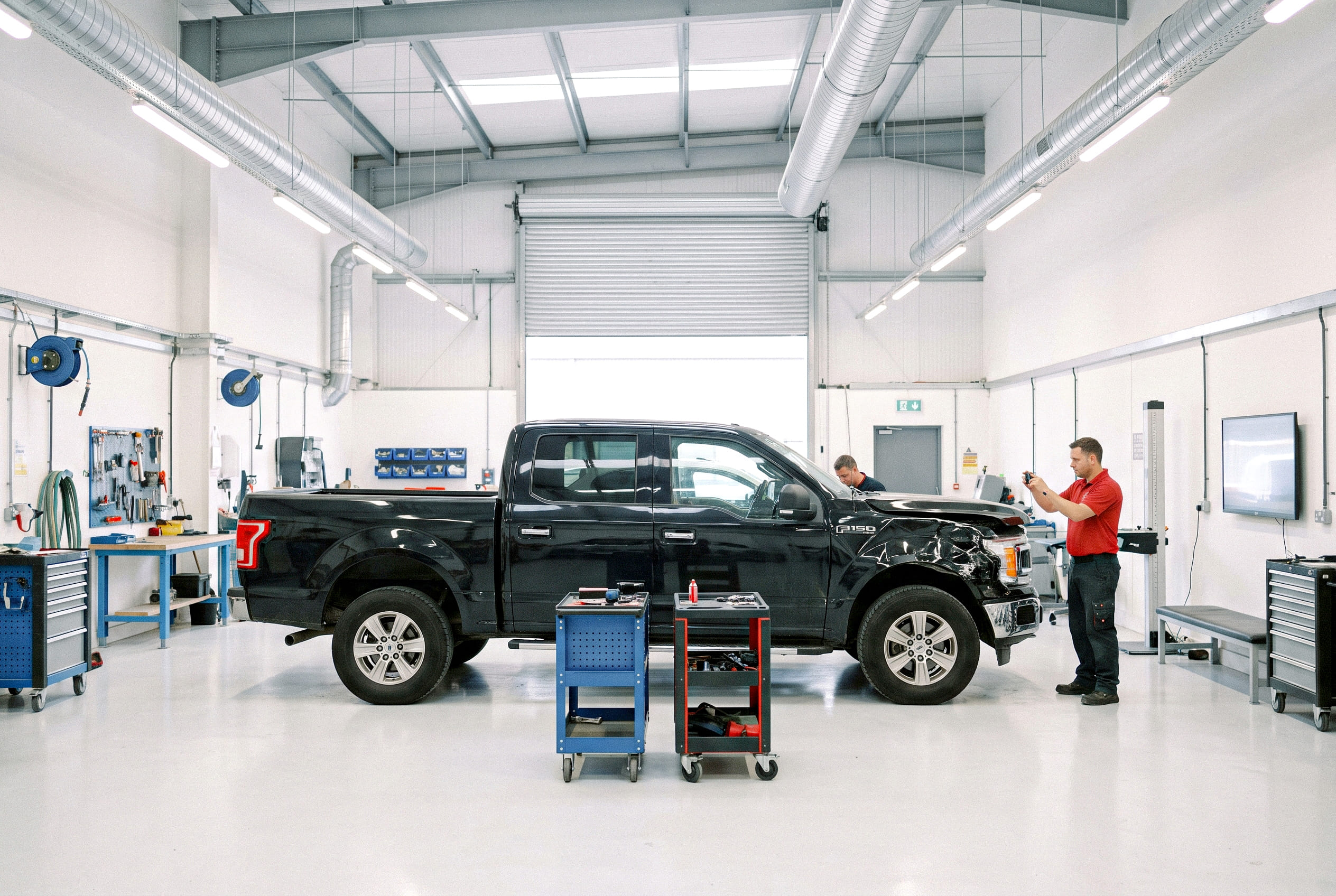
Partly describes licensed manufacturer data, proprietary research and expert parts interpreters annotating its training material. That accumulated trade knowledge is its proposed advantage over a generic assistant or manual catalog search. Established platforms such as Solera’s Audatex already cover estimating and claims; Partly’s emphasis is the intelligence connecting repair context to a purchasable part.
Its worked examples explain the distinction. A discontinued Camry bumper assembly becomes three current parts. Missing two means another order. A used door appears $136 cheaper until paint costs enter the calculation. The right decision depends on the repair, the supplier and the total bill.
repair context
resolves parts
the order
Illustrative workflow. The repairer stays in the loop.
Read the sentence after 98.8%
Partly’s June 2026 evaluation reports 98.8% historic parts-order accuracy for an estimator using Interpreter, versus 92.1% with existing tools. Accuracy here means the completed order contains the correct parts and all required parts. It is a result for a person working with a system.
The separate model-only test reports 58% F1 for Interpreter and 49% for remote estimators. F1 balances finding required parts against recommending incorrect ones. These figures answer a different question. Neither should be mistaken for a promise that an unattended model gets every job right.
There is a practical boundary, too. The historic data does not record whether vehicles underwent teardown, which reveals hidden damage. The evaluation therefore concentrates on small and medium repairs. Interpreter’s model card excludes heavier vehicle categories and markets outside North America, the EU, Australia and New Zealand. A workshop should check its vehicle mix before assuming the results transfer.
The order must travel with the job
A correct answer still has to reach the business. In January 2026, Partly announced a Panel Quote integration for New Zealand repairers. It connects parts lists, supplier offers, prices, shipment details and job updates with the bodyshop management system. The attraction is wonderfully plain: somebody gets to stop entering the same information twice.
Somebody gets to stop entering the same information twice.A small ambition with a very busy customer.
That gives a prospective buyer a sensible starting point. Choose one troublesome workflow, establish how often orders need correcting, and compare the assisted process. Count staff time and follow-up orders alongside part prices. The warehouse lesson persists: useful software must survive the work as it is actually performed.
Fifty million dollars, and another shop to visit
June brought a US$50 million Series B led by DST Global Partners, with a reported US$500 million valuation. Partly says the money funds North American entry, enterprise hiring and continued model development. In September it appointed Bill Lopez to lead commercial activity in North America.
The company now lists five offices and more than 220 team members. Its recruitment materials retain a New Zealand phrase, “No. 8 Wire Mentality,” among values including ownership and feedback. The geography has expanded; the underlying test remains quite small. A repairer asks for a part. Does the right one arrive?