At nine years old, Daniel Anstandig made the kind of pitch that does not need a deck. He called radio and television stations around Cleveland and offered to do anything. He would mop the floors. He would clean the toilets. He only wanted to come inside and learn. A family-owned station in Willoughby, Ohio, gave him the opening. The future founder of an artificial intelligence company began with the oldest apprenticeship in business: make yourself useful, then pay attention.
That detail is more than a charming origin story. It explains the operating instinct that keeps surfacing in Anstandig's career. He is interested in new machines, but he has spent most of his life around established industries. He learned broadcasting inside a local station. He later worked on digital ventures for traditional media businesses. When he talks about bringing technology to people who have been working for twenty, thirty or forty years, he emphasizes curiosity before disruption. The outsider sees an old workflow. The operator remembers why it exists.
Anstandig started his first company at 14, selling technology for streaming audio advertising. He sold it at 18, then moved into digital entrepreneurship roles connected to The Wall Street Journal, CBS and iHeartRadio. The assignment was already familiar: find a new-media business hiding inside a legacy-media company. By 24, he was ready to build from scratch.
Radio gave him the problem
Futuri began in Cleveland in 2009. Its early products helped listeners interact with radio programming and helped stations understand what an audience wanted in real time. That was a practical wedge into a business being rearranged by the internet. Radio still had reach, habit and local presence. What it lacked was the feedback loop digital platforms enjoyed by default.
The company kept widening that loop. Mobile apps, social intelligence, podcasting tools, sales research and content automation followed. The names and interfaces changed, while the recurring questions stayed recognizable. What does the audience care about? What deserves attention now? How does a media company turn that knowledge into better programming and more revenue?
Futuri says it now serves more than 7,000 brands in 22 countries. It has appeared on the Inc. 5000 nine times and has been private-equity-backed since 2019. Those figures mark growth, but longevity is the more revealing achievement. Technology companies are punished for standing still. Media companies are punished for changing without bringing their audience along. Futuri has lived between the two pressures for seventeen years.
“There is a certain value to sitting and listening with curiosity.”Daniel Anstandig
In a long conversation about his career, Anstandig described Futuri as a different company almost every year. The 2014 version was not the 2020 version, and neither resembles the company he is running today. This is not aimless pivoting. It is a company preserving a job while the available tools change. Help an organization notice the signal. Help it act before the moment passes.
Then the machine found its voice
Generative AI gave Futuri's media work a theatrical new form. RadioGPT, later renamed Futuri AudioAI, combined synthetic voices with systems that monitor local news and social trends. The product could help create a DJ segment, a news update or a podcast, then connect that material to a broadcaster's existing automation. To its supporters, it offered more local output from smaller teams. To anxious hosts and journalists, it looked uncomfortably like a colleague that never slept.
Anstandig's public answer has been consistent: start with extension, not replacement. Use AI to cover gaps, increase local relevance and remove repetitive production. He has also argued that broadcasters should disclose when AI helped develop programming and should remain responsible for what reaches the air. The position is commercially convenient for an AI vendor, but it is also shaped by someone who grew up understanding radio as a relationship. A synthetic voice can deliver a sentence. Trust belongs to the station that chose to broadcast it.
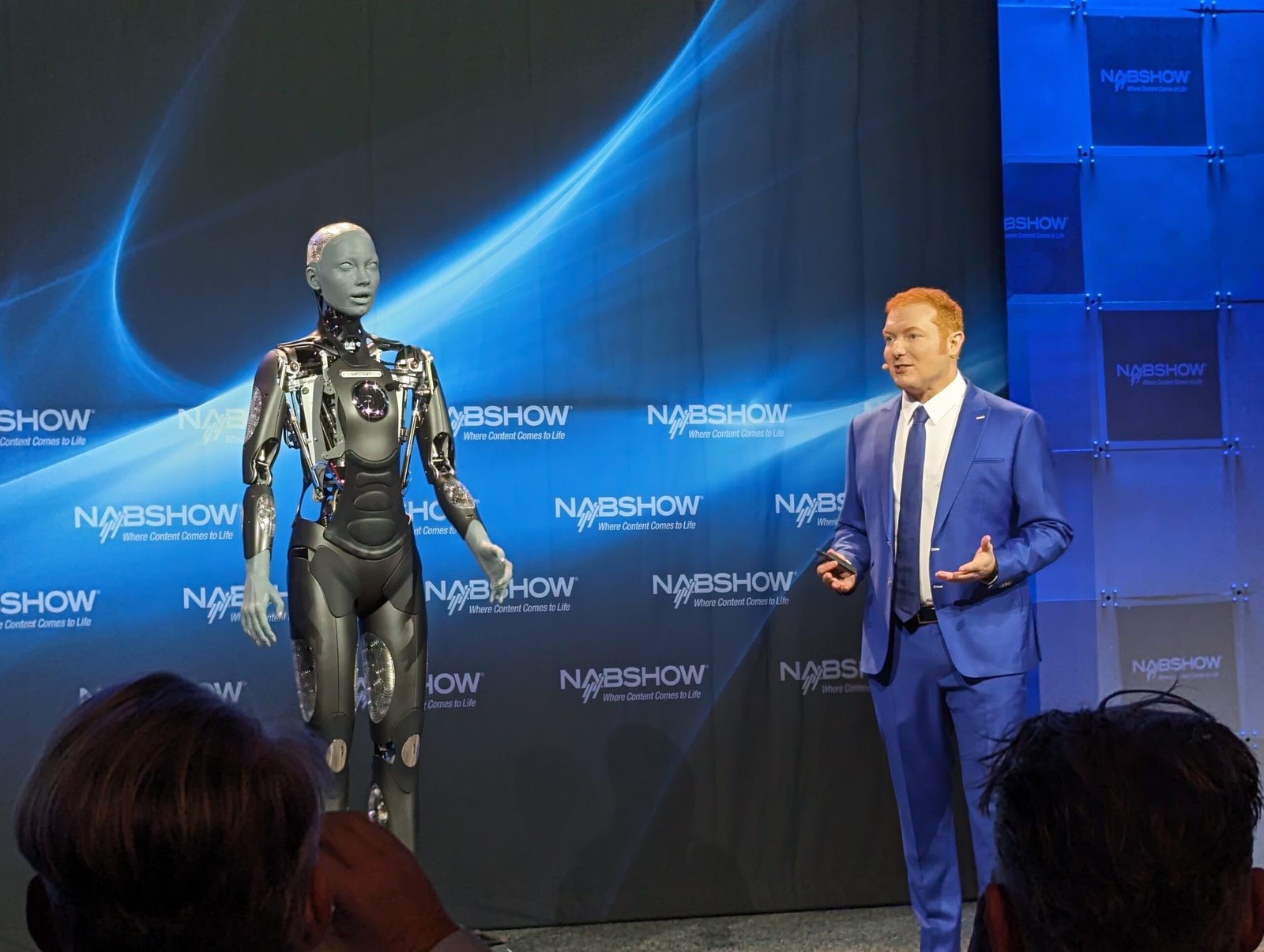
In April 2024, he made the metaphor literal. Anstandig walked onto the NAB Show welcome stage beside Ameca, an expressive humanoid robot built by Engineered Arts. Together they presented findings about how audiences perceive artificial intelligence in media. One result was especially tidy for a stage shared by a human and a machine: listeners presented with human and AI voices identified the AI voice as human 60 percent of the time.
The robot won the photograph. Anstandig's more durable point was about division of labor. Creative teams were spending too much time on process and too little on creativity. AI could help reverse that ratio. The argument works because it places the machine backstage even when Ameca is standing at center stage.
The recurring Futuri job
The new studio is the sales floor
Futuri's current identity moves beyond broadcasting. Its TopLine Enterprise products are aimed at B2B sales teams, while the Futuri Data Platform cleans and unifies the information underneath them. Anstandig describes the system as a pit crew: surface the right account intelligence at the right moment, prepare materials a rep can use and connect activity back to revenue.
The shift from radio to revenue operations is less strange than it first appears. A program director and a sales leader suffer from the same modern abundance. Both have more inputs than attention. Both need to distinguish an interesting blip from a decision-worthy signal. Both are tempted by dashboards that display everything and recommend nothing.
Anstandig's current pitch begins one level below the AI spectacle. Customer data is scattered across CRM records, email, call transcripts, proposals and third-party feeds. Add a model before cleaning that material and the machine organizes noise. Unify the data first and the model has a chance to surface a useful next move. It is plumbing before poetry, which may be why the idea sounds more credible than another promise of an all-knowing sales bot.
“We run it on our own pipeline before we sell it to anyone else.”Daniel Anstandig on TopLine Enterprise
The product portfolio around him is broad. He co-founded SparkTrade, which packages machine-learning equity signals for professional investors. He serves on the board of BoxCast, a live-streaming and remote production company, and works with technology investment firm Updata as an operating adviser. His personal site also lists 3D MediaVentures, the guided-audio company HappiSeek, public-alert technology and an independent music publishing business.
This could read as founder sprawl. Look closer and a common interest appears: systems that translate a dense stream of inputs into a timely human decision. What should a broadcaster put on air? Which equity signal deserves attention? Where should a sales team spend the next hour? The domain changes. The appetite for curation does not.
Gets his first opening inside a family-owned Ohio radio station.
Starts a streaming audio advertising company, then sells it at 18.
Founds Futuri in Cleveland at 24.
Shares the NAB Show welcome stage with the humanoid robot Ameca.
Pushes Futuri deeper into enterprise data and sales enablement.
A futurist with an apprentice's posture
Anstandig has never limited creation to software. He has produced music projects, developed albums and accumulated publishing interests. His Time Travlr project became a three-album run of soul, pop, funk and jazz. Love, MaKenzie, an album he helped produce and develop for singer MaKenzie Thomas, reached the top 20 of the iTunes Pop chart. In conversation, he connects music to entrepreneurship through rhythm, arrangement and the patience required to build something with other people.
He is also writing Letters to a Young Robot, scheduled for September 2026 and described as a field guide to conscious leadership in the age of AI. The title fits a career that has moved steadily closer to the philosophical questions hiding inside operational software. A machine can recommend, generate and predict. The executive still decides what deserves to happen.
That question is sharper now that AI has become easy to demonstrate and difficult to govern. Anstandig's own inventions span audio, automation, public safety and artificial intelligence, with more than 25 patents listed across his work. The portfolio suggests a builder attracted to systems that run continuously. His rhetoric increasingly stresses the limits that should remain human: judgment, awareness, accountability and trust.
There is a neat line from the boy in Willoughby to the CEO in Austin. The boy was willing to clean the station because access to the room mattered. The CEO now sells systems designed to clean a company's data because useful intelligence depends on understanding the room. In both cases, the glamorous part comes later.
The technology industry likes the clean break: before and after, obsolete and transformed. Anstandig's story is messier and more practical. Radio did not disappear when the internet arrived. It absorbed websites, apps, podcasts, social feeds, synthetic voices and machine learning. Futuri did not remain the company it was in 2009. It carried a set of problems forward and kept changing the tools.
That may be the useful version of futurism. No crystal ball. No contempt for the people still doing the work. Just the willingness to enter an old control room, listen closely and earn the right to touch the board.