Before Julia Hartz ran a company that sold tickets around the world, she had trouble with a customer who wanted a cup of coffee. As a teenage barista in Santa Cruz, she opened the shop early. One regular arrived ready to criticize. After several bruising encounters, Hartz told her mother, who suggested that the woman might simply need somebody to talk to.
So Hartz brought in her parents’ newspaper, spread its sections across the counter and invited the customer to discuss the stories. The complaints stopped. The coffee, apparently, had been carrying rather more responsibility than coffee ought to bear.
It is a small incident beside the public milestones: co-founding Eventbrite in 2006, becoming its chief executive in 2016, taking it public in 2018. Yet it supplies a useful way into her career. Again and again, Hartz’s work involved getting close enough to people to discover what they were actually asking for.
A television career, interrupted
Hartz grew up in Santa Cruz and studied telecommunications at Pepperdine University, graduating in 2001. Television offered the attraction of making something with other people, under pressure, for an audience. An internship on Friends gave her an early view of production. Development jobs at MTV and FX followed.
Her early credits belonged to a lively stretch of television: Jackass at MTV; the FX environment of The Shield, Rescue Me and Nip/Tuck. A development executive helps an idea become a program that somebody will watch. The distance from that job to event technology is shorter than the software vocabulary makes it sound. Both depend on persuading people that something is worth showing up for.
Then she met Kevin Hartz, an entrepreneur based in the Bay Area. Their courtship crossed two industries and two California cities. His work gave her a view of startups; hers gave him a view of Hollywood. She became interested in the speed with which a small technology company could turn a decision into a product.
She had an offer from Current TV when they decided to start a business together. Choosing Eventbrite meant abandoning an intelligible career ladder for something considerably less furnished. The early office arrangements included a wiring closet and a windowless room. Hollywood had offered an office with a view. Entrepreneurship was taking a stern position on windows.
The customers chose the room
Eventbrite’s three founders were Julia, Kevin and Renaud Visage. Kevin brought entrepreneurial experience; Visage brought technical expertise. Julia worked on the operations and customer experience that would make their product usable by people who had a gathering to organize and other things to worry about.
The opportunity was easy to overlook if ticketing meant only arenas and famous performers. There were also classes, community gatherings, fundraisers and independent promoters. An organizer might need a professional way to publish an event and collect money without negotiating a traditional ticketing contract.
That market was varied enough to resist a tidy description. A useful product had to accommodate people whose events shared very little beyond a date, a place and an invitation. Hartz’s early customer conversations became a way of understanding that variety. The support desk doubled as a listening post.
“I’m a natural-born operator and he’s a natural-born entrepreneur.”
Julia Hartz, describing her partnership with Kevin in 2013
The founders initially offered basic and premium services, but had put so much functionality into both that the reason to pay was unclear. Changing that arrangement made the choice simpler. Another feature of the model proved useful: an event with a zero-dollar ticket could use the platform free.
Free gatherings brought attendees into contact with Eventbrite. Some of those attendees later organized events themselves. This gave the business a route from one customer to another through participation. The invitation did some of the introduction; the ticket did some of the explaining. A person could encounter the product while making plans for a Saturday, long before considering it as a business tool.
- 01 An organizer publishes an event
- 02 Attendees encounter Eventbrite
- 03 Some attendees become organizers
A customer could arrive carrying a ticket and return carrying an idea.
The operator gets more people
Growth changed Julia’s job. Eventbrite’s workforce expanded from 30 to 100 in 2010, then doubled the following year. At that size, knowing everyone and sitting near the problem no longer provided a complete operating system. Culture, recruiting and management needed deliberate attention.
Hartz treated employees’ experience as part of the business she was building. The logic was practical: the people making and supporting the product shaped the experience customers received. A company could hardly promise accessibility outside while making itself impossible to navigate inside.
There was room for humor in the machinery. Employee question-and-answer sessions acquired the name “Hearts to Hartz,” courtesy of a product manager. In smaller versions, she brought together eight to ten people from different parts of the company. Half an hour of conversation could expose connections that an organizational chart concealed.
One such exchange paired someone who studied data with someone who spoke to customers all day. Hartz wanted those perspectives closer together. Numbers could reveal a pattern; conversations could explain the circumstances behind it. Keeping both in the room made for a more useful discussion of what to build next.
There is a particular temptation in writing about a founder with an interest in people: to make warmth sound like a substitute for business judgment. Hartz’s operating work suggests a more demanding relationship. Listening creates obligations. Once a problem has been heard, somebody still has to decide whether to change the product, hire a manager or explain why the answer is no.
Ten years before the title
On April 21, 2016, Eventbrite appointed Hartz CEO and a director. She had already spent a decade as president. Her responsibilities had included marketing, finance, customer support and employee experience, a reasonably comprehensive education in the parts of a company that refuse to run themselves.
Kevin remained executive chairman at that point. The appointment made a long-running partnership visible in a different way: Julia would carry the chief executive’s accountability for a business she had helped construct from its first room.
At the time of her appointment, Eventbrite said it had processed $5 billion in cumulative gross ticket sales across 180 countries. Those figures described the value of tickets moving through the platform. They were separate from the company’s own revenue, a distinction worth preserving when a business is measured in other people’s transactions.
- 2006Co-founds Eventbrite
- 2016Becomes chief executive
- 2018Leads the company into its IPO
- 2026Departs following the acquisition
Hartz spoke frankly about the difference between being a founder and being CEO. Founding allowed room for idealism; running the company required balancing that attachment against practical decisions. She did not describe the top job as an entitlement that came with being there first.
Her first year also supplied a vivid example of what the platform could carry. For the January 2017 Women’s March, she said Eventbrite handled more than a million registrations across 150 events worldwide. Ticketing infrastructure could serve a political gathering as readily as a performance. The product’s usefulness came partly from leaving the purpose of the gathering to the people arranging it.
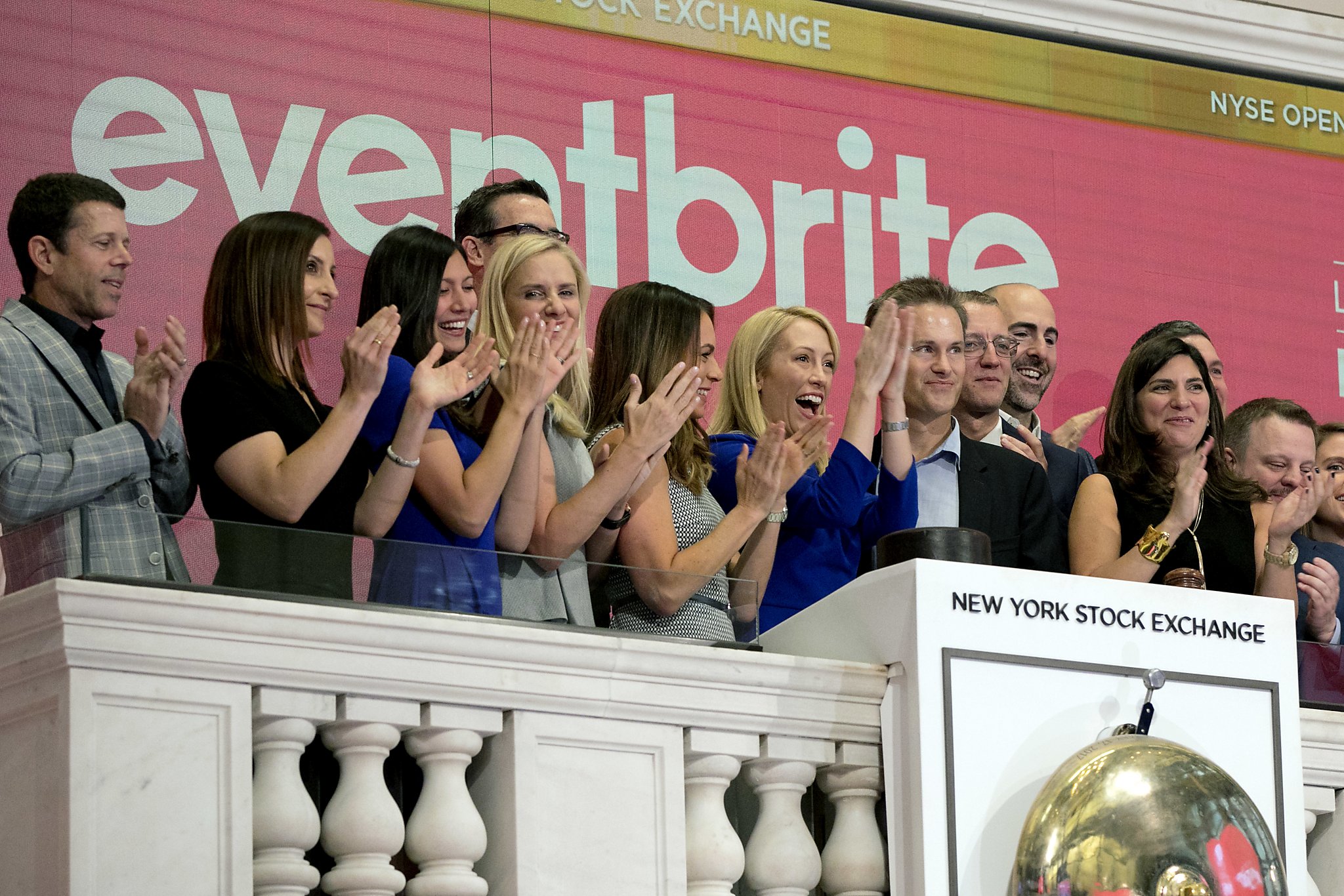
A bell is a beginning, too
On September 20, 2018, Hartz celebrated Eventbrite’s stock market debut at the New York Stock Exchange. The company’s shares were offered at $23. The bell, the colleagues and the photographs supplied a satisfying scene for a business that had started in borrowed space.
A public listing also changes the audience. Customers still want a working product. Employees still need decisions. Shareholders now have a regular appointment with the numbers. A founder’s account of where a company is going must coexist with the market’s judgment of how quickly it is getting there.
Hartz’s interests extended beyond the ticketing company. In 2017, she joined the board of Four Seasons Hotels and Resorts, representing Cascade Investment. Hospitality offered another setting in which a customer’s experience depends on many people doing coordinated work, often without drawing attention to the coordination.
Her public writing later kept returning to organizers and venues: independent music spaces, a touring horror event, a Brooklyn venue and a new 700-capacity room. The specifics matter. “Live experiences” is corporate language until somebody picks a building, books an artist and persuades an audience to come through the door.
Leaving the company, keeping the subject
In December 2025, Eventbrite announced an agreement to be acquired by Bending Spoons for approximately $500 million in cash. The transaction closed on March 10, 2026, with shareholders entitled to $4.50 per share. Eventbrite left the public markets, and Hartz subsequently left the CEO role.
The sale belongs in the same account as the founding and the IPO. Twenty years of building ended with a transfer of ownership, rather than an indefinitely extended founder’s tenure. An exit puts a date on a responsibility that can otherwise seem inseparable from the person carrying it.
Hartz remains an Eventbrite co-founder and a Four Seasons board director. Her later interviews look back on learning the CEO job and making the decision to take Eventbrite private. Her stated ambition for the platform was to let people gather around their interests. The next company decision is no longer hers to make.
That leaves a career with an unusually consistent subject. Television production, customer calls, employee conversations and event organizers all involve the difficult business of understanding an audience. Years before there was a ticketing platform, a teenager put a newspaper on a coffee counter and asked a question. She gave the customer something to respond to. The conversation improved.
More Hartz, in her own company
Follow Julia on LinkedIn, Instagram and X. Explore Eventbrite or its company profile.