At Georgia Tech, the AI classroom arrived in units of eight. Twenty NVIDIA HGX H100 systems, each containing eight GPUs, became the first phase of the university’s AI Makerspace in April 2024. Students could reach the machines online. Penguin Solutions designed, built, and deployed the infrastructure underneath.
The arithmetic is easy: 160 GPUs. The interesting part is everything the number leaves out. A teaching cluster needs networking, storage, software, and support before it can become useful to a student. The announcement carried NVIDIA’s name in its headline. Penguin’s contribution sat further down, in the machinery that made the promise practical.
THE STORY IN THREE POINTS
- It connects the parts. Penguin supplies AI systems, integration, software, and ongoing operations.
- Memory matters. Its memory segment generated more fiscal 2026 revenue than computing.
- The buyer buys execution. The proposition is a working environment, with people responsible for keeping it useful.
A business that began with a customer request
Penguin’s corporate ancestry starts in 1988 with SMART Modular Technologies. Its founders included Ajay Shah, Mukesh Patel, and Lata Krishnan. The name on the building changed much later; the problem of assembling something customers could use was there early.
In a retrospective interview, Shah described customers asking Samsung for custom memory devices. He and Patel proposed an internal business. Samsung declined. They started their own company with Krishnan, who became CFO. Shah recalled customers wanting “a more integrated solution from a dedicated provider.”
The route was imperfect. Shah said the Apex Data product acquisition failed, although its team and technology helped establish a new division. Financing also shaped decisions: IBM’s payment terms initially exceeded SMART’s resources. Guaranteed purchases and prepayment changed the calculation. The customer relationship became feasible when the cash cycle did.
The expensive space between parts
In 2018, SMART Global Holdings acquired Penguin Computing for up to $85 million, including up to $25 million tied to performance. The deal added specialty computing, storage, and networking expertise. In October 2024, the parent adopted Penguin Solutions as its own name.
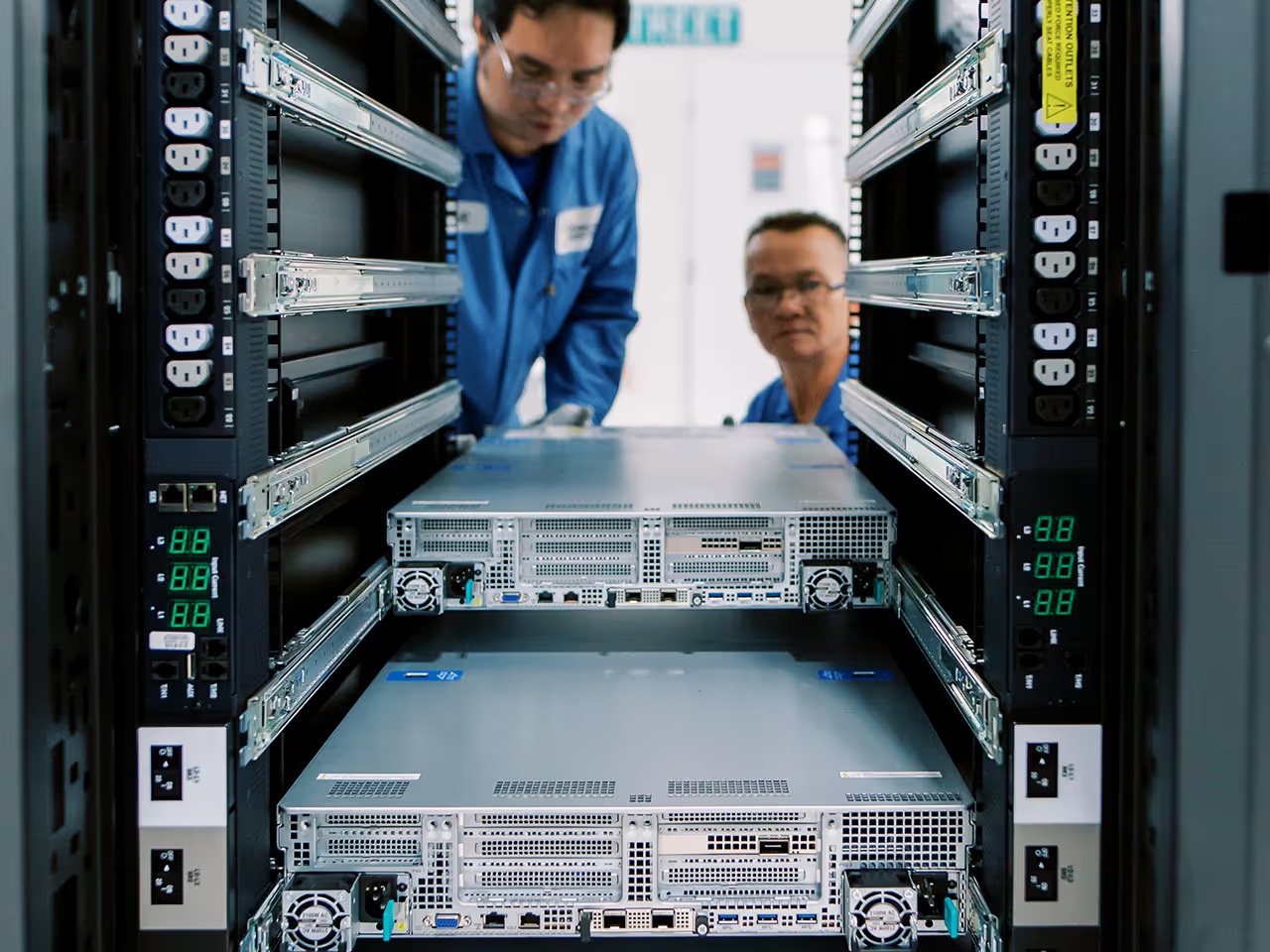
Today, its OriginAI offering packages validated architectures with hardware, software, and services. The process has four verbs: design, build, deploy, manage. Before delivery, Penguin integrates components and performs burn-in and performance testing. At the site, it coordinates installation. Afterward, its services and ClusterWareAI software help operators provision resources, inspect health, and manage the cluster.
That places Penguin across the boundary between equipment maker and systems integrator. Buyers can also consider enterprise infrastructure vendors such as HPE or Dell, specialist integrators, or their own teams. Partnerships complicate the comparison: Dell is also a Penguin collaborator.
ClusterWareAI gives that relationship a software component. Its control plane reaches across compute, networking, storage, and software resources. In June 2026, Penguin added an operations agent and automated GPU remediation for Kubernetes workloads. The practical appeal is straightforward: administrators need to understand why a machine is underperforming before another queue of jobs inherits the problem.
Deepgram makes that overlap concrete. In March 2026, Penguin announced infrastructure work for the voice AI company using Dell PowerEdge servers, PowerScale storage, and NVIDIA GPUs. Speech recognition and voice agents need consistent response times under concurrent demand. The integration job follows the application’s requirements all the way down to the equipment.
“Penguin Solutions demonstrated a deep understanding of our technical requirements”Abe Pursell, Deepgram · March 2026
Memory gets its turn
Training a model and serving its answers place different demands on a system. Inference must retain and move information while users wait. As conversations lengthen and concurrent requests accumulate, memory capacity becomes part of the response-time problem.
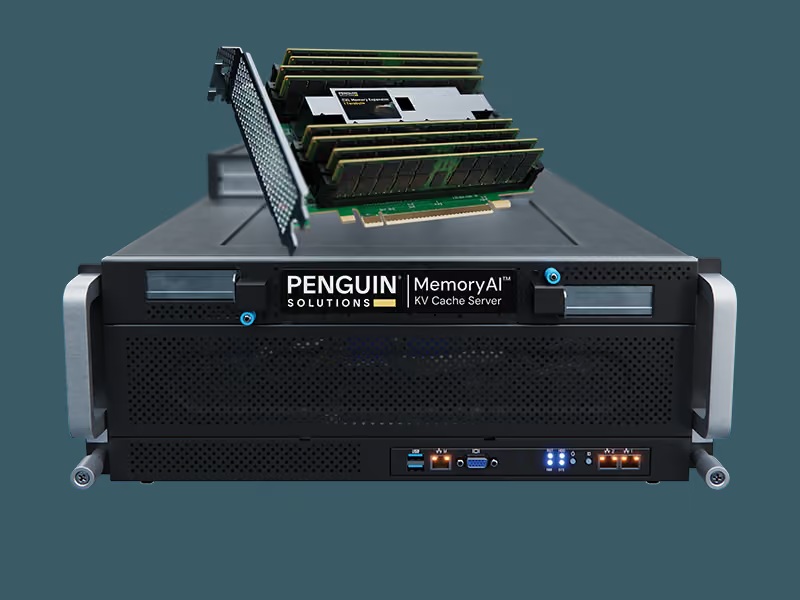
Penguin’s March 2026 MemoryAI KV Cache Server addresses that constraint. Its configuration combines 3 TB of DDR5 memory with up to eight 1 TB CXL expansion cards. The total is up to 11 TB. KV cache holds inference context; giving it another memory tier can change how a cluster uses its GPUs.
This is where the company’s old specialty meets its new positioning. Penguin sells DRAM modules, storage, and CXL products alongside computing infrastructure. It also retains Stratus fault-tolerant platforms and Cree LED products. The portfolio is broader, and less tidy, than the phrase “AI factory” suggests.
Read the revenue mix
Fiscal 2026 sales reached $1.73 billion, up 26% as reported. Integrated Memory contributed $924.0 million; Advanced Computing, $558.8 million; Optimized LED, $248.7 million. Computing revenue fell from the previous year even as the total grew. Treating every dollar as an AI server sale would miss the business.
FY2026 NET SALES / USD MILLIONS
The model combines product revenue with software, professional services, support, and managed operations. Its financing has grown accordingly. SK Telecom’s $200 million preferred investment closed in December 2024, carrying a 6% annual cumulative dividend. In January 2025, Penguin, SK Telecom, and SK hynix signed an AI data center collaboration.
Kash Shaikh became CEO in February 2026. By October, Penguin reported 17 new AI infrastructure customers during the fiscal year and 12 customer expansions. Those counts suggest a business built through individual deployments and repeat engagements, rather than millions of self-service accounts.
A lesson worth borrowing
For a buyer, the copyable practice is to write the acceptance test before ordering the cluster. Define the workload, response time, throughput, and operating responsibility. Then test the assembled environment against those requirements. Penguin’s factory-validation process makes that discipline part of the purchase.
The economics depend on the circumstances. A small team with occasional jobs may find rented cloud capacity easier to justify. A dedicated deployment needs suitable power, cooling, data, and operational ownership. Integration expertise cannot supply a missing application case.
A sensible comparison therefore includes the cost of running the system: staff time, maintenance, energy, and delays when capacity sits idle. The purchase order captures only part of that decision. Penguin’s pitch is most persuasive when those surrounding obligations are substantial enough that the customer wants an experienced operator involved.
Georgia Tech’s cluster offers a useful final measure. Count the GPUs, certainly. Then ask whether a student can use them. Penguin’s opportunity lives in the distance between those two questions.
Go inside the machinery
Explore the products, deployments, and people behind the story.