The problem with getting paid is that the money is only part of the job. Someone has to send the invoice, remind the customer, identify the deposit and persuade the accounting system that the whole thing happened. At Allterra Solar, those steps had become an obstacle to growth. Paper checks and card charges were familiar. Familiar, however, was getting expensive.
- Paystand automates the work between sending an invoice and closing the books.
- Its bank network has zero transaction fees. The software has a subscription.
- The savings depend on payment mix, customer adoption and the manual work removed.
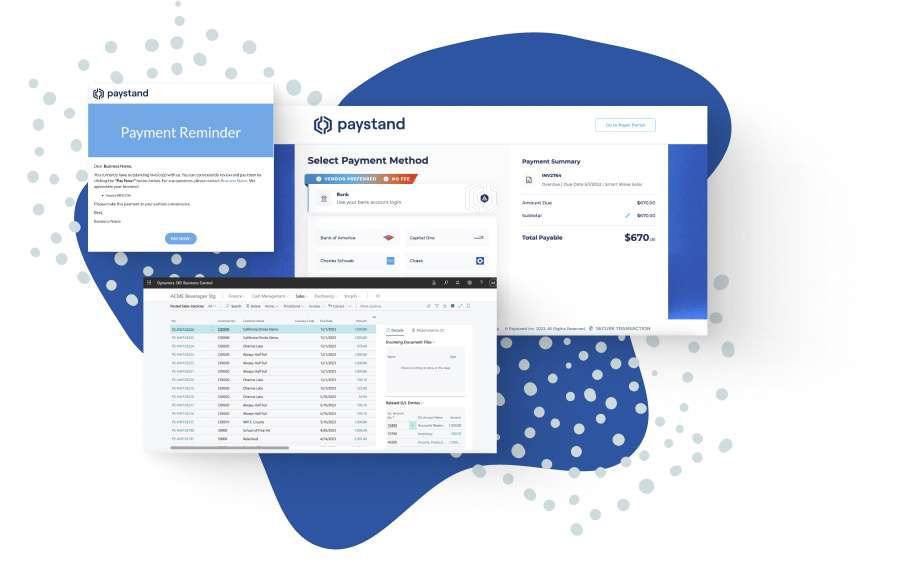
Paystand’s case study describes a practical intervention: digital invoices, a payment portal and a simpler way to pay. Allterra reported a 51% reduction in transaction costs. The interesting detail was smaller than the headline number. Customers could understand the payment buttons without creating an account. A confusing moment had become an ordinary click.
The button before the blockchain
James Allen, Allterra’s CEO, described the result this way: “Our clients and vendors were no longer confused at the critical moment when they’re ready to pay.” That is a useful place to begin with a company that talks so much about reinventing commercial finance. Before the infrastructure can matter, the person holding the invoice must know what to do.
Jeremy Almond and Scott Campbell founded Paystand in 2013. Almond brought engineering and entrepreneurial experience; Campbell had worked at Google and Morgan Stanley. Their target was the space between the cloud software businesses had adopted and the cumbersome machinery still moving their money. Paystand’s expertise sits at that junction: payment acceptance, accounting integrations and the operational details of collecting cash.
Allterra Solar’s reported result after adopting Paystand. A customer outcome, not a universal forecast.
Its customers include finance teams in manufacturing, distribution, healthcare, technology and solar. These are businesses where an invoice can outlive several reminder emails. The product offers payment links, recurring billing, collection reminders and automatic reconciliation. Integrations with NetSuite, Sage Intacct, Acumatica and Microsoft Dynamics 365 Business Central put those functions near the records accountants already trust.
A subscription replaces the percentage
The commercial argument is refreshingly legible. Paystand sells Payments-as-a-Service through a monthly subscription. On its bank network, payments carry no transaction fees. A company can therefore collect more money without paying a percentage on each additional network payment. That creates a different incentive from a processor whose income rises with every dollar passing through.
The word “network” does real work here. Paystand also supports cards and other payment methods, and its pricing page describes negotiated wholesale rates for legacy options. Zero transaction fees does not make the entire service free. A buyer still has a subscription bill, a particular mix of payment methods and an implementation to evaluate.
Consider an illustrative calculation: a business collecting $1 million through a method costing 2% would spend $20,000 on percentage fees. Moving that volume to a zero-fee network removes that hypothetical charge, but the subscription and remaining costs still belong in the comparison. This is arithmetic, not Paystand’s price list. The useful question is the total annual cost after customers actually change how they pay.
Cheaper rails need willing passengers
That last condition explains a less glamorous part of the product: payer incentives. Businesses can encourage cheaper payment choices through invoice discounts or configure card convenience fees. Paystand’s tools address behavior as well as processing. An accounting department cannot simply announce that every customer now prefers bank payments.
Invoice→02
Choose→03
Pay→04
Reconcile
For Allterra, the old approach was straining at the handoffs: collecting checks, managing card costs and making payment easy to understand. Its experience suggests something readers can copy before buying anything. Map the invoice journey. Count every manual intervention. Then identify whether the largest expense is processing, staff time or waiting for the customer. Those problems can coexist, but they need different fixes.
The economics become less persuasive when payment volume is low, customers insist on cards or an existing workflow already costs very little. Savings also depend on connecting the right accounting data. A cheaper transfer that leaves someone hunting for the invoice has solved only half the problem.
Three purchases around the CFO’s desk
Paystand’s expansion makes more sense viewed through that accounting workflow. A $50 million Series C announced in July 2021 brought investors including NewView Capital, SoftBank’s Opportunity Fund and King River Capital. The money supported a wider platform ambition. Subsequent acquisitions followed the money around the business.
Yaydoo, acquired in 2022, added Latin American finance capabilities. Teampay arrived in 2024 with spend management, purchasing approvals and corporate expense controls. Paystand reported that the combined network then touched more than one million businesses. That number describes network reach; it should not be mistaken for a million paying software subscribers.


Bitwage, acquired in November 2025, brought international payroll and payout infrastructure. Here the acquisition story contains an unusually concrete endorsement. Paystand had used Bitwage to pay international vendors and contractors before buying it. Management had encountered the product from the customer’s side of the screen.
“Before this acquisition, we were Bitwage customers ourselves.”Jeremy Almond · November 2025
The invoice travels farther
By 2026, Paystand was introducing USDb as a digital dollar designed for business. Its cross-border materials describe a managed arrangement: a company funds payments in dollars, digital-dollar settlement works underneath, and vendors receive local currency in existing bank accounts. The operational proposition is to remove work from international payments without requiring every recipient to become a cryptocurrency specialist.
Across this expanding portfolio, Paystand competes for several budgets: payment processing, receivables software and spend management. A bank-plus-ERP arrangement is an alternative, as are specialist software providers. Its distinctive wager is that controlling more of the workflow can make subscription economics and cheaper payment routes reinforce each other. The test happens where Allterra’s story began: can a customer pay easily, and can finance stop chasing the transaction afterward?