The office was considerably more impressive than the balance sheet. Paul Srivorakul and his brother had returned to Thailand with a combined $4,000 available on their credit cards. They arranged to work for a media company in exchange for desk space. When prospective clients visited, the surrounding bustle of a hundred-person business did some useful, unpaid sales work. The visitors assumed the office belonged to the brothers. A startup can spend heavily on appearances. This one borrowed the scenery.
It is a pleasing beginning for someone who would spend much of his career dealing with the distance between what customers see and what a business must actually do. An advertisement takes seconds to consume. A purchase takes seconds to make. Delivering what was promised involves a rather less photogenic collection of people, systems and decisions. Srivorakul kept moving toward that collection.
Today he is the co-founder and Group CEO of aCommerce, the Bangkok-based business that helps brands operate online across Southeast Asia. Its work includes marketing, online store operations, technology and fulfillment. The customer sees the shop. Srivorakul has made a career of attending to what happens behind it.
An anthropology degree, then the internet
He was born in Thailand, grew up in California and graduated from the University of California, Berkeley with a BA in anthropology in 2000. His early job was in sales at Ask Jeeves, the search company later known as Ask.com. His brother was working at Apple. The return to Thailand brought American internet experience into a market where the brothers saw room for a different approach to digital advertising.
The sequence of companies that followed covered several layers of the same commercial world. Newmedia was a digital agency, eventually acquired by Australia’s STW Group. Admax built an advertising network and was acquired by Komli Media in 2012. Ensogo took him into online deals and commerce; LivingSocial acquired that business in 2011. He also helped establish Ardent Capital, bringing an operator’s experience to investing and venture building.
Those company names can read like a series of exits, each ending neatly with a buyer. They also mark a progression in the questions his businesses had to answer. How do you attract attention? How do you distribute advertising? How do you turn interest into a transaction? And, once somebody orders an actual object, who gets it to the door? That last question refused to remain somebody else’s department.
A sequence of businesses. A growing view of what a sale requires.
The parcel that changed the question
At Ensogo, selling deals had developed into shipping physical goods. Srivorakul’s team went looking for local logistics providers able to handle consumer orders and collect cash at delivery. Finding suitable fulfillment partners proved difficult. The obstacles were practical and immediate: a sale could be recorded online while the work required to complete it remained unresolved.
Cash on delivery makes the gap particularly clear. The customer’s payment and the parcel’s arrival become part of the same event. A business has to coordinate the movement of money as well as merchandise. Buying an advertisement cannot settle either task. The neat line on a screen runs into the untidy requirements of an address, a route and a person waiting for an order.
By 2013, Paul, Tom and John Srivorakul were building aCommerce. Its founding funding included $3.1 million in a round led by NTT DOCOMO Ventures. The idea was to provide infrastructure that brands could share rather than asking each online business to assemble its own operating apparatus. Warehousing and fulfillment belonged in the same conversation as marketing and store management.
That decision also gave aCommerce a particular place in the market. It could help brands sell through established channels while running the work around those sales. The appeal lay in coordinating functions that a shopper expects to behave as one service, even when several organizations are involved. Nobody places an order hoping to admire the organizational chart.
$3.1m founding funding, led by NTT DOCOMO Ventures
A warehouse is a strategic relationship
The company’s expansion involved partners with physical assets as well as capital. In 2015, DKSH took a 20 percent stake. Srivorakul explained that aCommerce had already been helping some of DKSH’s brands in the region and using some of its older warehouses. Investment followed an existing working relationship. The arrangement had an unusually concrete foundation: the businesses already knew what they could do together.
In November 2017, aCommerce announced a $65 million Series B led by Emerald Media, the KKR-backed investment platform. The planned uses included strengthening its technology, expanding strategic partnerships and helping clients reach additional markets. The round put financial weight behind a business built around connecting brands with multiple routes to the customer.
The accompanying strategy extended beyond an online brand store. It encompassed consumer marketplaces and business customers, with data helping brands understand pricing and customer interactions. Samsung and L’Oréal were among the brands associated with its initiatives. The ambition was to make those routes manageable together, instead of leaving clients to reconcile disconnected pieces.
There is a useful discipline in this kind of business: the grand phrase has to survive the small task. A regional strategy eventually becomes an inventory record, an order, a payment or a delivery. Capital can fund the systems and relationships. Their value is tested when the pieces have to work together.
The people who might leave to start something
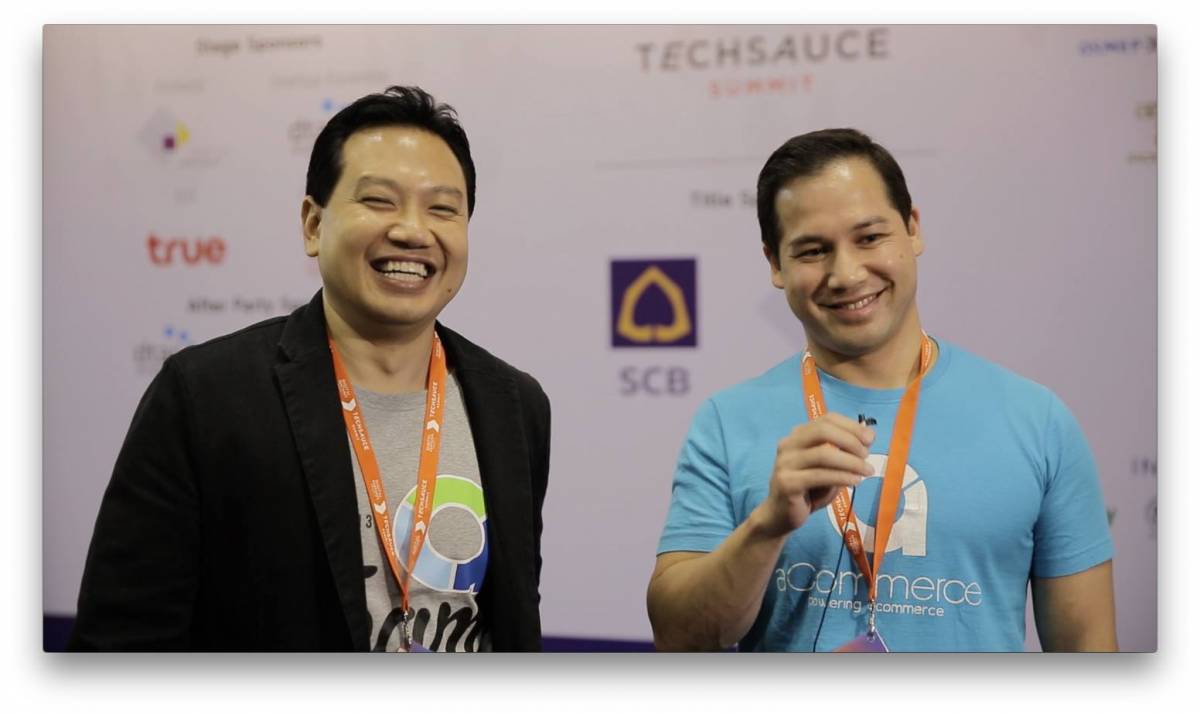
Srivorakul’s public manner has often matched the pace of his subject. A 2017 encounter in his Bangkok office caught him in shorts and a blue aCommerce T-shirt, moving between his seat and a whiteboard as he talked. The surroundings were informal; the concern was competitive survival. His argument was that local knowledge and operations gave Southeast Asian businesses something substantial to build on.
People were central to that argument. In a 2016 conversation alongside Tom, Paul emphasized assembling technical, sales and operational expertise. He also described an ecosystem that grows when employees of established startups go on to create companies of their own. A successful employer can, in that view, become a training ground for the next generation of founders.
That observation gives his work a second timescale. A client needs its store to function now. A region needs experienced builders over years. The two can meet inside a company where employees learn several sides of commerce. It is an unusually patient way to think about a sector fond of measuring progress every quarter.
“A business is about solving problems so when there are no problems, we are in trouble.”Paul Srivorakul · 2022
A taste for problems, a case for patience
A company without problems would give Srivorakul something to worry about. His formulation has the cheerful inconvenience of giving nobody a quiet afternoon. He has described actively looking for problems and wanting colleagues to regard them as a normal part of improving a company.
By 2022, his advice also emphasized conserving cash, understanding the economics and allowing a market time to develop. He argued for patience before accelerating spending. The order matters: understand the model, establish workable economics, then consider the capital needed to grow. Building infrastructure asks for persistence as well as pace.
His 2022 discussion of aCommerce also acknowledged how much management changes with scale. A founding group could span retail, logistics and technology; a larger organization needed specialists and senior managers capable of coordinating departments across countries. The founder’s willingness to tackle everything had to coexist with other people’s authority to run particular things.
In a separate 2022 account of the company’s culture, he emphasized learning, adaptation and growth. He described regional operations supported by strategies tailored to individual markets. It is a recurring point in his account of the business: a regional presence still requires attention to local conditions. Five country names on a presentation do not by themselves produce five functioning operations.
- UnderstandThe problem and the business model.
- EstablishEconomics that can support growth.
- AccelerateWith capital and a market that is ready.
An editorial rendering of Srivorakul’s 2022 advice on patient growth.
After the missed window
In May 2024, Srivorakul described ambitions to enter Vietnam, preserve profitability ahead of a possible IPO and extend the usefulness of aCommerce’s data beyond online consumer sales. These were stated goals. They reveal how he was thinking about the company’s next boundaries: additional countries, additional uses for its information and additional kinds of commerce.
By February 2025, aCommerce was promoting a discussion pairing him with Central Retail’s Alison Muyard on retailer-led marketplaces and retail media. Later that year, he was weighing the broader conditions for Thailand’s digital economy. In October, he welcomed the investment potential of freer data flows while arguing that the benefits of digital trade should reach the Thai economy. The operating questions had acquired a policy dimension.
His June 2026 conversation with January Capital’s The First Podcast revisited a difficult chapter: an intended 2021 listing that did not happen as markets turned. He described communicating openly with his team and changing the business’s emphasis toward profitability. It complicates the easy version of a founder’s biography, where every company is a launch followed by a triumph followed by a cheque.
He also outlined a new sequence of priorities: aggregation, automation and agentic commerce. AI-driven discovery, he argued, could give brands fresh reasons to develop their own websites and coordinated content. The tools had changed since Ask Jeeves. The old question about how a business reaches a customer remained recognisable.
Seen across those years, his career keeps circling the moment when a convincing idea must become an operating business. Advertising introduced the audience. Commerce introduced the order. Fulfillment introduced everything required to keep the promise. The borrowed office helped the young founders look established. The work since then has been to build what other businesses can depend on once the visitor has gone home.