A food business can acquire a customer in another city long before it can afford a shop there. The order is the easy part. Between the kitchen and the customer come the questions that spoil an otherwise pleasant transaction: who will collect it, how long will it travel, and what condition will it be in when somebody opens the box?
Bryant Christanto has a practical answer to the expansion problem. Talking about Paxel’s arrival in Makassar in April 2020, he explained that small businesses could sell outside their home cities without establishing branches. Their products could travel while the business stayed put. For an entrepreneur considering another lease, another kitchen and another payroll, that is a fairly consequential parcel.
As Paxel’s co-founder and CEO, Christanto works where the attractive idea of a bigger market meets the stubborn business of moving things. A customer’s appetite has little respect for provincial boundaries. A delivery system has to respect time, distance and the contents of the box.
Before the parcel, the balance sheet
His earlier professional life unfolded in finance. He worked as an associate at Goldman Sachs in Singapore, a vice president at Credit Suisse in Indonesia and a director at General Atlantic in Singapore. His education included Boston University and an MBA at the Australian Graduate School of Management. This was a route through institutions accustomed to evaluating businesses and the money required to grow them.
At Paxel, the questions became physical. A delivery network needs people, equipment and places where packages can change hands. It must fit a customer’s expectations into an operating schedule. Financial experience has an obvious application here: somebody has to understand what it costs to keep a promise repeated thousands of times.
His public interests had already wandered beyond financial institutions. In 2016, he published LinkedIn articles about augmented reality, including one on educational books and another asking what the technology could do beyond Pokémon. The titles catch a moment when digital creatures were attracting attention. Christanto was asking about other uses for the underlying technology.
A year later, Paxel was founded. The business brought him together with people whose experience complemented his own, including logistics veteran Djohari Zein, Zaldy Ilham Masita and technology leader Erick Soedjasa. Its founding story contains several careers meeting around one operational problem. Giving the CEO all the credit would leave rather a lot of the machinery unexplained.
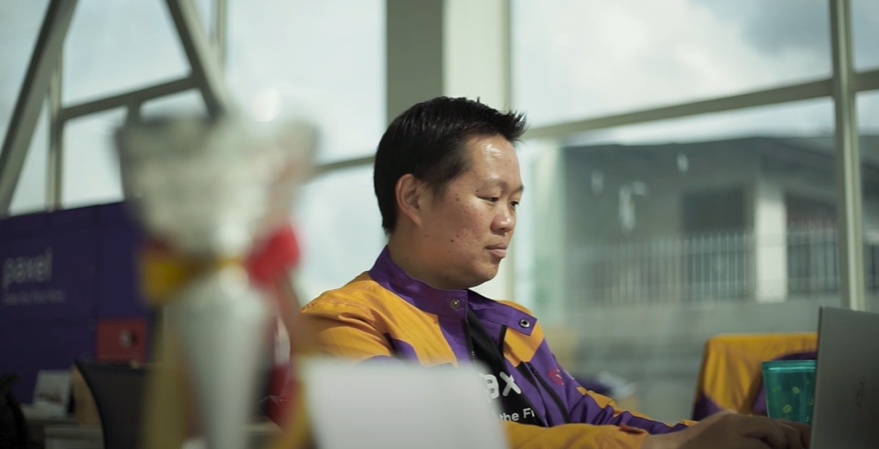
When the food started travelling
Food soon supplied evidence of what the network could become. Paxel reported 200,000 same-day shipments in 2018 and 1.5 million in 2019. More than half of the latter were food deliveries. An operation that moved parcels was finding a particularly demanding constituency among things people intended to eat.
The details were agreeably specific. A year-end snapshot included Bandung’s Cilok Cepot, Jakarta’s Pisang Goreng Bu Nanik and Surabaya’s Bebek Sinjay. Customers were ordering regional favourites across city boundaries. The appeal of a familiar snack had acquired a distribution problem, and the distribution problem had acquired a business.
By the Makassar launch, the company was describing a relay system combining couriers, algorithms and smart lockers. A parcel could move through a coordinated sequence rather than depend on one person making the whole journey. The lockers supplied sorting and handoff points; the software helped organise the movement.
For food sellers, the physical equipment mattered just as much as the application. Freezers, chillers and cooler boxes helped preserve products in transit. A beautifully designed booking screen is limited consolation when the contents arrive in a form the cook never intended. The cold chain gives the digital promise something solid to stand on.
Makassar also meant a step beyond the earlier Java and Bali footprint into Sulawesi. Christanto described the expansion in terms of opportunities for local businesses. The useful unit of progress in that explanation was the seller who could reach further. The app download was merely the beginning of the transaction.
A tray of food, an unexpected teacher
In 2022, Christanto joined Endeavor alongside Masita and Soedjasa. His sister Rika, then co-founder and COO of Ontruck in Spain, had suggested the introduction. Later that year, encouraged by his wife despite his reservations about the cost and distance, he attended the network’s retreat in Scotts Valley, California.
There, a buffet-line encounter turned into an hour discussing culture and international business with Martín Migoya, the CEO of Globant. Christanto had begun the conversation without knowing his companion’s identity. He ended it taking notes. It is an appealingly unceremonious scene: professional education conducted with a dinner tray nearby.
“Being an entrepreneur and a leader is a lonely journey.”
Bryant Christanto, 2022
His account puts community beside ambition. Leadership can leave a founder with questions that are difficult to discuss inside the company. A conversation with somebody who has faced similar decisions offers another place to think. In Christanto’s telling, the surprise was how freely that help arrived.
The work behind the word Hero
There is another organisation in his biography: Lifehub, the nonprofit he co-founded. It has supported more than 2,000 disadvantaged children in Indonesia. Alongside the finance positions and the logistics company, that work gives his record a further dimension, centred on opportunities for people who have fewer of them.
At Paxel, the couriers are called Happiness Heroes. The title is conspicuous; the work remains exacting. Somebody has to collect the package, complete the handoff and get it to the customer. A network diagram can make these movements look effortless. The person carrying the box has a rather more detailed understanding of the route.
In 2024, Paxel’s support for the families behind its deliveries included 20 scholarships for couriers’ children. It also sponsored eight couples for umrah. These are concrete examples of how the company describes sharing the benefits of its work with the people carrying it out, extending the relationship beyond the next delivery shift.
That dependence on reliable people also appears in an unexpected corner of Paxel’s work: football. The company partnered with Indonesia’s football association, PSSI, to move national-team equipment and provide inventory support. The arrangement included a dedicated warehouse in West Jakarta and collections managed through the app.
Christanto’s explanation was straightforward. Getting the logistics right would let the team concentrate on training. It is a useful example because the outcome is so easy to picture. Somebody playing football should have their equipment where they need it. The delivery business succeeds by removing one worry from somebody else’s working day.
Food entrepreneurs, couriers and kit managers do very different jobs. Each nevertheless meets the same question at the handoff: will the next part happen as expected? Across these examples, Christanto’s work keeps returning to that small, consequential moment when one person depends on another.
A business that can keep its promises
The capital behind the operation also grew. MDI Ventures announced in March 2022 that it had led Paxel’s Series B round, which closed late in the previous year. Investment brings resources for expansion. It also makes the relationship between growth and operating discipline harder to set aside.
In his account of 2023, Christanto described a focus on efficiency and reported that Paxel’s gross margin rose from below 10 percent to 30 percent by year-end. He paired the financial measures with attention to customer and employee satisfaction. These were company-reported results, attached to a particular year, rather than a promise that future expansion would be easy.
His following annual letter reported break-even EBITDA for 2024. That measure concerns earnings before interest, taxes, depreciation and amortisation. He also set out plans for cross-border logistics and preparation to be potentially IPO-ready by 2027. Those ambitions carry an unfinished quality appropriate to a business still being built.
Meanwhile, his role in founder communities had begun to travel in the other direction. In 2024, he served as an Endeavor selection panelist for Daniel Eberhard of KOHO Financial. Someone who had benefited from other founders’ questions was now contributing questions of his own. In January 2025, he also joined Howard Gani for a fireside chat during a Bank Mandiri programme visit to Paxel.
There is no need to turn that sequence into a grand theory of his life. Its appeal lies in the scale of the exchanges: an introduction from a sister, a conversation over dinner, a question offered to another founder. Beside them sits the larger task of running a delivery business whose usefulness is judged one arrival at a time.
There is a useful tension in the ambition to grow. More destinations increase the opportunities for merchants, while each additional route asks more of the operation. The network must stay dependable as it becomes more complicated. A seller cannot serve a customer with an expansion announcement. The package still has to arrive.
Christanto’s financial background and his attention to the people doing the work meet in that tension. Training, equipment and careful coordination all require resources. A company that intends to keep serving small businesses has to sustain the service itself. The next chapter will be judged through those ordinary obligations as well as any larger corporate milestone.
The kitchen and the customer remain a good place to end. The seller has made something worth buying. The customer wants it. Christanto’s undertaking is to make the distance between them manageable enough for another order to follow. For all the strategy involved, the final review may be delivered by somebody opening a box before lunch.