Before Paul Lambert would start Quilt, he required an answer to a question that venture capital cannot settle: would he want to spend ten years of his life on it? A company can acquire customers while its founder quietly loses interest. He had already learned how that felt. This time, enthusiasm at the beginning would have to survive the imagined middle.
The question arrived with some inconvenient context. He had worked at Twitter and Google, helped bring Gmail’s Smart Compose to users, and become a partner at Google’s internal incubator, Area 120. Starting over would mean leaving a career that was working. On paternity leave after the arrival of his second child, he began thinking about the world those children would inherit. Home heating eventually became his answer.
There is a certain comic distance between helping a computer finish a sentence and persuading a household to replace its furnace. Lambert crossed it because he wanted to make things, and because he had become more particular about which things deserved his time.
The novelist takes a detour
Growing up in Calgary, Lambert imagined a creative life. He liked music and writing. Kurt Vonnegut’s interest in anthropology helped send him toward writing and anthropology studies in Vancouver. Meanwhile, he was already making websites, first for bands he played in and then for businesses. The activity that paid him seemed less like a career than the ambition that did not.
Before the 2008 Beijing Olympics, he moved to China, where a friend was teaching English. He saw a translation problem and built a web application that connected local businesses with writer friends back home. Technology gave his creative instincts somewhere practical to go. He later returned to university for computer science.
That sequence matters. The writer did not vanish when the programmer appeared. A useful product still needs someone to imagine how another person will encounter it, understand it, and fit it into a day. The medium changed; the interest in making something for an audience remained.
The education of an education founder
At the University of British Columbia, the learning software annoyed him. In his 2015 essay about starting companies, Lambert recalled discovering that instructors shared the students’ frustration. He and his childhood friend Joe built an alternative, initially called Matygo. The early version had browser problems; fixing them was part of the education. He described growth from a 200-student pilot to more than 10,000 students across Canada within two semesters.
Popularity and a business model proved to be separate assignments. The company changed direction and became Learndot, a platform for customer education at software companies. ServiceRocket announced its acquisition of the assets behind Learndot in January 2015. Lambert had spent roughly six years leading the business.
His later account of that experience is unusually candid. He had been so pleased to be an entrepreneur that he followed traction without giving enough thought to whether corporate education was work he wanted to keep doing. Success had answered a commercial question while leaving a personal one open.
His essay’s advice now reads like an early draft of Quilt: build something you understand through use, pay attention to technological shifts, address enduring needs, and think beyond a modest plan. Heating a house is an enduring need with remarkably little patience for a bad product. Winter is an unsentimental customer.
From finishing emails to choosing a decade
At Twitter, Lambert worked in product management, including recommendation systems. At Google, his work moved into Gmail. In May 2018, he announced Smart Compose on Google’s product blog: suggestions would appear while someone typed, and the Tab key would accept them. The feature put machine learning inside an ordinary task, with very little ceremony.
That is a useful precedent for his present work. Most people composing an email want to finish the email. Most people adjusting the temperature want the room to feel right. Technical sophistication earns its keep by making those intentions easier to carry out.
Area 120 gave Lambert a different position, evaluating and supporting new businesses within Google. He could help others pursue ideas, but he missed building things himself. The ten-year test made choosing his own next company harder. A plausible venture was no longer enough.
“I’m an entrepreneur whether I like it or not”
Paul Lambert, 2024
On leave, he worked backwards from the problem he wanted to spend his career addressing. Climate change gave him a reason to persist even if a particular company failed. Then he had to find a part of that enormous problem where his consumer product experience, and the people he could recruit, would actually help.
Energy was already in the family
Calgary had given him a close view of the energy business. His father’s career included leading the law firm Bennett Jones and later an energy company. An uncle built and sold a coil tubing business. Entrepreneurship was familiar long before Silicon Valley entered the picture.
Leaving Alberta also complicated his view of it. In Vancouver, Lambert encountered judgments about the oil industry that did not match the people he knew. His conclusion was that talented people follow available opportunities. Changing the opportunities could change what their talent built.
That argument gives Quilt a particular emotional texture. Lambert is trying to redirect an inherited familiarity with energy toward electrification. He does not need to make his upbringing into a villain’s origin story. The more interesting possibility is continuity: another generation making a business around energy, with a different answer about where that energy should come from.
He has also described growing up skiing in the Canadian mountains and feeling attached to the outdoors. The motivation has several roots: family, landscape, children, and the practical pleasure of making a product. Those roots help explain why an unfashionable appliance could hold his attention.
A wall is a difficult place to hide
Lambert became interested in heat pumps while researching electrification, then ran into the difficulties of buying one himself. The engineering made sense to him. The shopping experience and the objects on offer were much harder to love.
A heat pump moves heat between indoors and outdoors, reversing direction to heat or cool. Quilt chose a ductless design with units in individual rooms. Its proposition includes control over those rooms, a physical Dial, an app, and software that can be updated after installation. This places the system inside everyday domestic decisions: which room is being used, who wants which temperature, and whether anyone wants to find another remote.
The indoor unit is just 7⅞ inches tall and comes with white oak or paintable white front covers. These details give it a chance to sit above doors and windows without overwhelming the room. Lambert’s bet is that appearance affects adoption. A homeowner has to live with the equipment after the installer leaves; the wall deserves a vote.
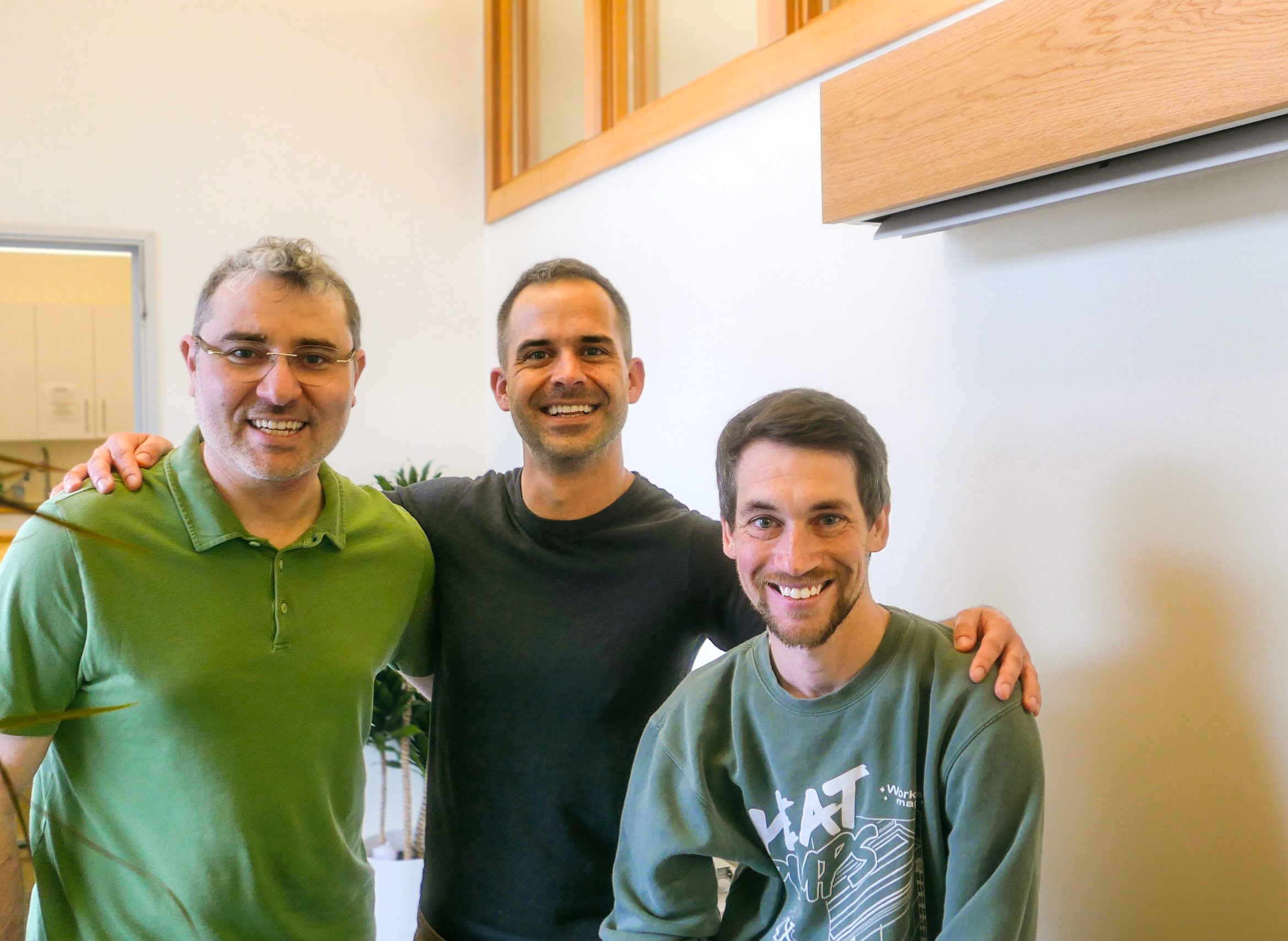
Quilt was founded in 2022 by Lambert, Bill Kee, and Matthew Knoll. Kee brought experience in Google products and energy efficiency; Knoll brought hardware and software experience from projects including Loon and Tidal. The company launched its heating and cooling system in the Bay Area in 2024. The team’s backgrounds help explain its insistence on considering hardware, controls, and the customer’s experience together.
The appliance gets a second draft
In September 2025, Quilt announced a software update that increased the maximum heating and cooling capacity of existing systems. The two-zone outdoor unit’s maximum cooling output rose from 19,700 to 24,000 BTU per hour; heating rose from 20,500 to 25,200. Owners did not need to buy replacement equipment.
The request had come from installation partners who wanted to serve larger spaces. Engineers tested firmware changes and found additional capacity. It is a concrete example of Lambert carrying a software habit into hardware: a shipped product can receive another draft.
The distinction matters. More capacity is a specific engineering result, rather than a promise that every household’s bill will fall by the same percentage. For Lambert, the deeper implication is a continuing relationship with equipment already in the field. Installation begins another phase of product development.
The next customer carries tools
Quilt initially installed systems itself. In April 2025, it introduced a Certified Partner Program to expand through HVAC professionals. A home appliance reaches its customer through a jobsite, and the person doing that job knows things a product team in Redwood City needs to learn.
By March 2026, Quilt reported 100 certified partners across 26 states and six Canadian provinces. That month it launched Toolbox inside its app, giving technicians a guided installation workflow, refrigerant calculations, troubleshooting material, and a homeowner handoff. The design problem had expanded from the living room to the working day.
In August 2026, the company launched Quilt Tools for partner businesses, including remote diagnostics when homeowners opt into data sharing. It reported more than 150 partners across 46 U.S. states and Canadian provinces combined. A technician could look at a system’s past behavior before deciding whether to send a truck. Lambert described the homeowner and contractor as participants in one connected system.
This is where the ten-year commitment acquires some unglamorous contents. It includes manuals, support, installations, and service appointments. A beautiful object can start the conversation. Someone still has to make it work on a Tuesday in a house the engineers have never visited.
A name worth passing down
The company was first called Abri, French for shelter. Quilt came later, through work with a naming specialist. Lambert liked a short noun people could picture and spell. He also liked the way separate pieces worked together to provide warmth.
There was a more personal association: he has a quilt made by his great-grandmother. The name carries his interest in what one generation leaves another. For a business built around equipment that should last, the domestic reference is well chosen. It is warmer than an acronym, and considerably easier to explain at dinner.
In December 2025, Quilt raised a $20 million Series B. In his letter marking the round, Lambert celebrated the company’s expansion into Canada. His stated ambition is to reach millions of homes. That remains an ambition, with a great deal of manufacturing, distribution, and service between here and there.
The ten-year rule cannot guarantee the outcome. It can make the work worth returning to. Lambert began by asking which problem deserved a decade. He now has a company whose answer must be delivered room by room, by people carrying tools through somebody else’s front door.
Keep the conversation going
- Quilt: the company and its products
- Paul Lambert on LinkedIn
- Paul Lambert on X
- Paul Lambert on Instagram
- Paul Lambert on Facebook
- Four Rules for Starting a Startup
- The early career conversation with Allen Pike
- The heat pump conversation with David Roberts
- The naming story and product conversation with Cody Simms
- The Calgary conversation
- Smart Compose: Lambert’s 2018 announcement
- Quilt Tools: August 2026 announcement
- Watch: the Heat Pump Podcast
- Watch: CleanTech Talk