DR Richardson had invested in the energy transition for years when he encountered an awkward problem: buying a heat pump for his own home. His Boulder townhouse had central ducts. He knew the technology existed. He had a reason to want it. What followed was a purchasing experience with enough loose ends to suggest a second career.
He spoke to 20 contractors, he later recalled. All but one told him he could not install a heat pump without gas backup. Questions about equipment, sizing and installation multiplied. For someone accustomed to assessing clean-energy businesses, becoming a customer supplied a rather thorough education in why good technology sometimes stays in the brochure.
The trouble became the beginning of Elephant Energy, which Richardson co-founded with Josh Lake in 2021. Today he is its CEO. Their proposition grew from a specific irritation: a homeowner should be able to buy an electric heating system without personally assembling the expertise of several trades. Richardson had found a problem he understood well enough to want someone else to solve. Then he volunteered.
A year in Boulder, give or take a decade
Richardson attended Brown University from 2004 to 2008. His college activities included captaining the men’s ski team and serving as managing director and editor-in-chief of the Roosevelt Institution. The combination put sport and organizing alongside his studies. Snow, at least, would continue to feature in his plans.
After college came strategy consulting, where he worked with Lake. Richardson wanted a career connected to climate, but the route was unclear. Lake’s departure to start a solar-development business in 2009 helped make the possibility more concrete. A colleague had made the move; Richardson began considering his own.
In 2010 he moved to Boulder and joined the early team at Vision Ridge Partners. He initially imagined a year in Colorado before heading to San Francisco. The temporary stop acquired the inconvenient habit of becoming his life.
He spent roughly a decade helping build the investment firm, eventually becoming a partner. Its focus on sustainable real assets gave him a close view of businesses deploying established technology. He has described investments involving solar projects and EVgo, the electric-vehicle fast-charging network. The attraction was the possibility of putting capital into equipment and operating businesses whose economics could support the energy transition.
Eventually he wanted the responsibility of building an operating company himself. After leaving the firm, he explored ideas in decarbonization. The heat-pump experiment gave that search a household address.
An investor meets the installation calendar
In Elephant’s model, the homeowner receives help with the work surrounding the machine: choosing equipment, designing the system, arranging installation and handling applicable incentives. Local contractor partners carry out installations. The company coordinates the pieces that can otherwise leave a customer playing project manager in an unfamiliar trade.
That division also shapes Richardson’s relationship with contractors. By August 2024, he described a network of about 12 installation partners. Elephant handled tasks including procurement, billing and commissioning. For a small contractor, repeated work with a defined scope can make the day less dependent on finding the next customer and writing the next proposal.
The work imposes a useful discipline on the founder. A convincing explanation of electrification still has to become an appointment, equipment delivery and completed installation. Every household asks the business to repeat the exercise. Scaling means getting the details right again, with a different building and a different set of constraints.
THE WORK AROUND THE MACHINE
- 01Design
the system - 02Procure
equipment - 03Coordinate
incentives - 04Arrange
installation
Four connected jobs in Elephant’s service model. A schematic, not a timed sequence.
Money with an installation attached
In late 2022, Elephant announced a $3.5 million seed round led by Building Ventures, with participation from Daniel Gulati, Workshop, Reuben Munger and others. The planned uses were hiring, product development and expansion. The investor had become the founder explaining how new capital would translate into a bigger business.
The original service proposition already allowed homeowners to approach electrification in stages. A personalized roadmap could cover upgrades over time, rather than requiring the household to do everything at once. That matters to the story because Richardson’s customer is making decisions about a home, with a budget and equipment that may need replacing on different schedules.
His financing interests also surfaced in a partnership with WattCarbon. The collaboration directed purchases of energy-related environmental attributes toward helping fund heat-pump installations. The intended benefit for homeowners was a lower upfront cost. It connected the financial world Richardson knew with the equipment Elephant was trying to get installed.
“We can’t just SaaS our way out of the climate crisis.”
DR Richardson
His point was about the physical work required. Software can organize a project; money still has to reach the hardware and labor. In that arrangement, an installation is where an abstract financial commitment acquires a practical result. Richardson’s earlier investment career and his newer operating role meet beside the same equipment.
The thousandth one belonged to Justin
In December 2024, Elephant celebrated its 1,000th heat-pump installation by giving a system to a household in Lafayette, Colorado. The recipient, Justin Bailey, had wanted to reduce his fossil-fuel use and had been waiting for rebates to make the change affordable.
Richardson appears in the celebration photograph shaking Bailey’s hand beside a sign announcing the milestone. There is a heat pump at the edge of the frame and paperwork in Richardson’s other hand. It is a fitting combination for a company whose business involves making both behave.
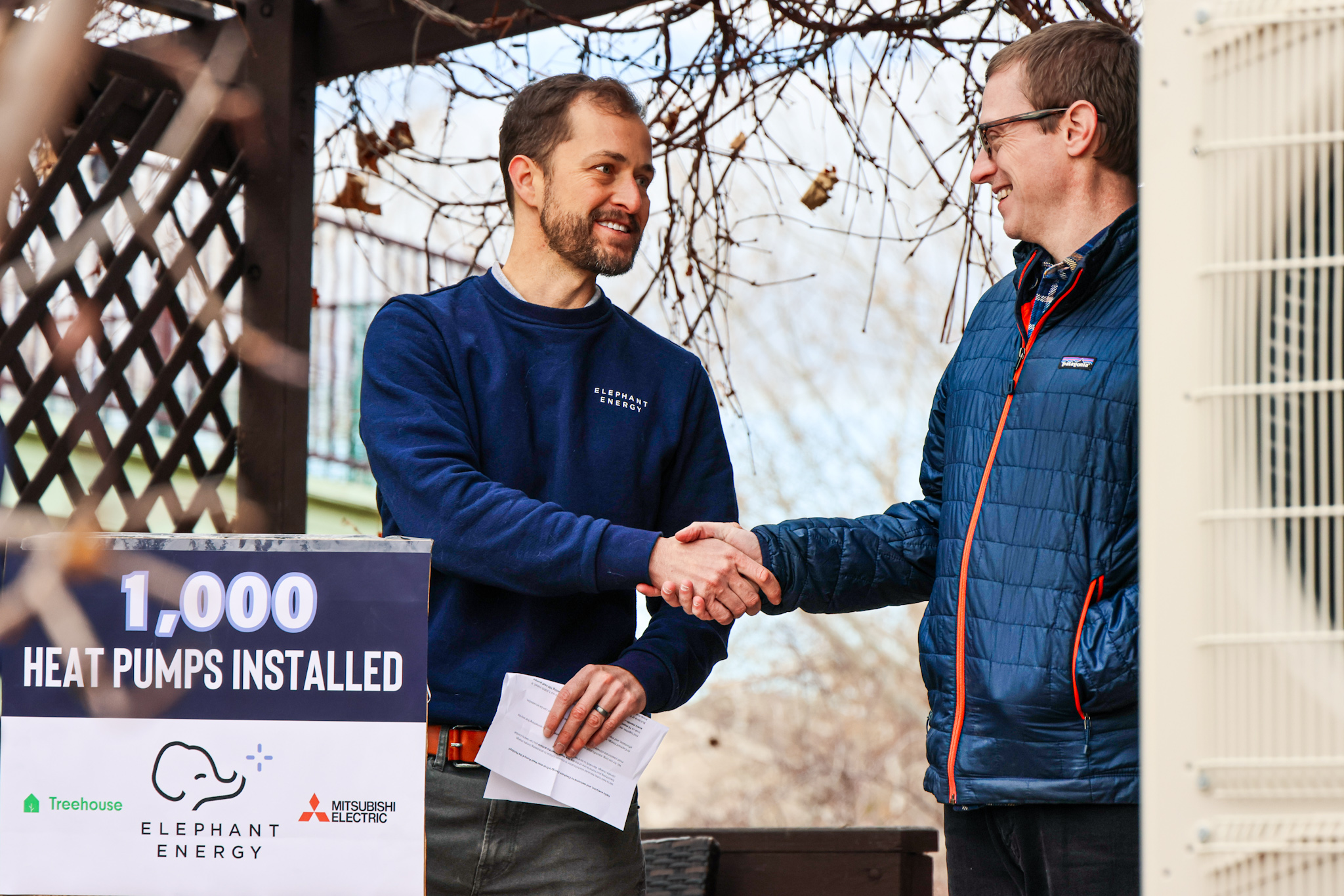
Treehouse, CD Jones and Mitsubishi helped cover electrical work and equipment for the donated system. The event also brought together local and energy-sector partners. Behind the celebratory scissors sat the same arrangement the company needed every day: organizations contributing different parts of a finished job.
A milestone is easy to describe as a number. Bailey’s installation gave this one an owner. Someone who had been waiting could finally use the thing Richardson had spent years trying to make easier to buy.
A bigger map, a familiar problem
Elephant’s company history records a Boston expansion in 2024. Los Angeles followed in March 2025. By then, the company said it had installed more than 1,000 heat pumps across Colorado and Boston. The new market put its coordination model to work in another region, with another set of households, contractors and incentive programs.
The scale changed, but the founder’s interest remained recognizable. In his public comments about the launch, Richardson emphasized making the process less complicated and more accessible. Expansion gives that intention a harder test: the business must carry its way of working across state lines and into homes it has never seen before.
He has also put weight on how the company operates. Elephant announced B Corp certification in April 2024. Richardson explained the commitment in terms of employees, communities and the environment as well as shareholders. He argued that “how we conduct business and treat stakeholders is also hugely important”.
Certification gave those priorities a formal expression. For a founder coordinating homeowners, workers and partners, the question of whose experience counts is present in ordinary decisions. A business can talk about impact in broad terms. Its participants encounter that promise through the work they do together.
The neighbors enter the equation
By September 2026, Richardson was describing another way to organize the purchase: community group buying. A municipality, nonprofit or other trusted local organization can bring interested households together, creating a concentrated pool of potential customers for a contractor.
He reported that Elephant’s 2025 campaign with Switch Together had generated more than 85 heat-pump installations in about three months. He put conversion at 80%, compared with the 40% to 50% he said the company typically saw through traditional sales channels. These were his reported campaign results, tied to that particular effort.
WHEN CUSTOMERS ARRIVE TOGETHER
Richardson’s reported conversion rates
The appeal, in his account, includes lower customer-acquisition costs, easier scheduling and work during quieter periods. For homeowners, the program offers help navigating an expensive decision through a familiar organization. Group buying makes the social surroundings of a purchase part of its economics.
It also returns Richardson to the problem at his own house. An interested buyer needs a workable route to an installed system. Organizing several interested buyers at once is another attempt to improve that route.
A career with a place to come back to
Boulder has provided more than a launch market. Richardson has described choosing Colorado for the skiing, hiking and relationships he wanted in his life. His public biography mentions camping, his partner Carey and their dog Griswold. The biography even supplies a musical starting point: the Isley Brothers’ Fight the Power begins his Spotify playlist radio.
His community activity extends to co-hosting Boulder Climate Happy Hour and mentoring through Terra.do. Those commitments put him in touch with people trying to enter the field he once struggled to find his own way into. Having found a route, he spends some time helping others look for theirs.
His ambition for Elephant is similarly practical: make electrification affordable enough to stand on its own economics. That goal leaves plenty of ordinary work ahead. Equipment has to be selected. People have to trust the proposal. Someone has to show up and finish the job. Richardson’s own townhouse taught him how much could happen in between. He has been building around that lesson ever since.
FOLLOW THE WORK