The Company Turning Your Roof Into a Subscription
Palmetto owns the solar panels. You get the power. Inside the Charlotte software company betting that clean energy should work like a subscription - and raising billions to prove it.
For most of its history, residential solar was sold the way used cars are sold: a salesperson at your door, a five-figure price tag, a stack of financing paperwork, and a quiet hope that the contractor who drilled into your roof would still be in business when something broke. Palmetto looked at that experience and decided the panels were never really the problem. The friction was ownership. So it kept the ownership.
Palmetto is a clean-energy technology company based in Charlotte, North Carolina. It builds software, runs a marketplace of vetted installers, and - through a financing arm called LightReach - can pay for the solar and battery system on your roof, install it, maintain it, and then sell you the electricity it produces for a fixed monthly rate. No upfront cost. No surprise repair bills. The company owns the hardware; the homeowner buys the power. It is, in the company's own framing, a bit like a Netflix subscription for sunshine.
That reframing - from a $25,000 purchase to a monthly bill - is the whole business. And in 2025 it convinced Morgan Stanley, Truist, and a group of institutional investors to put more than $1.2 billion behind it.
01 / The ModelHow a solar lease became a bond
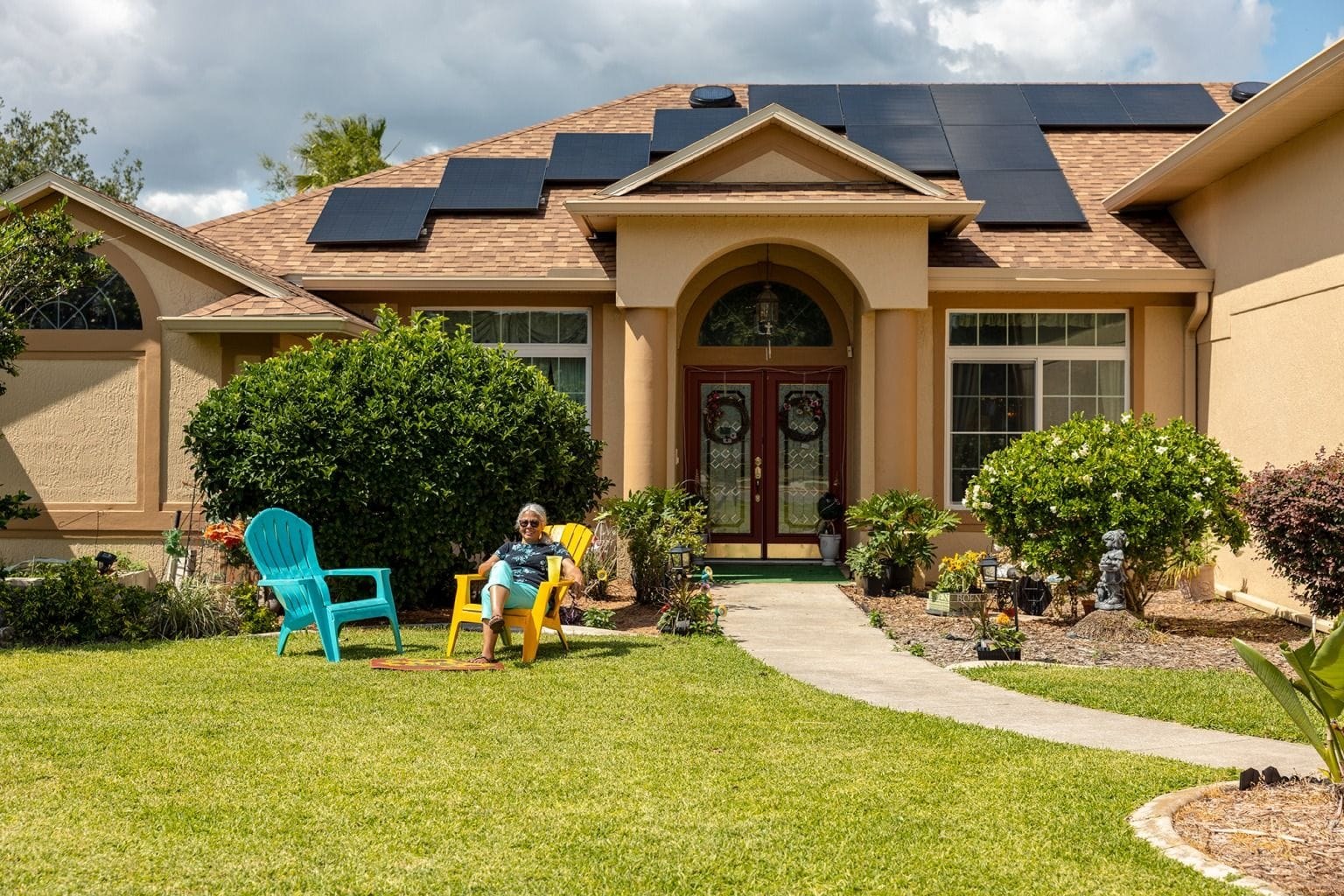
The mechanics of LightReach are simpler than the industry it disrupts. Palmetto handles the solar mapping and system design, pulls the permits, manages the installation, and stays on the hook for maintenance. The homeowner signs one of two agreements - a lease or a power purchase agreement (PPA) - and pays a stable monthly amount. According to the company, plans are designed to deliver savings against local utility rates within the first year, with no interest, no dealer fees, and no lifetime maintenance costs.
Here is the part that made Wall Street pay attention. A 20-to-25-year contract for a stable monthly payment, secured against a physical asset, behaves a lot like a bond. Bundle enough of those contracts together and you have something institutions can finance and securitize. In October 2025 Palmetto closed a $420 million asset-backed securitization built on exactly these residential solar assets. The homeowner sees a cheaper power bill; the capital markets see a new asset class.
This is why the company describes itself as a software business rather than a solar installer, even though panels end up on roofs. The defensible thing Palmetto built is not the hardware. It is the machinery that decides which roofs are worth it, prices the risk, and turns a two-decade promise into something a bank will fund.
02 / The BrainThe MIT spinout that maps your roof
In 2021 Palmetto acquired Mapdwell, a geospatial technology that was incubated at MIT and first piloted by the City of Cambridge, Massachusetts. Mapdwell's original trick was an instant assessment of any building's rooftop solar potential - a cost-benefit read in minutes rather than a site visit. Palmetto folded that capability into its own stack and used it to map the solar potential of more than 107 million US buildings.
That data became two things. Internally, it is the targeting engine: when your software already knows which houses are good candidates, the sales conversation gets shorter and cheaper. Externally, it became a product. Palmetto packaged the technology into an Energy Intelligence API - building "digital twins" and energy simulations that other companies pay to use. Utility giant Exelon integrated the technology to give its roughly 10 million customers property-level solar analysis through a customer-facing calculator.
It is a classic picks-and-shovels move layered on top of a consumer business: sell solar to homeowners, and also sell the map of every rooftop to everyone else trying to do the same thing. The API even won at MIT's 10th annual Climate & Energy Hackathon.
03 / The MoneyFrom a UN job to a billion-dollar bet
Palmetto's founder, chairman and CEO is Christopher Kemper, who started the company in 2010. His route in was unusual for a solar entrepreneur. Before Palmetto he held roles at the financial firm Compagnie Financière Tradition and at the United Nations, where he focused on delivering clean-energy technology to developing nations - places that could leapfrog centralized utility infrastructure entirely. He later wrote a manifesto he called the "New Utility Revolution," arguing that clean-tech breakthroughs and economic logic were converging on an inflection point.
The company itself has been on the move. Kemper started it in London, shifted the headquarters to Charleston, South Carolina, and relocated to Charlotte in 2023. The funding followed a similar upward curve. A $20 million credit line in 2019 grew into an $80 million round, then a $375 million Series C in 2022 led by Social Capital, with investors including ArcTern Ventures, Lerer Hippeau, Gaingels, and MacKinnon, Bennett & Co. By 2025 the story had shifted from venture equity to project finance - the $1.2 billion-plus that actually funds the panels.
Truist, the Charlotte-based lender, has been a repeat backer - a hometown bank helping fund a hometown company's national expansion. The scale of ambition is large: in early 2024 the company signaled plans to raise as much as $2 billion to finance solar and home electrification across its customer base.
04 / The DifferenceWhy keep the panels?
Plenty of companies will lease you solar, and plenty of software firms will model your roof. Palmetto's bet is that doing all of it - software, marketplace, and financing - under one roof is a moat rather than a distraction. The clearest way to see the difference is the ownership question.
The old way
- Large upfront purchase or a separate loan
- You own the system - and every future repair
- Installer may vanish after the sale
- Value tied to one contractor's follow-through
The Palmetto / LightReach way
- $0 upfront, one fixed monthly rate
- Palmetto owns and maintains the system
- It stays on the hook for 20-25 years
- Software and financing built in-house
Because Palmetto keeps the asset, its incentives are aligned with the panels actually working for two decades. That is skin in the game as a marketing strategy - and a direct answer to residential solar's reputation problem, where door-to-door sales and abandoned installations have soured plenty of homeowners. The company competes on that promise against players like Sunrun, Sunnova, and Tesla Energy, and against the traditional local installers who still sell the outright-purchase model.
05 / The Fine PrintWhere the model could strain
The design is elegant, but it moves risk rather than erasing it. In a lease or PPA, the homeowner does not own the system and generally cannot claim the tax credits that come with a cash purchase - those benefits accrue to the owner, which is Palmetto and its financing partners. The savings depend on the contracted rate and any built-in annual price escalator holding up against future utility prices, which no one can guarantee. And a business that owns hundreds of thousands of long-dated assets is, by construction, sensitive to interest rates and the appetite of capital markets - the same markets that made the $1.2 billion possible can tighten.
None of that is a secret catch. It is the visible cost of removing the upfront price entirely: the risk had to go somewhere, and Palmetto put it on its own balance sheet and its investors'. For a homeowner who wants solar without a five-figure check or a maintenance headache, that trade can be exactly right. For someone who wants to own the asset and harvest the tax credits, the old model may still win. The useful thing Palmetto did was make that a real choice.
What a reader can take from this
The transferable idea is not "sell solar." It is that in a category with a trust problem and a high sticker price, the winning move can be to change the transaction rather than the product. Palmetto lowered the barrier to zero by keeping the thing customers were nervous about owning, then made the resulting cash flows legible enough for institutions to fund. Software did the targeting, financing did the scaling, and ownership - the part everyone else tried to offload - became the point.