●BREAKING Aeromine closes ~$9M Series A led by Veriten●Bladeless rooftop wind — 50% more energy than solar, says the company●BMW Group trials motionless wind at MINI plant, Oxford●TIME names it one of the 200 Best Inventions of 2022●BASF pilot runs in Wyandotte, Michigan●11,000 inquiries from 6,500+ companies●BREAKING Aeromine closes ~$9M Series A led by Veriten●Bladeless rooftop wind — 50% more energy than solar, says the company●BMW Group trials motionless wind at MINI plant, Oxford●TIME names it one of the 200 Best Inventions of 2022●BASF pilot runs in Wyandotte, Michigan●11,000 inquiries from 6,500+ companies
Company Dossier · Climate · Hardware
Aeromine Technologies
The wind turbine that forgot to spin — and started outproducing the solar panels next to it.
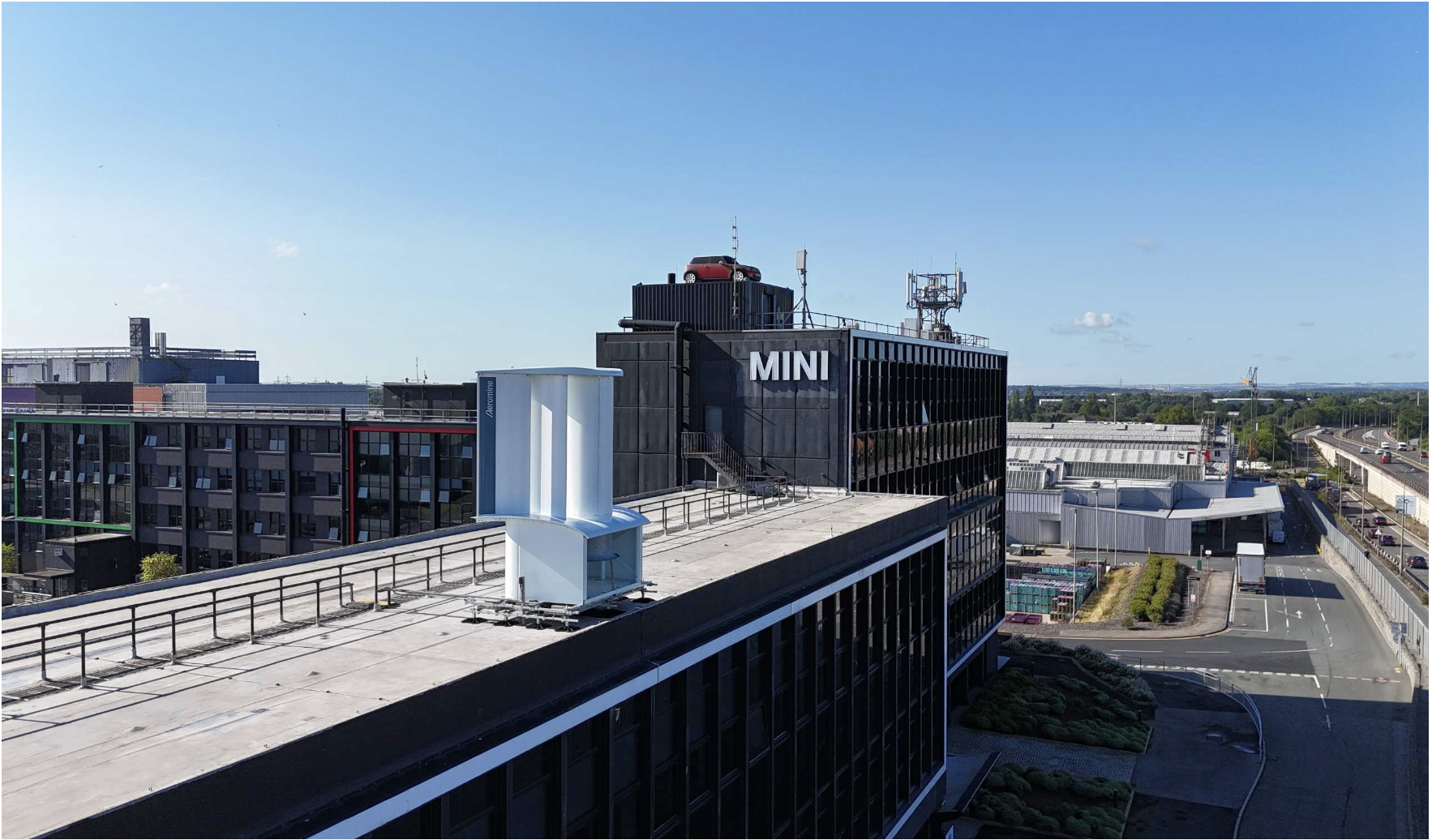
ABOVE: Aeromine’s units stand at attention along a factory roof at BMW’s MINI plant in Oxford — no blades, no blur, no birds ducking for cover. The wind goes in; the photo, helpfully, holds still.
A wind company betting that the future of wind is standing still
Look at a wind farm and you picture motion: white blades sweeping a hilltop, a faint whoosh, a bird the size of your worry. Now look at an Aeromine roof. Nothing moves. A row of squat, wing-shaped boxes lines the edge of a warehouse, doing what looks like absolutely nothing - and quietly making electricity the whole time.
Aeromine Technologies is a Houston-based climate-tech company selling a motionless, bladeless rooftop wind system to the people who own big flat buildings: warehouses, distribution centers, factories, big-box retail. The pitch is almost rude in its simplicity. Put our units along your roof edge, use about a tenth of the space solar would need, and harvest the wind your building is already shoving into the sky.
“A wind generator with no visible moving parts. The blades, it turns out, were optional.”
It sounds like a magic trick. It is closer to plumbing. And the reason it exists is a problem nearly everyone in clean energy has politely agreed to live with.
The problem they saw
Solar owns the roof. The roof is not enough.
Rooftop solar is a triumph and a ceiling. It works gloriously while the sun is up, gives back the roof at dusk, and asks you to cover most of your available surface to get there. For a logistics company running shifts after dark, the math has an awkward gap. Wind blows at night. Wind blows in winter. Wind blows when clouds roll in - which is, inconveniently, exactly when solar clocks out.
So why isn’t there wind on every roof already? Because the traditional turbine is a terrible houseguest. It’s tall, it’s loud, it vibrates through the building, it frightens the neighbors, and it has a complicated relationship with wildlife. Bolting a spinning three-blade machine onto a commercial roof has always been a way to generate complaints faster than kilowatts.
“The sun keeps office hours. The wind does not. Somebody had to design for the second shift.”
That gap - real wind, no acceptable way to catch it on a building - is the tension the whole company hangs from. Everything that follows is an attempt to close it.
The founders' bet
Borrow from race cars, not windmills
The idea did not start in a garage in 2021. It started in 2015, when Dr. Carsten H. Westergaard - a career aerodynamicist who spent his working life on utility-scale wind - patented a different way to think about catching air. Instead of a rotor swinging through the wind, use stationary vertical airfoils, the same family of shapes that press a race car to the track. Angle them right and they create a low-pressure vacuum that pulls air through an internal generator tucked safely inside the unit.
The moving part still exists. It’s just hidden, small, and out of everyone’s way. From the parking lot, the machine appears to be loafing.
In 2021, Westergaard turned the patent into a company with co-founders Martin Manniche (Executive Chairman) and David Asarnow, later bringing in Mark Swanson as CEO. The bet was specific: the next wave of wind power would not come from taller towers in emptier fields. It would come from making wind behave well enough to live on a roof in a business park.
“Distributed power is a key and increasingly strategic element to an evolving all-of-the-above energy mix... its ability to quickly and affordably help a wide variety of companies meet their energy needs with wind is unique.”
- Maynard Holt, Founder & CEO, Veriten (lead Series A investor)
The product
One box, five kilowatts, zero drama
Each Aeromine unit is roughly ten feet by ten feet and mounts along the roof’s edge, facing the prevailing wind. No external blades. No noise to speak of. No vibration telegraphed into the structure below. The company rates each unit at about five kilowatts - in its framing, comparable to roughly sixteen rooftop solar panels - and says a full installation can deliver up to 50% more energy than a comparable solar array while occupying only about 10% of the roof.
5 kW
Per unit output
~50%
More energy vs. solar*
10%
Of roof space used
0
Visible blades
The hardware is half the story. Aeromine wraps it in cloud-based, digital-twin software that models a specific building’s airflow using regional wind and GIS data, then monitors deployed systems remotely. The point is to answer the only question a property owner actually cares about - how many kilowatt-hours will this roof give me - before anyone climbs a ladder.
Designed to share, not to win
Crucially, Aeromine doesn’t ask you to rip out solar. It asks for the strip of roof solar didn’t want anyway, and it works the hours solar can’t. Wind and solar, same roof, different shifts. The company likes to frame its product as solar’s roommate rather than its rival - which is a more durable business than picking a fight with the most successful clean-energy technology of the century.
Milestones
From a quiet patent to a quiet roof
2015
The patent. Dr. Carsten Westergaard patents the stationary-airfoil approach to capturing building airflow.
2021
Company formed. Aeromine Technologies launches in Houston to commercialize the technology.
2022
First pilot & first headlines. A unit goes up at BASF’s plant in Wyandotte, Michigan; TIME names the system one of its 200 Best Inventions of the year.
2023
Demand shows up. Named a Top Building Product by Building Design+Construction; reports ~11,000 inquiries from 6,500+ companies.
2024
BMW & the raise. BMW Group trials the system at its MINI plant in Oxford - a UK first - and Aeromine closes a ~$9M Series A led by Veriten.
The proof
Skepticism is the correct response. So they collected receipts.
A motionless wind generator that beats solar is exactly the kind of claim that should make an informed reader narrow their eyes. Aeromine seems to know it, which is why the validation came before the marketing. The aerodynamic performance was tested through joint research with Sandia National Laboratories and Texas Tech University - which also went ahead and named the company its Startup of the Year.
Funding raised, by round (USD)
Earlier rounds
~$1.1M
Series A (2024)
~$9.0M
Total to date
~$10.1M
Source: company and press disclosures. The 2024 Series A was led by Veriten, with Thornton Tomasetti and family offices participating.
Then there are the logos that agreed to be test sites. BASF, the chemical giant, ran an early pilot in Michigan. BMW Group put units on its MINI factory in Oxford - the first motionless wind installation in the UK - and framed it as a testbed for sites across the company. When manufacturers this conservative volunteer their roofs, the claim stops being a press release and starts being a procurement decision.
“When BMW and BASF lend you a roof, you have stopped pitching and started piloting.”
BMW Group
Trial at the MINI plant in Oxford, England - the UK’s first motionless wind energy installation, evaluated for use across BMW sites.
BASF
Early pilot installation at the company’s manufacturing plant in Wyandotte, Michigan.
Sandia National Labs
Joint research that helped validate the system’s aerodynamic performance.
Texas Tech University
Research collaboration on validation - and the school that named Aeromine its Startup of the Year.
The mission
Wind power for the buildings everyone forgot
Aeromine describes its purpose plainly: bring wind power to unfulfilled needs in unserved markets. Translated, that means the millions of square feet of flat commercial and industrial roof that wind energy has never been able to reach. Those buildings have power bills, decarbonization targets, and - it turns out - a steady supply of wind moving over them every day, unharvested.
The company runs lean, around eleven people, spread across Houston, Copenhagen, and Irvine, with engineering DNA inherited straight from utility-scale wind. It is not trying to reinvent the grid. It is trying to add a second renewable source to a roof that currently has, at most, one - and to do it without the noise, the eyesore, or the wildlife guilt that kept wind off rooftops in the first place.
“The roof you already own is a power plant. It has simply been working part-time.”
Why it matters tomorrow
The case for the second shift
Electricity demand is climbing, grids are straining, and companies are being asked to find clean power that is reliable, on-site, and affordable - ideally all three at once. Solar handles the daytime beautifully. The unglamorous, valuable job is covering the rest: the night, the storm, the dark months. That is the slot Aeromine is built to fill, and it’s a slot that gets more valuable as more buildings electrify.
There is real distance left to travel. The bold performance numbers come from the company and need fleet-scale, third-party operating data to fully settle. Ten thousand inquiries are not ten thousand installations. But the direction is coherent and the early customers are not the gullible kind.
Return to that warehouse roof. A year ago it was solar to the horizon, productive until sundown, then dark. Now a line of still, wing-shaped boxes runs along its edge, doing nothing you can see and quite a lot you can measure - through the night, through the weather, on a tenth of the space. The wind was always there. Aeromine’s wager is simply that the most interesting machine on the roof is the one that holds perfectly still.