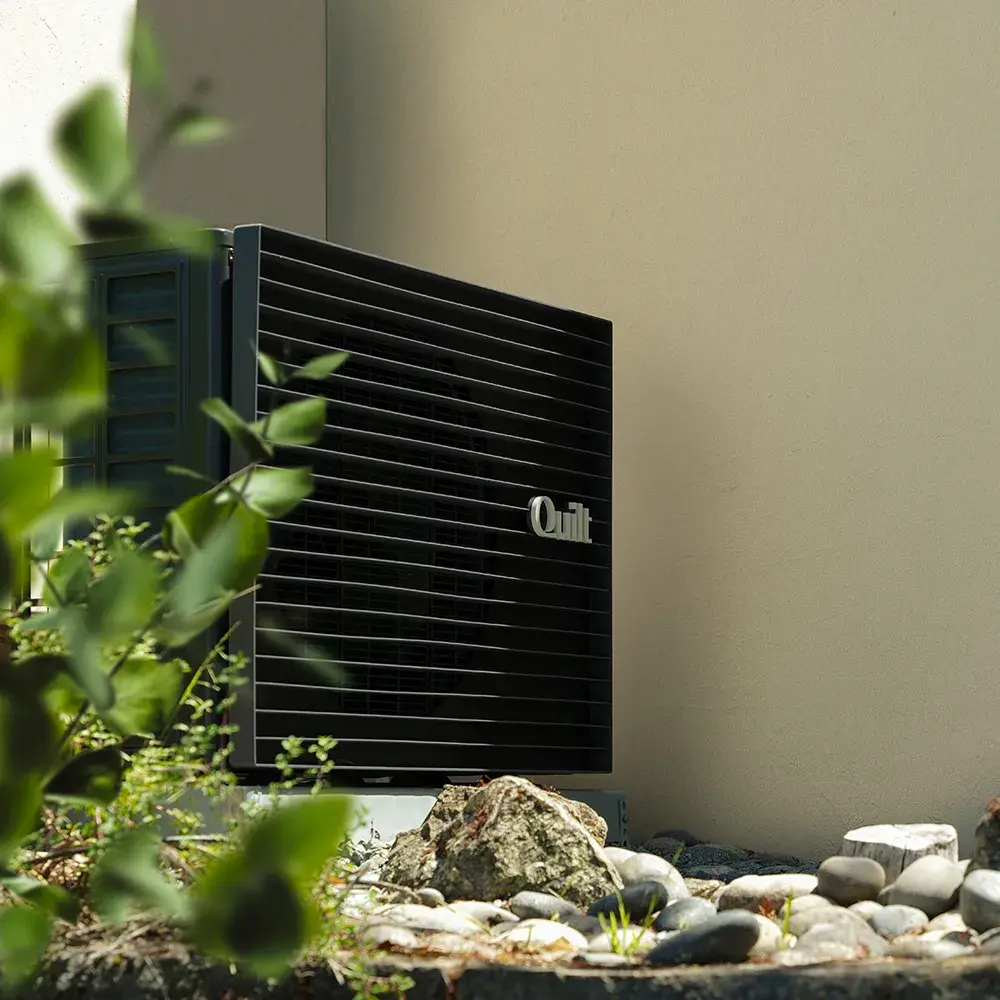
There is a certain genre of climate company that asks you to feel guilty first and buy second, and Quilt is not that company. Quilt is a Redwood City startup that makes a heat pump - the boring, beige box that heats and cools a home by moving warmth around instead of burning gas - and its founding insight is almost suspiciously mundane: the reason people don't electrify their homes isn't that heat pumps are bad. It's that they are ugly, confusing, and sold by whoever answers the phone at 2 a.m. when the old system dies.
So three former Googlers - Paul Lambert, Bill Kee, and Matthew Knoll - started Quilt in 2022 to fix the product, not scold the customer. Lambert had run sustainability investments at Area 120, Google's internal incubator; Knoll had worked on Google X moonshots including the Loon balloons; Kee had shipped things like Gmail and Google Analytics. They are, in other words, consumer-software people who wandered into one of the least glamorous categories in the physical world and decided that was exactly the point.
What they built is a ductless mini-split, which is industry-speak for an outdoor compressor connected to slim indoor units mounted high on a wall. The Quilt version is about 7 7/8 inches tall and is designed to be seen rather than hidden - a decision that sounds trivial until you remember that most of the HVAC industry has spent decades assuming nobody wants to look at its work. The New York Times' Wirecutter, not a publication given to swooning, called it "an energy-saving mini-split you won't want to hide."
The genuinely clever part is inside. Each indoor head carries a millimeter-wave occupancy sensor - the kind of radar that can tell you're in the room even when you're motionless on the couch. Cheaper systems use infrared, which tends to decide a room is empty the moment you stop fidgeting, which is a problem if the point is to save energy without freezing the people watching TV. Quilt's sensors feed software that maps the room, figures out where people actually are, and quietly stops conditioning the rooms nobody is in. The feature is called Auto-Away, and it is the sort of thing you are supposed to never think about, which is the highest compliment a comfort product can earn.
Then there is the software conceit that makes venture capitalists lean forward: the system ships over-the-air updates. Your furnace does not get better after you install it. It gets older, and then it dies. Quilt's pitch is that its hardware improves over time the way a phone does - new features, better logic, remote diagnostics that catch a failing part before it strands you in January. Whether "software-defined HVAC" turns out to be a durable moat or a nice line in a pitch deck is one of the real open questions here, but it is at least a genuinely different answer than "we made the same box, but blue."
You control all of it two ways: a physical dial called the Quilt Dial, for people who want to walk up and turn something, and an app, for people who want room-by-room schedules and real-time energy readouts. The refrigerant is R32, chosen partly for cold-climate performance, which matters because Quilt has been installing not just in temperate California but across five Canadian provinces, where a heat pump that quits when it gets cold is not a heat pump anyone wants.
The business model is where the ambition gets expensive. Quilt sells direct-to-consumer, but a heat pump is not a gadget you unbox - somebody has to install it, and installation is where most home-electrification dreams go to die. Quilt's answer is a tiered network of certified, select, and expert installer partners who handle the physical work and back warranties that run from 10 to 12 years depending on the tier. In effect the installer becomes part of the product, which is a harder problem than building the machine and a more important one. A beautiful heat pump that takes six weeks and a fight to install is still, functionally, a fossil-fuel furnace's best friend.
The traction so far is real but early: nearly 1,000 systems installed across 16 U.S. states and five Canadian provinces, having launched in the San Francisco Bay Area in spring 2024 and expanded to markets like Seattle with flagship partner Home Comfort Alliance. Annual revenue is estimated in the low single-digit millions - which is to say Quilt is still much closer to its beginning than its middle. This is a company that has proven people will buy the thing, and now has to prove it can build the machine that builds the things at national scale.
Investors, notably, keep showing up. Quilt raised a $9M seed in 2023 led by Lowercarbon Capital and Gradient Ventures, a $33M Series A in 2024, and a $20M Series B in December 2025 led by Energy Impact Partners and Galvanize - $62M in total. Nest co-founder Matt Rogers is an investor through Incite Ventures, and former Nest CFO Tom vonReichbauer joined the board alongside Galvanize's Veery Maxwell. The Nest lineage is not subtle, and it is not accidental: Quilt is, quite deliberately, trying to do to the heat pump what Nest did to the thermostat - take a dull, load-bearing piece of the home and make it something you'd actually mention to a friend.
Whether that works is a question about people as much as physics. The physics of heat pumps has been settled for a long time; they are wildly more efficient than combustion, which is why governments keep subsidizing them. The unsolved part has always been desire. Quilt's whole thesis is that decarbonization, at the level of an individual kitchen, is a design problem - that the fastest way to get a gas furnace out of a house is to sell something people want more than they want to avoid the hassle of switching. It is a comfortable thesis to like. The next few years, and a few thousand more installs, will say whether it's also correct.