At 5:59 in the morning, Paul Hamilton was on his way to a business event and thinking about trains. It was still dark. Halo Orbit 2024 lay ahead. He posted about his excitement, then offered an explanation for anyone surprised that a software company’s chief executive travelled by public transport. He liked trains. He liked the connection and community. And he could get his laptop out.
There was a business argument tucked into the journey. Time saved and money saved helped keep Halo profitable and free of outside investment. Hamilton treated these small decisions as cumulative. The destination might have been a conference, but the post explained how he intended to keep travelling.
“The compound effect of every little step really does make a huge difference,” he wrote.
It is a useful place to meet the co-founder of Halo Service Solutions. His company sells the software that helps organisations handle requests, support customers and organise work. His public ambitions are large. His explanations often begin with something you can picture: a railway seat, a spare bedroom, a young recruit sitting beside someone who knows the answer.
The office that cost £50 a month
Hamilton grew up in the north-east of Scotland. His father drove buses and taught people to drive. Business ownership did not seem an obvious destination. “I just thought running businesses was something other people did,” he recalled. University appealed partly because earning money would give him choices, including where he could go on holiday.
He attended the University of Leeds between 1999 and 2002. Later came work with Alan Rogerson, his co-founder. From 2004 to 2008, the pair supplied bespoke software packages. Over time, Hamilton recognised that the code they were accumulating could become a product sold repeatedly. The move from individual commissions to a reusable product gave the work a different future.
Suffolk entered the story through family. Hamilton moved to be closer to his wife’s relatives. Between 2009 and 2011, his mother-in-law’s spare bedroom served as his office. He paid £50 a month. A two-bedroom flat is a modest setting for a company’s early expansion; the rent, at least, was unlikely to require a finance committee.
His early customer acquisition was equally tangible. Hamilton has recounted posting 300 letters and receiving a cheque from a first customer. The details are almost stubbornly physical for a software story. Letters went out. A cheque came back. Someone had agreed that what he had made was worth paying for.
Rent for a spare bedroom in his mother-in-law’s Stowmarket flat, 2009-2011.
Independence, in writing
Halo grew without external investment. Hamilton’s preference for independence eventually became something customers could read in a contract. From 13 June 2023, Halo announced a rolling ten-year commitment against mergers, acquisitions and private equity deals.
A decade is a substantial unit of time in a software purchase. Customers invest in configuration, training and working habits as well as licences. Hamilton is offering continuity alongside the product. The commitment gives buyers a way to judge his intentions beyond the next friendly conversation.
He has gone further in his public statements, saying Halo will never sell or pursue an initial public offering. In a post about student outreach, he explained that decisions were made with ten years, sometimes twenty years, in mind. The students hearing about Halo at sixteen might become colleagues much later. He was willing to spend money before that possibility became a job application.
That makes his version of success unusually dependent on what happens after a company becomes valuable. The continuing business is the project. Independence gives him room to choose its pace, its people and the terms on which it deals with customers.
“We believe we’ll be the market leader.”
Paul Hamilton, February 2026
He is hardly shy about competition. In February 2026, Hamilton predicted market leadership while explaining a pricing programme tied to Halo’s recurring revenue. Under ARR Milestones, the company announced successive five per cent licence reductions at specified revenue thresholds. Halo’s current terms describe compounded discounts for customers on standard list pricing.
His reasoning is practical: as a software business grows, infrastructure and development costs can fall per customer. He wants customers to share in that advantage. A lower bill becomes part of his argument for remaining with Halo. Independence, in his telling, should be visible at renewal time.
An academy with a help desk
Hamilton’s other long investment is in people at the beginning of their careers. He talks about character when discussing hiring, and Halo’s graduate programme gives that preference an operating method. The company likens itself to a football academy, developing people internally rather than importing established senior hires.
The published graduate route starts in support. Recruits learn the software and the company, then work directly with customers as support technicians. Some later move into consultancy or other roles. Progress depends on what they have learned rather than a fixed timetable of rotations.
There is an appealing seriousness to that first assignment. A customer with a problem supplies an immediate reason to understand the product. The person answering cannot get very far on enthusiasm alone. Each question exposes another piece of the system, another customer requirement, another gap that a colleague can help close.
The current Ipswich scheme advertises a £35,000 starting salary, accepts any degree subject and requires no previous software experience. That widens the point of entry. It also places a substantial obligation on the company to teach.
- 01Learn HaloProduct, colleagues, customers
- 02Start in supportWork on real customer problems
- 03Take on moreProgress as knowledge grows
Hamilton insists on working in the office. His case rests on the speed of learning when people can ask a question across a desk, see a problem being solved and build relationships while doing the work. For a business recruiting heavily from university, the office is part of the training system.
That choice is specific, and so are its demands. Recruiting people with potential only begins the job. They need colleagues with time to explain, customers whose problems they can learn from, and enough responsibility to make the learning count. A larger intake makes all three requirements more consequential.
A football shirt and a Formula 1 car
Hamilton’s business has also acquired a very public sporting life. McLaren announced Halo as an official Formula 1 team partner in June 2023. The arrangement involved using HaloITSM to help the team collaborate and manage IT services. Branding appeared on the cars’ halo and the pit wall. The placement was a gift to anyone who enjoys a literal-minded sponsorship.
Later that year, Halo held its inaugural Orbit conference at the McLaren Technology Centre, welcoming 150 partners. Hamilton took attendees through the company’s philosophy, updates and financial figures. His interest in compact development teams formed part of the discussion: more people create more lines of communication, and growth in headcount does not automatically make software arrive sooner.
These relationships serve different purposes. McLaren uses the technology inside its operations. Partners help bring it to customers. A founder can enjoy the association with racing while still needing to explain what the product does on a working Tuesday.
Then there is Ipswich Town. Halo became the club’s main shirt sponsor in 2025, following Ed Sheeran’s sponsorship. In the announcement conversation, Sheeran spoke about keeping the relationship local and his admiration for Halo’s work with young people. Hamilton’s software company was becoming part of the county’s shared visual life.
Hamilton supports the club himself. That supplied a small complication when Halo moved into Ipswich’s Willis Building. The interior is green and yellow, colours associated with Norwich City, Ipswich’s rivals. He has accepted the scheme, although Ipswich shirts have begun appearing inside. Architectural preservation has survived its encounter with football allegiance.
Room for the next thousand
The headquarters move was announced in January 2026, after seventeen years in Stowmarket. Hamilton described Halo’s role as becoming a custodian of a special building. The Norman Foster-designed Willis Building offered a larger home in central Ipswich and a way to bring more of the company’s activity into the town.
Halo moved in at the end of September. A new address can be a tidy corporate announcement. Here it also connects several of Hamilton’s decisions: keeping the company independent, training recruits together and growing from Suffolk. The building supplies space in which those choices can continue.
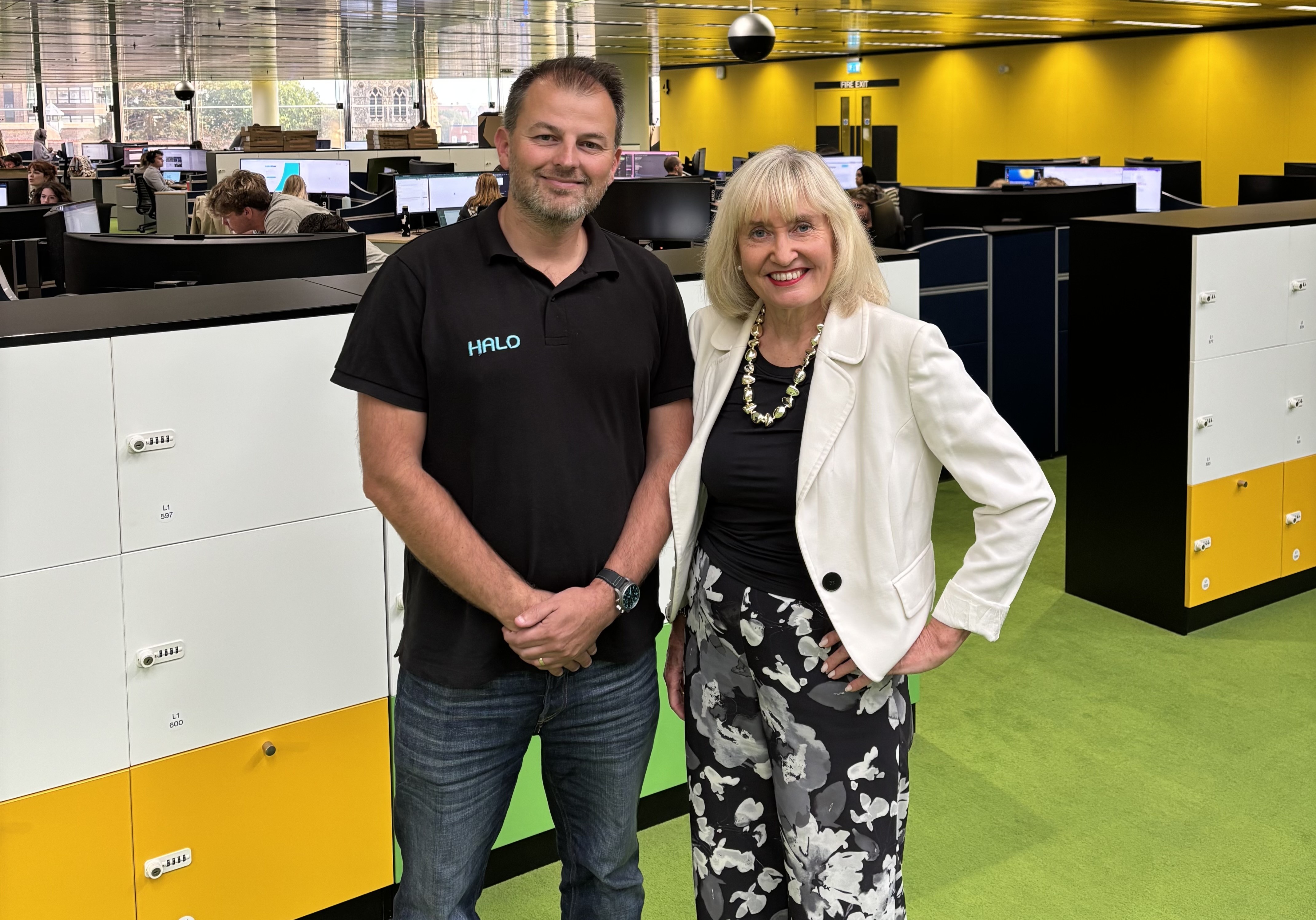
By October, another piece was in place. Six Halo employees had begun the University of Suffolk’s Level 6 Project Manager degree apprenticeship in September. The three-year programme combines paid work with academic study, covering subjects including planning, governance, finance and leadership.
The university relationship reaches beyond those six employees. Students have worked on live briefs, and Halo case studies have entered university modules. Hamilton welcomed the first degree apprentice cohort and said the Ipswich headquarters would help the organisations work together more closely.
His larger target is to employ 1,000 graduates in Ipswich by the end of 2030. It is an ambition with a date attached, and its meaning will depend on the careers built along the way. Six apprentices are already studying. Future recruits will need their own first customer problem, their own patient colleague, their own chance to take on more.
Suffolk began as a place where Hamilton could be near family and afford a room to work. Now he wants young people to see a future there. The early arrangement needed one spare bedroom. The next one needs a town, a university and enough desks for people who have yet to arrive.