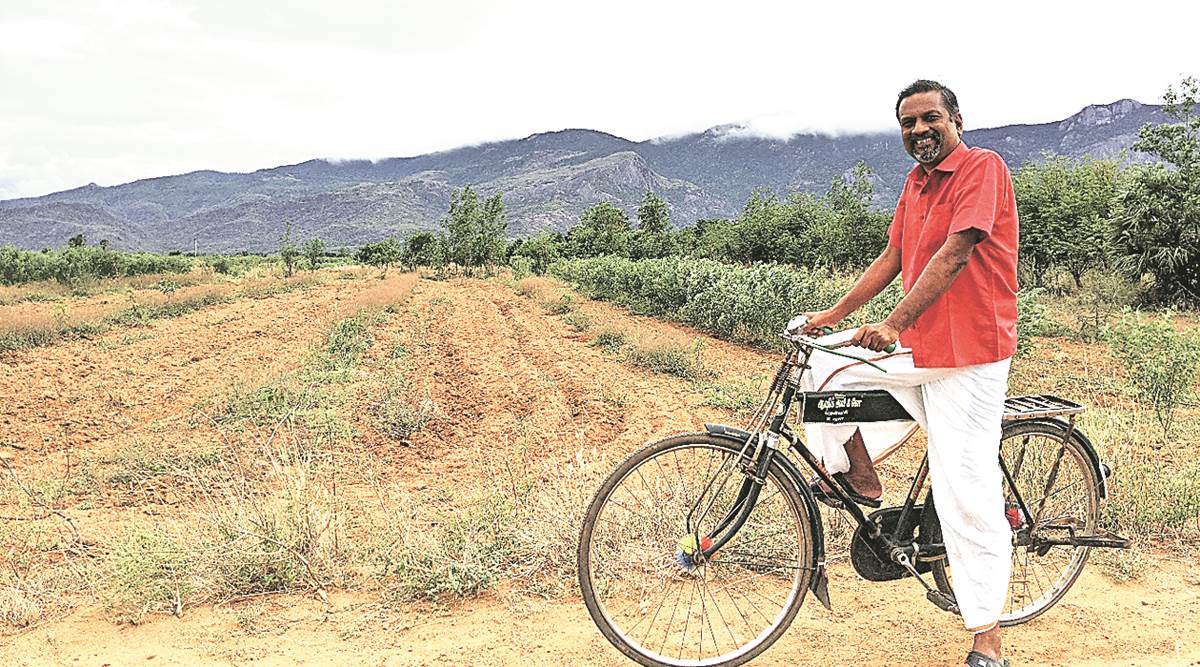
In Mathalamparai, near Tenkasi, Sridhar Vembu has been photographed beside a bicycle, wearing a red shirt and a white veshti, with fields and mountains behind him. The picture has the usual ingredients of an escape from corporate life. Except the business came along. Vembu moved here in 2019 while still running Zoho, the software company he helped build across India and the United States. The village was becoming a place to work.
There is a familiar bargain in the technology industry: acquire valuable skills, then move to where those skills are bought. Vembu followed that route through IIT Madras, Princeton and Qualcomm. Later, he began asking whether the employer could do some of the travelling. For a young person in a village, the difference is substantial. A salary can arrive without an empty chair appearing at the family table.
He now serves as Zoho’s chief scientist, having handed over the group CEO role in January 2025. Artificial intelligence occupies much of his working attention. Rural development remains an explicitly stated personal mission. Those interests can look like separate entries on an executive biography. In Vembu’s working life, they keep meeting in the same place: the question of who gets to build things, and where.
The degree, the code, the sales pitch
Vembu’s qualifications are precisely the sort that would make a conventional recruiter relax. He graduated in electrical engineering from IIT Madras in 1989, completed his doctorate at Princeton in 1994, and worked on wireless communications at Qualcomm. Before his arguments against credentialism came the credentials. That makes his later impatience with them more interesting: he had benefited from the system whose limits he would question.
The early company story was a collective effort. His brothers and Shailesh Kumar were working in Chennai; Tony Thomas and Sreenivas Kanumuru were building an operation in the United States. AdventNet took shape in 1996. Vembu’s own account places his move into selling the software in 1997, after an unsuccessful attempt at hardware and a period of contract programming.
At a Las Vegas trade show, he helped staff a small booth and discovered that explaining software could produce sales. The scientist had become a salesman. He later joked that he could explain a product and forget to ask for the money. It is a useful detail to retain when the polished founder biography arrives: commercial instinct sometimes needs remedial lessons.
Thomas eventually persuaded him to become CEO around 2000. The telecom downturn then forced the company to reconsider its business. ManageEngine and the Zoho cloud applications followed. Underneath the changes was a recurring habit: retain earnings, keep engineers working, and spend on the next product. The organisation that became Zoho Corporation in 2009 had already practised changing its mind.
What independence buys
Zoho’s refusal of venture capital has become part of its public identity. The company has also chosen to stay private rather than pursue an IPO or a sale. In an industry where fundraising can serve as a running scoreboard, this leaves the spectators with fewer numbers to applaud. Customers still have to pay. Products still have to work. The absence of investors does not abolish arithmetic.
“We are in business to run it, not run away from it.”
Sridhar Vembu · On staying independent
For Vembu, that ownership structure creates room for decisions whose return may take years to appear. Training school-leavers, establishing offices outside the usual technology corridors and investing in research all require someone to accept a delay. Private ownership lets Zoho choose the delay. It also leaves the company responsible for whether that patience produces useful work.
Zoho describes software development as a craft, best practised in small teams with time to improve their skills. There is something quietly unfashionable about the image: people returning to the same work, making it better, without a compulsory ceremony of reinvention every quarter. Vembu’s rural ambitions fit this picture. A town gains more from an employer prepared to remain than from one merely passing through.
A Princeton graduate argues with the degree
Zoho Schools of Learning began in 2005 with six students and two teachers. Its alternative to college involves practical training and a pathway into work at the company. Students receive a stipend rather than a tuition bill. The direction of that payment matters. Learning becomes possible for someone whose family needs an income, rather than another expense requiring permission from the household budget.
2005
by April 2025
By its twentieth anniversary in April 2025, the programme reported more than 2,000 graduates, representing over a tenth of Zoho’s workforce. Rajendran Dandapani, its president, described alumni taking leadership roles and contributing to research and product development. Those details give the experiment substance. A different admissions policy is relatively easy to announce; continuing to train people and trust them with consequential work takes longer.
The programme also makes Vembu’s argument more demanding than a slogan about dropping out. Someone must teach. Someone must design the curriculum, assess progress and provide a useful first job. Removing a degree requirement transfers responsibility to the employer. A company cannot complain indefinitely about the talent pipeline while treating the building of that pipeline as somebody else’s chore.
In 2020, his involvement became more personal. What began as tuition for three local children grew into a village education project with additional teachers. He taught science, mathematics and English, and described the difficulty of managing an expanding class. Executive authority apparently travels poorly across a group of children. The experience brought his interest in learning down to the level of an actual lesson.
The office changes its address
Zoho established its Tenkasi technology hub in 2011, years before Vembu made the area his home. His relocation gave the rural strategy a more visible advocate. The bicycle and veshti became recurring details in profiles, but the consequential decision was the office. A company that hires locally and sells internationally can bring outside income into a place that otherwise exports its young people.
Vembu has described the loss of talent from villages as a form of topsoil erosion. The metaphor explains why he talks about local economies alongside software. When capable people leave, they take more than their future wages. They take the possibility of starting businesses, teaching neighbours and organising things where they grew up. Bringing work closer offers a way to retain some of that capacity.
The idea is not that everyone should stay put. People have good reasons to leave and ambitions that may require it. The useful question is whether departure is a choice. A local software office adds an option. Its success must be judged through the jobs, skills and businesses it supports, rather than through the agreeable appearance of an office with a mountain view.
The model has travelled. In January 2026, Zoho launched its enterprise resource planning product from Kumbakonam, where part of the development team operates. The company said it would continue hiring local talent as the product expanded. Kumbakonam also gained a Zoho Schools branch in 2025. Training and product development were being placed near each other, giving the rural thesis another practical test.
A long experiment meets a short fuse
On January 27, 2025, Vembu announced his move to chief scientist, with co-founder Shailesh Kumar Davey taking over as group CEO. He identified AI developments, research and his rural mission as reasons for the change. The title brought him closer to the technical work that had preceded his years in management. It also put him near a fast-moving source of uncertainty.
By February 2026, Zoho reported more than 150 million users and one million paying organisations. In September, it announced Zia Chat, a conversational interface spanning business applications, alongside seven industry-specific applications. The company was pursuing a new way for customers to use its software while continuing to widen what that software covered. For its chief scientist, research had immediate commercial consequences.
Then came a less comfortable update. In October 2026, Vembu said Zoho had skipped its usual annual pay increases and reduced marketing spending as AI and server costs rose. He said employee numbers had not grown for eighteen months and that the company would work to avoid mass layoffs. He put the assessment of its reinvention on a three-to-five-year horizon. The patience he advocates was acquiring a bill.
That admission belongs in the same story as the schools and rural offices. An employer’s ambitions are experienced by employees through ordinary things: a first opportunity, a useful manager, the next pay increase. Building institutions over decades requires surviving periods when those interests pull against each other. Neither a picturesque setting nor a principled ownership structure resolves the tension automatically.
Vembu’s public ambitions remain rooted in research capability and local opportunity. His own route demonstrates how much travel, elite education and international networks can give a person. His later work asks how some of those advantages might reach people with fewer chances to move. There is no tidy finish to that experiment. The next product must find customers; the next student must learn; the office must still be there tomorrow.
The bicycle photograph makes an appealing portrait of a founder. The more revealing picture takes longer to develop: a young person acquiring a difficult skill, finding useful work nearby, and deciding for themselves whether to leave. Vembu has spent years trying to make that sequence less unusual. In a business accustomed to celebrating the distance travelled, he has made room for the possibility of staying.
Read, watch, follow
- ZohoCompany website
- Vembu on XHis public posts
- Vembu’s essaysCompany building, research and rural development
- 25 years of ZohoVembu’s account of the early years
- The Tenkasi conversation ↗Watch · Moneycontrol interview, April 2023
- Zoho Schools of LearningThe training programme and its admissions FAQ
- From Silicon Valley to village teachingOctober 2020 profile
- Rural India and the innovation economyDecember 2023 interview
- The chief scientist transitionJanuary 2025 announcement
- The Kumbakonam ERP launchJanuary 2026
- AI, productivity and Zoho’s scaleFebruary 2026 update
- Zia Chat and industry applicationsSeptember 2026
- The cost of reinventionOctober 2026 reporting on spending and pay