The awkward question in Taylor Farms’ network was whom to call. The vegetable producer had a patchwork of providers, and when something went wrong, finding the right one became work of its own. A business can buy connectivity at every location and still struggle to connect a fault with the person responsible for fixing it. The invoices arrive reliably. The answers can take longer.
- CommandLink combines managed connectivity, security and communications with its own IT service management software.
- Its distinguishing promise is operational: dedicated engineers, shared visibility and fewer vendor handoffs.
- Taylor Farms’ network overhaul involved diverse connections and an accelerated rollout.
- The useful buying question is how much coordination your own team will still have to do.
That is the opening for CommandLink. The company’s proposition sounds almost impolite in an industry fond of adding products: perhaps the customer has enough suppliers. Perhaps the missing item is an accountable relationship across them.
A salad company’s very unappetizing problem
In 2021, Taylor Farms turned to technology advisor UPSTACK for help centralizing its network. UPSTACK recommended CommandLink. The project began with 68 locations; its published account later put the count at 78. The requirements included better visibility, security, support and a way to manage a scattered collection of services.
The resulting design combined primary and secondary dedicated internet access with a third wireless connection, using Versa appliances for networking and security. CommandLink and UPSTACK also changed the installation calendar. Cutovers took place after business hours during the week instead of being confined to weekends. UPSTACK reports that the rollout proceeded without offices losing connectivity.
“We are looking to achieve annual cost savings of $1 million”Scott Gribben, VP of IT, Taylor Farms
That wording matters. It describes a savings expectation, while the reported 100 percent uptime SLA describes a contractual commitment. Neither should quietly become a promise that every subsequent customer will save a million dollars or never suffer an outage. The case is persuasive because of its operating detail: who chose the design, who handled the transition, and who remained available afterward.
The product hiding inside the handoff
CommandLink sits between the company buying a network and the collection of businesses supplying its parts. It develops software and supplies managed services. That combination lets it connect information about a circuit to the people procuring it, deploying it, monitoring it and supporting it.
Its IT service management platform, usually shortened to ITSM, organizes locations, assets, configurations, projects, cases, contracts and billing. These are unromantic nouns. They become rather consequential when a failing connection belongs to a site whose inventory has drifted out of date, or when a ticket lacks the contract information needed to chase a supplier.
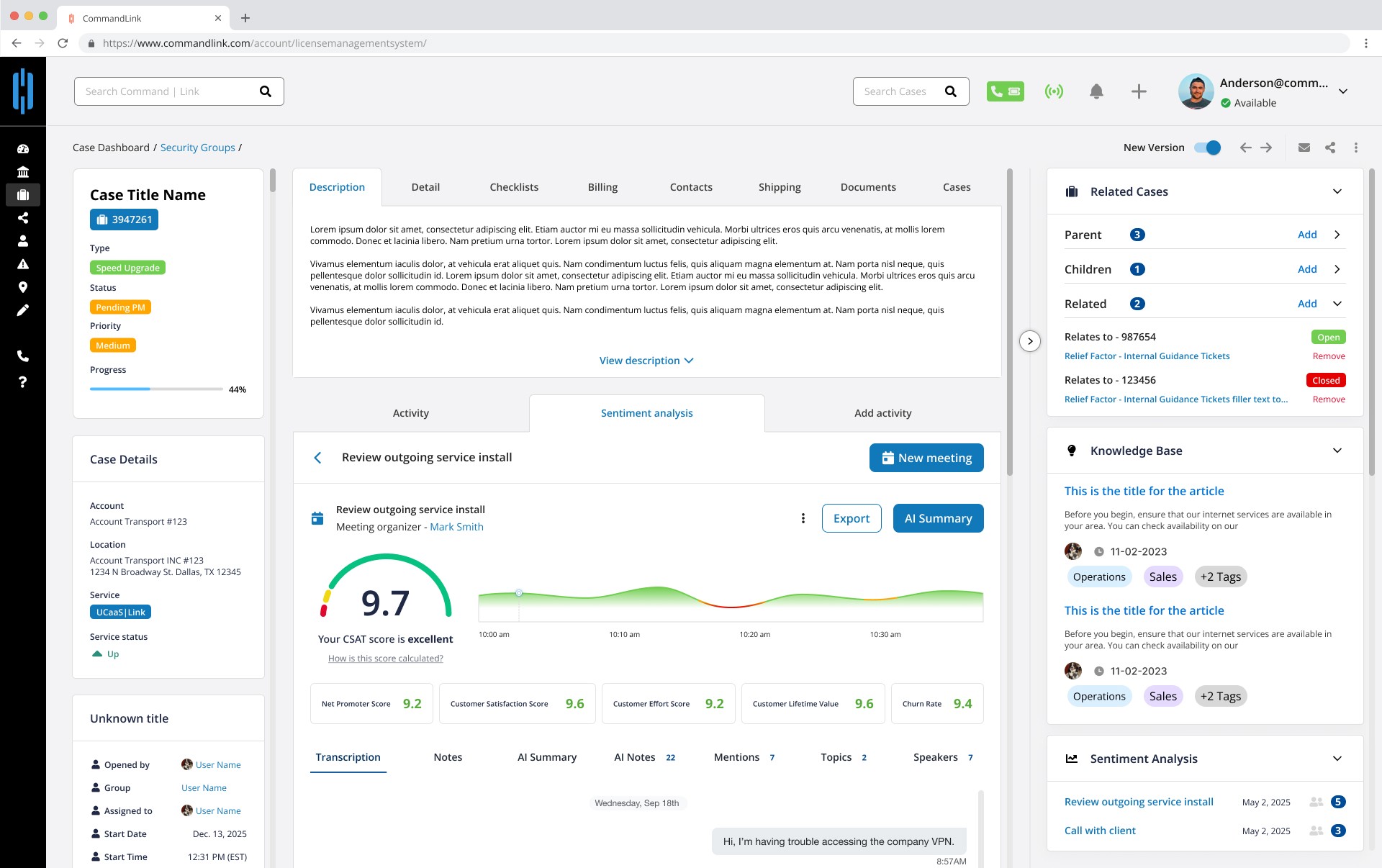
The company also manages internet sourcing, SD-WAN, security and cloud communications. SD-WAN is software that helps control traffic across a wide-area network. SASE brings networking and security functions together around distributed access. For a buyer, the practical questions are less alphabetical: can applications keep working, can remote users connect safely, and can someone explain what just failed?
CommandLink integrates technology from vendors including Versa, Fortinet, Meraki and Cato. Its claim to differentiation rests on how those components are managed together. A networking vendor can supply a capable appliance. An ITSM vendor can supply a capable case system. CommandLink offers the services and the system in one relationship, with engineers attached.
Service monitoring
Site + asset + contract
Alert becomes work
Dedicated POD
Illustration of CommandLink’s published monitoring-to-support model.
The engineer who remembers your network
The human part has a name: Command|POD. CommandLink describes dedicated teams of Tier 3 engineers who know the customer’s environment and provide around-the-clock support. The premise is continuity. The person handling a problem should have useful context before asking the customer to supply it again.
This is an important distinction for an IT department with many locations. An outage creates two jobs. Someone has to restore service; someone has to organize the restoration. When those jobs fall to the same overstretched internal team, even a relatively ordinary fault can crowd out planned work.
CommandLink’s anonymous medical-practice case gives that burden a scale. The company reports consolidating more than 300 vendor relationships across more than 500 locations, with over 80 IT hours saved weekly. Those are vendor-reported results for one engagement. Still, they identify a useful unit of value: staff time recovered from managing the network’s surrounding bureaucracy.
Reported savings in CommandLink’s anonymous medical-practice case, following vendor consolidation and support automation.
Managed security follows a similar logic. CommandLink combines network and security operations within its platform, with dedicated security teams, threat hunting and case management. A security signal need not live in a separate administrative universe from the network on which it appeared. Whether that improves a particular incident depends on the integrations and the response process actually agreed with the customer.
One relationship can still contain several routes
A single vendor relationship and a single physical connection are quite different arrangements. CommandLink’s network cases describe primary, secondary and tertiary connectivity. Consolidating the commercial side can leave the underlying network deliberately varied.
That distinction deserves attention in a buying meeting. Redundancy is an engineering question before it is a purchasing slogan. Buyers should ask how proposed connections are diverse, how failover is tested and which party investigates a shared failure. A neat invoice offers little comfort if the backup path shares the vulnerability that disabled the first.
The same scrutiny applies to outsourcing. A company with one modest site and an internal team already handling its few suppliers efficiently may have little coordination cost to remove. A tightly controlled environment may also require approvals that cannot simply be automated. The fit improves when multiple locations, carriers and teams create enough recurring work to justify an integrated service relationship.
The company has its own coordination problem
Wells Fargo reported tenfold growth in CommandLink’s run-rate recurring revenue over just over three years after CFO Daniel Kenney joined in 2021. The bank describes growth without private equity during that period, supported by working capital. Scaling a service company creates its own coordination demands.
Founder and CEO Jason Ness acknowledged delays in addressing problems. “You have to be able to fail fast,” he said. That observation fits a business selling prompt action: responsibility has to operate inside the company too.

The business earns recurring revenue from its software-and-managed-services offering. Technology advisors help it reach enterprise buyers; UPSTACK’s Taylor Farms engagement shows that route in practice. In September 2026, CommandLink added Jeff Zimmerman to service-provider sales, describing a wholesale proposition for MSPs that want to consolidate carrier relationships.
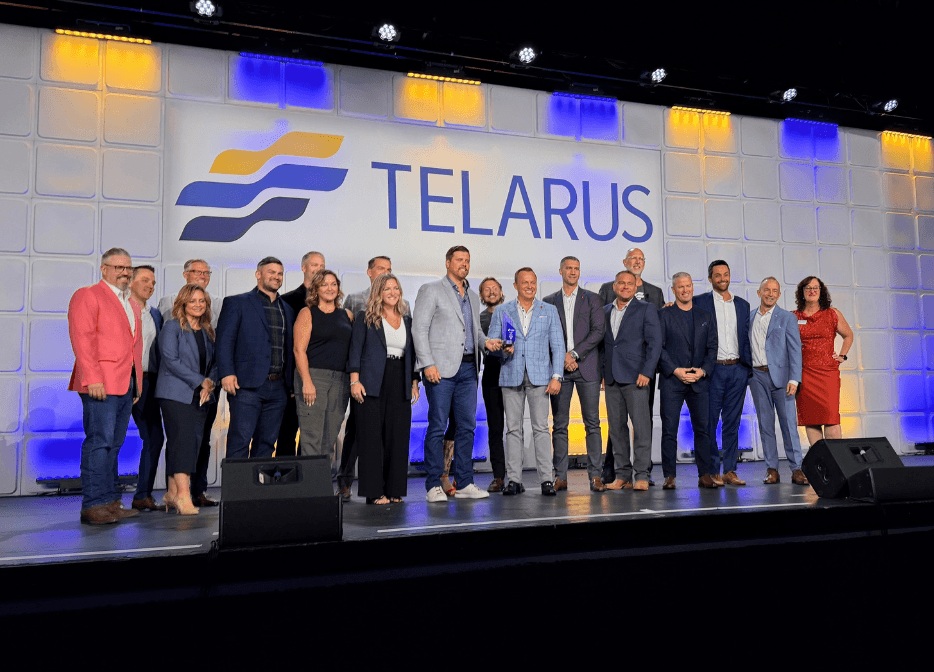
Recognition has followed the partner work. Versa named CommandLink Best Managed Services Provider in its June 2025 awards announcement. In August 2026, CommandLink reported receiving Telarus’s Advisors’ Choice award for Best Overall Supplier of 2025. The dates can look like a typo until one notices that the award recognizes the previous year.
Count the work between the boxes
The lesson a reader can copy begins with an inventory of handoffs. Trace one recent outage. Count the tools opened, people contacted, contracts consulted and explanations repeated. Then ask what a supplier would own at each step, including procurement, migration, escalation and communication.
A pilot is useful precisely because a polished demo cannot answer all of that. In CommandLink’s anonymous global Fortune 500 case, the customer spent three years evaluating the relationship before making CommandLink its single connectivity source as sites transitioned. That is a patient test of an impatient promise.
CommandLink’s place in the market is easiest to understand here. It competes with carrier-led services, aggregators and the customer’s own assembled stack of tools and contracts. The appeal is a reduction in the work required to make those pieces behave as a system. Ask a prospective provider to show the next action and its owner. Then ask again when the happy path ends. The answer is often more revealing than another slide about bandwidth.
Website · ITSM product · News & blog · LinkedIn · X · Facebook
Company video on YouTube · AI platform walkthrough · CommandLink + Versa SASE webinar