The easiest way to understand Netskope is to picture an employee with a quarterly forecast open in one tab and an AI assistant in another. The employee wants a summary. The security team wants the forecast to remain inside the company. Netskope wants to stand between those two intentions, inspect the context, permit the useful part, stop the reckless part, and complete the trip quickly enough that nobody notices the checkpoint.
That is a larger assignment than blocking bad websites. It includes cloud apps that IT bought, cloud apps that IT has never heard of, private applications, branch offices, remote laptops, file uploads, malicious downloads, and now prompts sent to language models. Netskope sells the control layer as subscriptions to Netskope One, a platform combining Security Service Edge, or SSE, with SD-WAN and other networking functions into the broader category called Secure Access Service Edge, or SASE.
The acronyms are dreadful; the customer problem is not. Old enterprise security was built around an office perimeter. Modern work dissolved that perimeter into browsers, phones, SaaS tools, home networks, clouds, contractors, and machines acting on behalf of people. Sending all of it back through an appliance at headquarters is like routing every flight through one regional airport for a passport stamp.
The wedge was smaller than the dream
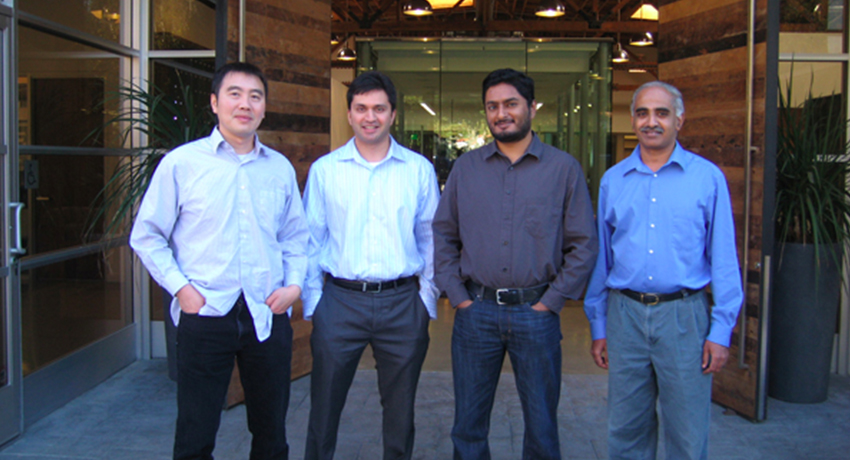
Sanjay Beri founded Netskope in 2012 with Krishna Narayanaswamy, Ravi Ithal, and Lebin Cheng. Beri had worked on early Internet Explorer and Office products, then moved through security roles at McAfee and Juniper Networks. He saw corporate data leaving data centers for the cloud before most buyers wanted to admit it. In one recollection, about eight out of ten CISOs told him the cloud-security vision was crazy.
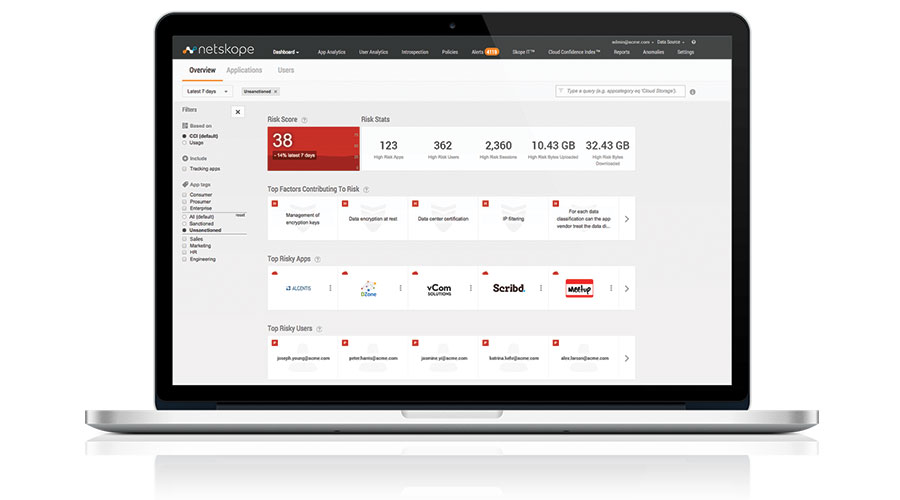
The first clever decision was not the prediction. It was restraint. Beri says the founding idea was a secure on-ramp for all internet traffic, but an unknown startup could not stroll into a global company and ask to replace its proxy, VPN, firewall, and data tools. Early prospects sometimes confused Netskope with Netscape. So the company led with a specific job: find and secure cloud storage and SaaS use, including the unsanctioned tools known as shadow IT.
Build the broad platform. Sell the painfully specific first use case.The part of Netskope's playbook worth stealing
Netskope initially sat beside products from the companies it ultimately intended to challenge. That reduced political resistance inside customers and let the startup learn from live deployments. The sequence is copyable: choose a problem with its own budget, integrate with the incumbent stack, and earn the right to consolidate later. It works only if the underlying architecture is genuinely capable of the later expansion. A thin point product with a platform slide is still a thin point product.
The product is a checkpoint. The moat is the road.
Netskope One now covers secure web gateway, cloud access security broker, zero trust access to private apps, firewall services, data loss prevention, threat protection, digital experience monitoring, SD-WAN, and controls for AI use. Its Zero Trust Engine uses signals about user, device, application, activity, and data to decide what should happen. A finance employee may download a file to a managed laptop but be coached or blocked when moving the same file into a personal cloud drive.
One policy decision, four pieces of context
The less visible product is NewEdge, Netskope's private global network. Inline security is unforgiving: when a vendor inserts itself between a user and an application, any delay becomes the vendor's fault. Netskope therefore runs points of presence around the world, peers with major networks and cloud providers, and publishes uptime and latency commitments. In July 2026 it said its AI Fast Path reduced latency to popular AI destinations by as much as 90 percent in its testing. That is a vendor test, not a universal outcome, but it reveals the battlefield. Security vendors are competing in milliseconds.
Who pays, and what it costs
Netskope sells one-to-three-year subscriptions, generally priced by the size of the customer and the products deployed. Public list pricing is not the norm. Large enterprises negotiate bundles through Netskope and channel partners, then expand into more users, regions, and modules. By July 2025, 111 customers each represented more than $1 million in annual recurring revenue and together supplied 37 percent of ARR. Major and enterprise accounts supplied roughly 80 percent.
The cost to build the seller has been easier to see. Netskope raised roughly $1.4 billion privately, including a $340 million investment in 2020, $300 million in 2021, and $401 million in convertible notes announced in 2023. Its September 2025 IPO added about $992 million in net proceeds. The money financed years of research, a global network, acquisitions, and an enterprise sales organization. In the quarter ended April 2026, revenue rose 28 percent to $201.6 million, while the company recorded a $108.7 million GAAP operating loss and used $53.9 million of operating cash.
What failed first was the original perimeter model, not a disclosed Netskope product. Cloud adoption made the mismatch visible. What changed buyers' minds was not rhetoric alone: SaaS became unavoidable, remote work became normal, and early CASB deployments exposed thousands of cloud services that central IT did not control. Netskope's own strategy changed too. CASB became SSE; buying Infiot in 2022 added SD-WAN; Kadiska added experience monitoring; Dasera added data security posture management. The narrow cloud-app guard became a broad security-and-networking platform.
AI is a gift wrapped as an incident ticket
Generative AI makes Netskope's founding argument newly vivid. Employees adopt useful cloud tools faster than policy committees can classify them. The risk is not simply a malicious chatbot. It is ordinary people moving valuable information into systems whose storage, training, and retention rules they may not understand. Netskope can discover AI services, inspect prompts and uploads, classify data, block prohibited actions, or coach a user toward an approved tool.
Its newly announced DataSec Command Center pushes the pitch across data at rest and in motion: SaaS drives, public-cloud stores, email, endpoints, networks, AI systems, and on-premises sources. The attraction is one lineage view rather than eleven disconnected alerts. The catch is familiar. A unified console is useful only when its connectors, classifications, and policies survive the messy exceptions of an actual business.
The winning product does not merely say no. It makes the safe action easier than the unsafe one.Why coaching and performance matter
Where Netskope wins - and where it does not
The alternatives are formidable: Zscaler, Palo Alto Networks, Cisco, Cato Networks, Cloudflare, Fortinet, and a shelf of specialists. Their checklists increasingly rhyme. Netskope leans on granular cloud and data context, a single-pass policy architecture, NewEdge performance, and the breadth to serve both security and networking teams. Its customer list spans healthcare, finance, government, manufacturing, retail, and global services. Customers including Orbia have described deploying across 200 sites and 14,000 users in four months; others use the platform to retire VPN environments or control dozens of Microsoft 365 tenants.
Conditions that favor Netskope
- Global users and heavy SaaS, web, AI, or multi-cloud traffic
- A real need to consolidate SWG, CASB, DLP, ZTNA, and SD-WAN
- Security and networking teams willing to share policy ownership
- Enough scale to value private-network reach and enterprise support
Conditions that fight it
- A small company with simple cloud use and little security staff
- An incumbent suite that already works and is deeply integrated
- A lift-and-shift plan that preserves every old routing assumption
- Procurement focused on lowest seat price rather than stack cost
Under the wrong conditions, SASE becomes an expensive new layer over the old stack. Migration can expose routing surprises, identity gaps, brittle applications, and policies written for a perimeter that no longer exists. Smaller organizations may get more value from native cloud controls, strong identity, and fewer tools. Companies standardized on a rival may sensibly prefer that vendor's operational familiarity. Consolidation is not automatically simplification.
Netskope's useful lesson is less about cybersecurity than sequencing. It held a large destination in mind, entered through a specific pain, coexisted with the powers it planned to displace, and invested ahead of demand in the infrastructure its promise required. The company is now public, growing, and still unprofitable. Its next proof is not whether enterprises need safer AI and cloud traffic. They plainly do. It is whether Netskope can turn all that inspection into a habit users barely feel and a business shareholders can finally see through.