The first thing to fail is rarely the ticket queue. It is the innocent request to change a form. The adjustment waits for a developer, the developer waits for a consultant, the consultant waits for a statement of work, and three months later somebody in HR creates a spreadsheet. Enterprise software is full of these tiny capitulations. TeamDynamix has spent 25 years turning them into a sales pitch.
The privately held company, founded in Columbus, Ohio, in 2001, sells a cloud platform for IT service management, enterprise service management, project portfolio management, asset management, integration automation and conversational AI. That list is long enough to make any sensible buyer reach for aspirin. The point, however, is subtraction: fewer disconnected tools, fewer scripts and fewer specialists required to change how work moves.
TeamDynamix usually enters through the IT department - the service desk, the IT project office or the CIO. A support request can become a project; the project can draw from the same pool of staff capacity; an automation can call another system; an asset record can add context; a virtual agent can collect the information and start the flow. Once that machinery works in IT, the company encourages customers to carry it into HR, finance, facilities, legal and marketing.
01 / The useful bundle
A service desk with peripheral vision
TeamDynamix began around collaboration and project portfolio management, then expanded into full-lifecycle ITSM by 2014. It launched its iPaaS integration and automation layer in 2020, crossed 500 customers that year, added conversational AI in 2024 and bought Sassafras in 2025 to deepen hardware and software asset management. The chronology explains the product better than a feature grid. The company kept attaching the systems that answer the next operational question.
The combined view matters because service work and project work compete for the same people. A team that tracks tickets in one application and projects in another can produce two immaculate dashboards and still overbook the same engineer. TeamDynamix lets a ticket become a task, card or project and puts service demand beside milestones and resource plans. It is not glamorous. It is the difference between reporting activity and understanding capacity.
02 / The breaking point
What failed first - and what changed their minds
Customer accounts show a remarkably ordinary set of failures. At San Joaquin County, an old BMC Track-It installation suffered from low adoption, separate ticketing and project systems, email requests and poor visibility across 25 departments. At Gainesville Regional Utilities, managers looked in four places to see what employees were doing. Legacy Supply Chain Services had a SharePoint-based approach that worked until the team wanted better change management, automation and scale.
Legacy began shopping for a change-management add-on. Its renewal arrived while the team was evaluating options, and the search widened: why bolt another feature onto a system that could not automate the surrounding process? The company replaced the old setup, but only after interviewing frontline help-desk employees and revising the processes behind its self-service portal. That sequence is worth stealing. Diagnose the work with the people who do it. Redesign it. Then configure the software.
“We started our search ... looking at just change management, then realized we also wanted to find a tool that could help us automate processes.”Keyon Farrier / Legacy Supply Chain Services
For universities moving away from ServiceNow, the trigger was often the tax surrounding the license. The University of Michigan described simple form changes as weekslong or monthslong work before adopting TeamDynamix. The University of Minnesota reported immediate savings and said a broader licensing arrangement allowed it to expand service delivery and technician headcount. Exact prices remain behind a sales form, so the defensible conclusion is comparative, not numerical: those customers say TeamDynamix cost less to license and administer in their circumstances.
What buyers thought they needed
A change module, a better queue, another integration, a chatbot or a cleaner report.
What changed the decision
The surrounding cost: specialist admins, slow changes, extra systems, low adoption and manual handoffs.
03 / The economic argument
The price is the people around the software
TeamDynamix does not publish standard pricing. It sells custom-quoted SaaS subscriptions, with modular and broader enterprise or site arrangements, then offers implementation, process consulting and managed services. Public customer stories are more revealing than a sticker price because the decisive number is often administrative labor.
San Joaquin County says its county-wide environment is run by half of one full-time role. At Michigan, distributed administration lets dozens of groups operate their own applications. At Minnesota, savings were redirected into technicians. These are vendor-published customer accounts, not controlled trials, but they clarify the company's market: organizations large enough to need governance, and constrained enough to resent building a private development shop around the tool.
That puts TeamDynamix between two poles. Basic ticketing products can be cheaper and quicker for a small team. ServiceNow, BMC and other broad platforms bring enormous ecosystems and customization depth for global enterprises prepared to fund them. TeamDynamix competes with those vendors - as well as Freshservice, Ivanti, Jira Service Management and HaloITSM - by arguing that most mid-market and departmental buyers need breadth without maximum complexity.
“Now, we can make those same changes a thousand times quicker.”Rhain Copeland / University of Michigan
04 / AI that has somewhere to go
The chatbot is not the product
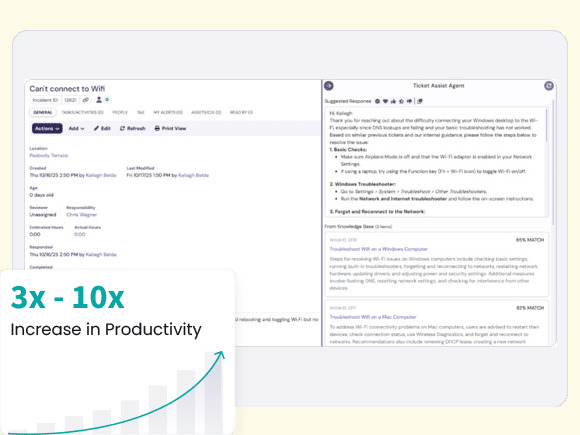
Every service-management vendor now speaks fluent AI. TeamDynamix's more credible distinction is architectural: its virtual agents can do more than retrieve an answer. They can match intent, present a dynamic form, pull data from a connected system, trigger a workflow and pass context to a human. A password reset or onboarding conversation has somewhere to go after the pleasantries.
The company says customers using its AI features report 30 to 60 percent ticket deflection and 40 to 90 percent faster resolution, with technicians saving four to seven minutes per ticket. Those ranges are broad and come from TeamDynamix, so they are best treated as reported outcomes, not a promise. The practical insight is smaller: put AI beside a well-defined service, good knowledge and an executable workflow. A clever interface placed over a broken process simply lets users reach the broken part faster.
The 2025 acquisition of Sassafras follows the same logic. Asset intelligence tells a service team what hardware and software exist, who uses them and which licenses are wasting money. When that data shares context with tickets and automation, an agent can respond with more than generic advice. In February 2026, TeamDynamix also entered Microsoft Marketplace. The move makes procurement easier for customers already buying through Microsoft and complements a platform built on Azure and using Microsoft's AI services.
05 / The playbook
What a reader can copy tomorrow
Steal the sequence, not the software
- Count the administrators, consultants and waiting time - not only the license.
- Start with one painful service whose result can be measured.
- Ask frontline technicians where requests lose context or require re-entry.
- Clean the process and knowledge before adding automation or AI.
- Give departments bounded control, with shared governance and reporting.
- Connect the systems needed to finish the request, not every system on the diagram.
The method does have failure conditions. It will not rescue an organization that refuses to name process owners, standardize intake or maintain knowledge. Distributed administration becomes distributed chaos without permissions, templates and review. Integration expands the security surface and needs disciplined credential and API management. A small company with a simple inbox may be buying far too much machinery. A highly customized global enterprise may prefer the deeper ecosystem of a larger incumbent.
And consolidation can create its own concentration risk. One platform is easier to understand until every department depends on it. Buyers should test export options, uptime, accessibility, security controls, connector coverage and the true boundaries of no-code. “Configurable” is not the same as infinitely adaptable.
Still, TeamDynamix has identified an enduring piece of enterprise absurdity: software bought to organize work often creates another category of work to administer the software. Its business is built on shrinking that loop. The service desk is merely the front door. Behind it is a bid to become the place where an organization decides, routes, staffs and completes the uncelebrated work that keeps everything else moving.