Paul Burke took his niece and nephew to Rome and found himself competing with their phones. Here were museums, history, the Colosseum. Here were two young visitors looking down at screens. An uncle could reasonably feel that the itinerary deserved a little more respect. Burke challenged them. They showed him what they were doing: looking up information about the things in front of them.
It is a pleasingly awkward beginning for a museum technology business. The supposed distraction contained evidence of interest. The young visitors wanted to know more, on terms that suited them. Burke’s mistake was useful because he let it change his understanding of the visit. Guru Experience, the company he co-founded and formerly led as CEO, grew around the possibility that museums could work with that impulse.
The scene also offers a useful way into Burke himself. His public work at Guru kept returning to the visitor’s experience: the information that arrives too late, the tour that assumes everyone wants the same thing, the software that gives an institution another job to do. His subject was culture. His recurring question was how to make the encounter work better for the person standing there.
The phone had a perfectly good alibi
By 2015, Burke was building Guru with Paul Shockley and Hilary Srole. San Diego became the proving ground. The early ambition included museums, parks and other cultural attractions, places where a visitor could be surrounded by interesting things and still struggle to find a satisfying route through them. A wall label can contain useful information. It is less accommodating when several people want to read it at once.
“It’s the everyman’s VIP tour,” Burke said of the San Diego Museum of Art app. The phrase made the proposition unusually plain. A curator’s explanation could arrive on a visitor’s own device, near the relevant artwork, without the visitor having to arrange a private appointment. The original offering included a free version with limited access and a $5 option for the full content.
The Balboa Park app dealt in more earthly assistance: attractions, events, self-guided tours, a checklist, even help locating a parked car. The juxtaposition is part of the charm. A cultural afternoon can require an explanation of a painting and directions to an ATM. Burke’s early products made room for both. Visitors have practical needs even when their surroundings are beautiful.
A route of your own.
Guru’s museum apps brought location, interpretation and visitor choices into the same experience.
Give the visitor fewer instructions
Burke’s account of the technology was refreshingly concrete. Bluetooth Low Energy beacons placed around a venue allowed an app to identify a visitor’s location and bring up nearby material. Someone approaching an artwork could receive text, audio or video without scanning a code or entering a stop number. There was less administrative ceremony between noticing something and learning about it.
He also described themed tours for visitors who preferred a route, alongside the freedom to wander. Trivia and scavenger hunts offered another way through the material, with animated mascots guiding some children’s activities. The choices reflected a fairly modest observation with substantial design consequences: people do not all visit museums in the same manner. A family group and a solitary browser need room to behave differently.
At the company’s launch, Burke described his aim as making learning more enjoyable and changing perceptions of cultural tours. Guru’s early partners included Balboa Park, the San Diego Museum of Art and the USS Iowa Museum. Those were different settings, with different stories to tell. The common work was helping a visitor navigate, choose and understand, without turning every encounter into a lesson in operating the app.
Less fumbling. More looking.
- 01ApproachA visitor reaches an exhibit.
- 02LocateNearby beacons help the app find the relevant stop.
- 03ExploreText, audio or video supplies context.
A schematic of the location-aware experience Burke described in 2015.
Before Guru, Burke had worked in financial markets. His early company biography describes currency options trading at the Chicago Board of Trade, followed by investment work involving long and short equity strategies. It is a career background concerned with interpreting information and making decisions. At Guru, the raw material changed to collections, places and the people moving through them.
There is a temptation to make every career turn sound inevitable. Museums do not require a derivatives desk as an entrance qualification. What makes Burke’s turn interesting is the distance between the settings. A business can emerge when someone brings a familiar habit of questioning into a place where he is initially just another visitor, with relatives and an itinerary.
A very large cheque for a small screen
On June 15, 2017, Guru won $100,000 in Qualcomm funding at SeismicSD. Nine startups competed at San Diego’s Music Box, in front of a crowd drawn from the local and Silicon Valley technology communities. Mayor Kevin Faulconer presented the award. In the photograph, Burke stands third from the left behind a cheque large enough to require a supporting cast.
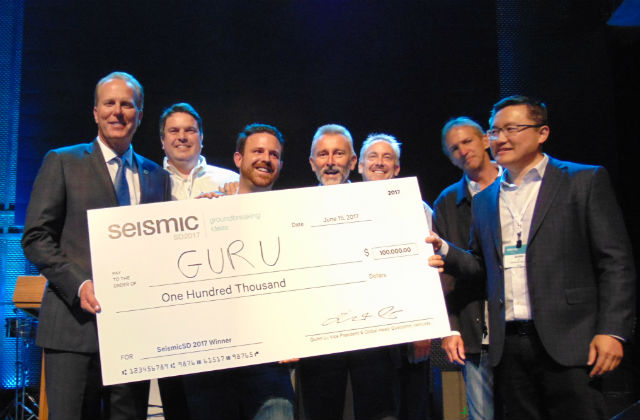
The package also included $100,000 in Amazon cloud services and $25,000 in legal services from DLA Piper. These were different kinds of support, rather than a single cash prize. For a company developing visitor software, the distinction matters: infrastructure and legal work are costs even when they do not appear in an app demonstration. The stage photograph captures the celebration; the credits suggest the bills waiting afterward.
Burke’s thinking about the product extended beyond getting an app installed. In 2017 he described a continuing relationship with institutions, including new and refreshed content, audio, video and work with augmented and virtual reality. A museum could obtain a platform and still face the difficulty of filling it. It could commission material and then struggle to keep it current. Guru’s service proposition addressed the work between those purchases.
“We want to help everyone we work with be as successful as possible.”Paul Burke · 2019
What happens after the novelty wears off?
Burke wrote about immersive storytelling in 2017, arguing for experiences that helped visitors feel involved in what they were seeing. His examples were rooted in actual artworks. At a Monet exhibition, mobile content could demonstrate changes in light. In a gallery of Venetian views, an augmented experience could animate a scene whose original appeal included carrying the memory of a city home.
The interesting part of that argument was its restraint about the collection itself. His proposal concerned the experience around the art, rather than replacing the art with something more fashionable. The phone could supply a way of seeing. The painting still had to reward the attention. It is a useful standard for a product whose most visible tricks might otherwise become the whole performance.
He also considered the institution’s side of the encounter: understanding how people moved through exhibitions and which storytelling approaches held their interest. Visitor data could inform changes to routes and interpretation. That introduced another audience for Guru’s work. Alongside the person holding a phone stood a museum team trying to understand whether its choices were helping people connect with the collection.
Some of Burke’s management comments were equally practical. He emphasized giving writers, designers and developers room to contribute their different perspectives. A museum app involves several kinds of judgment: what to say, how to show it, how to make it function. Inviting those disciplines into the conversation is a way of improving the experience before a visitor ever opens the software.
He also pressed for quick responses to partners and for solving problems before partners had to raise them. That is the less photogenic side of interactive culture. An elegant demonstration earns attention; dependable service gives an institution a reason to keep using the product. Burke’s account of the business made space for both kinds of work.
Bring your questions to booth 2234
By 2018, Burke was taking those questions into the museum profession’s own meeting rooms. At the American Alliance of Museums gathering in Phoenix, he and sales and partnerships director Alenna Gatti were available to discuss Guru’s applications. Burke also spoke about virtual reality with Nik Honeysett of the Balboa Park Online Collaborative and Dieter Fenkart-Froeschl of the San Diego Museum of Art.
The proposed discussion covered what worked, what failed to work, financial considerations and implementation. That list is revealing. The distance between a promising idea and a working museum experience contains budgets, institutional decisions and technical details. Burke was addressing people who would have to live with the result long after the conference booth had been dismantled.
Guru continued adding creative skills. In August 2018 it welcomed Jeff Domitrz, whose background included television design and immersive art. Burke highlighted Domitrz’s combination of interactive media, technology and art. The appointment fits the company’s broader approach: technical possibilities needed people capable of turning them into experiences that made sense in a museum or zoo.
The former competitor on the other end of the table
In November 2019, Guru and Acoustiguide announced the A-G Experience, a partnership joining software and interpretation. Burke had approached Acoustiguide about working together. The arrangement assigned Acoustiguide content, equipment and staffing, with Guru supplying software and augmented and virtual reality capabilities. The planned rollout would start with North American clients before expanding internationally.
It was an instructive development for a business born from dissatisfaction with museum tours. Acoustiguide brought a long history of audio interpretation. Guru brought a mobile platform. Their agreement made collaboration a practical answer to the institution’s problem of assembling separate pieces. Burke, identified then as Guru’s founder and president, spoke about helping partners succeed through a more collaborative approach.
Guru’s corporate story continued: in 2022, Live Current Media acquired the company, with Suzie Dergham identified as its CEO. Burke’s place in the account is as co-founder and former chief executive. The episode that makes his work memorable remains much smaller than a transaction or a conference: an uncle, two younger visitors, and a phone he had misunderstood. The useful thing was what he did after looking at the screen.